

Tech writers are being dragged into AI conversations whether they volunteered or not.
One minute we’re trying to fix a broken procedure, standardize terminology, or get one stubborn SME to stop rewriting our approved interface labels. The next minute, someone in leadership is asking whether our content is “AI-ready,” as if that were a setting buried in a dropdown menu somewhere between Export and Panic.
That is why a tool like the Content-First + AI Readiness Scorecard is worth a look. The brainchild of Sarah Johnson, Founder and Strategic Consultant at Content-first Design, the scorecard gives us a way to assess whether our organization is actually ready for AI or not. It helps us spot weak governance, shaky workflows, missing structure, poor feedback loops, and the usual fantasy that better output will somehow emerge from messy inputs.
It also gives us a better way to talk with leadership. Instead of muttering about metadata until the room goes glassy-eyed, we can point to gaps in readiness, consistency, ownership, and review. That shifts the conversation from technical whining to business risk.
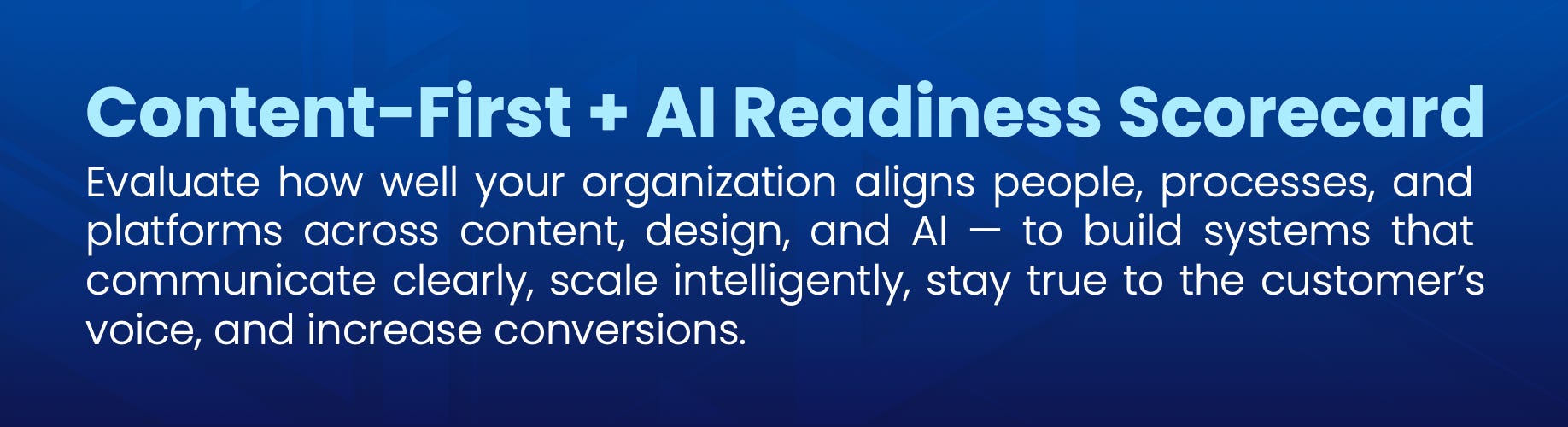
For technical writers, that matters. The scorecard frames AI readiness as a content systems issue — which is our turf. It helps us find workflow gaps, make the case for structured content and cross-functional involvement, identify training needs, and ask better questions before bad content starts scaling with machine-speed confidence.
No, it won’t fix governance by itself. It won’t make leadership care. It won’t stop random prompt shenanigans from spreading through the building like office glitter. But it can help us see what’s broken, name it clearly, and start a smarter conversation.
A downloadable (and fillable) PDF of the Content-First + AI Readiness Scorecard can be found at the end of this post.
Section 01: Framework And Process Maturity
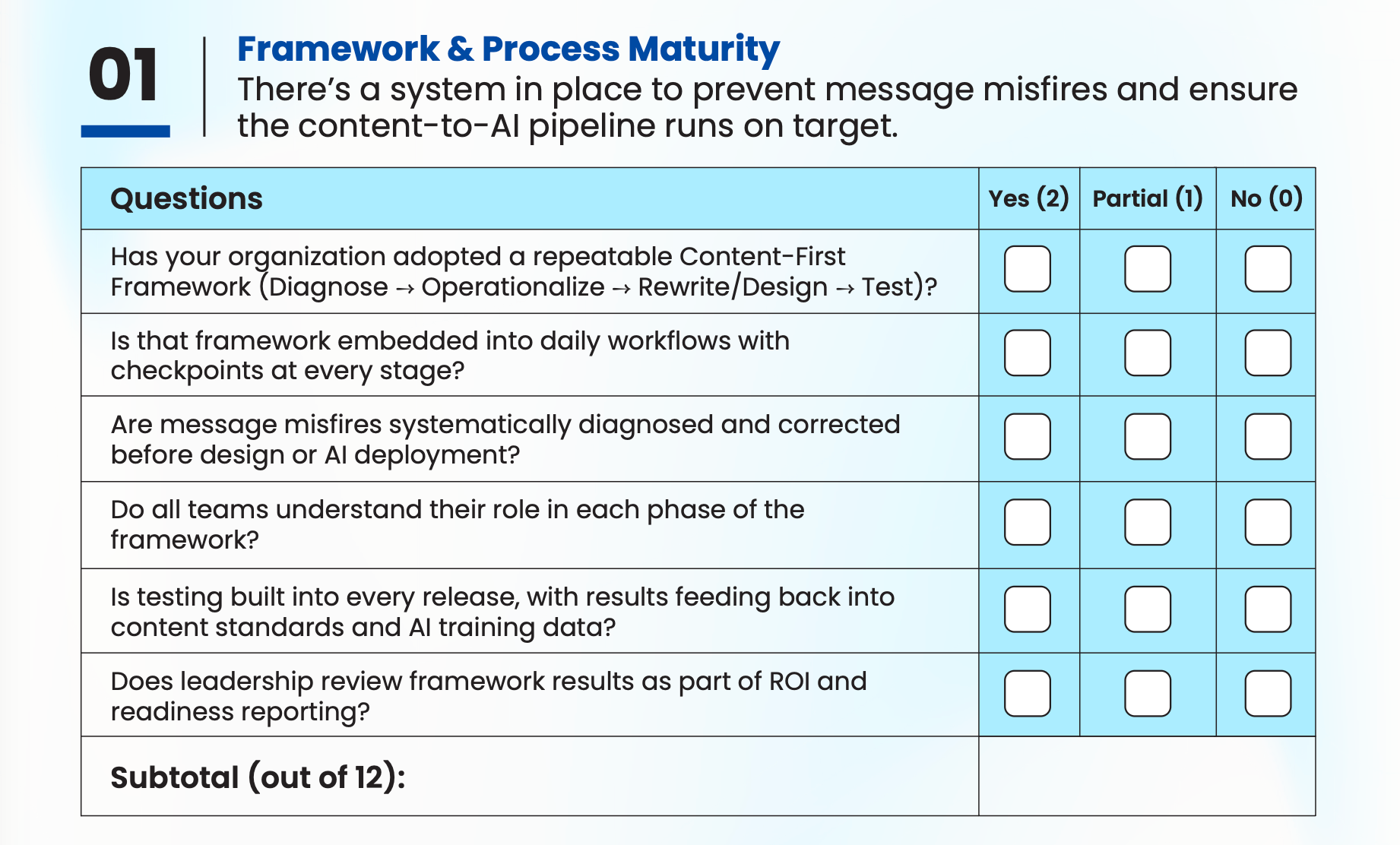
This part of the scorecard checks whether our organization has a real, repeatable way to get content in shape before we dump it into design systems, publishing workflows, or AI experiences and pretend that was a strategy. It asks whether we have an actual framework, whether we use it in day-to-day work, whether we catch message problems early, whether we understand our roles, whether our testing improves our standards and training data, and whether leadership actually reviews the results.
In plain language, this section is asking: Do we have a real process, or are people mostly winging it and hoping AI won’t notice?
Why This Matters For AI Readiness
AI is only as reliable as the content operations behind it. If our organization doesn’t have a repeatable way to spot content problems, fix them, test the results, and feed those lessons back into standards, AI won’t improve much of anything. It will just help bad content move faster and sound weirdly sure of itself on the way out the door.
This section of the scorecard shows whether our tech docs team is mature enough to support trustworthy AI. Strong scores suggest we have a disciplined workflow, clear checkpoints, defined ownership, and feedback loops that improve both human-written content and machine-generated output over time. Weak scores suggest the opposite: inconsistent processes, fuzzy accountability, and the kind of chaos that produces polished answers right up until they mislead someone who matters.
What Tech Writers Should Pay Attention To
Tech docs pros should read this section as a test of whether our operation is serious or just wearing glasses and hoping no one asks questions. It’s not only asking whether our content gets written; it’s asking whether it gets governed — whether we know when we’re involved, what we’re responsible for, and how we catch quality problems before they turn into design issues, support messes, or AI hallucinations.
It also makes one of the scorecard’s clearest points: documentation isn’t just a deliverable. It’s part of the system that determines what AI can safely say.
What A Low Score Here May Indicate
A low score here may mean we’re excited about AI but still don’t have a reliable content pipeline to support it. That usually shows up as ad hoc reviews, inconsistent terminology, unclear ownership, weak testing, and leadership that wants proof of ROI without paying for the plumbing. 😑
That’s usually when someone says the AI output is “surprisingly off-brand,” which is corporate language for “we built this on a shaky foundation and are now acting shocked that it wobbles.”
What A High Score Here May Indicate
A high score suggests we’ve moved past improvisation. It means we have a documented workflow, checkpoints that catch problems before release, clear roles, and a habit of learning from results and mistakes. That doesn’t guarantee AI success, but it does mean we’re treating content like infrastructure, not decorative mulch.
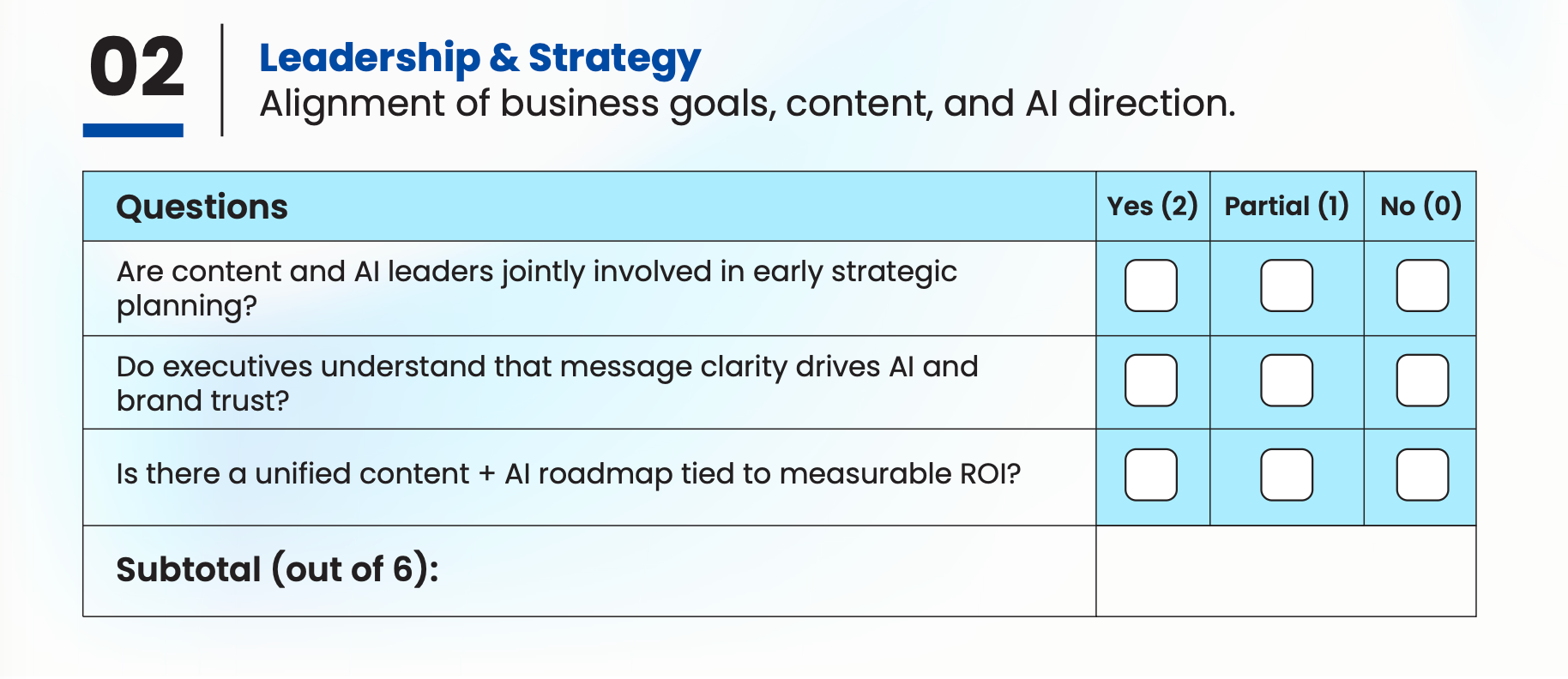
This section is trying to determine whether AI readiness has executive backing or is just another shiny-object side quest happening off to the side of the real business. It asks whether content and AI leaders are involved together in early planning, whether executives understand that message clarity affects both AI performance and brand trust, and whether there is a shared roadmap tied to measurable return on investment.
In plain language, this section is asking: Is leadership treating content and AI as strategic business infrastructure, or are they still acting like documentation is what happens after the important people leave the room?
Why This Matters For AI Readiness
AI readiness is not just a workflow issue. It is also a leadership issue. If executives do not understand that content quality drives the usefulness, safety, and trustworthiness of AI outputs, the organization will underinvest in the very things AI depends on. That usually means weak governance, fragmented systems, inconsistent voice, and a lot of magical thinking about what prompts can fix.
This section helps reveal whether the organization has strategic alignment at the top. Strong scores suggest that leaders understand the relationship between clear communication, customer trust, and AI performance. Weak scores suggest the company may be pursuing AI without a shared purpose, a unified plan, or a realistic understanding of what makes machine-generated output reliable.
What Tech Writers Should Pay Attention To
Tech writers should pay attention to this section because leadership priorities shape everything downstream. When our content leaders are missing from strategy discussions, we usually get dragged in late, after the important decisions have already put on their shoes and left the house. And when our leadership doesn’t connect message clarity with trust, we end up fighting for standards, review cycles, structured content, and enough time to do the work properly.
This section also helps us explain content work in language leadership tends to hear. It moves the conversation from “we need cleaner source content” to “we need alignment between business goals, customer communication, and AI behavior.” That usually lands better than pleading for metadata in a conference room full of people who treat governance like a vibe.
What A Low Score Here May Indicate
A low score here may mean our company is experimenting with AI without executive alignment, shared ownership, or a roadmap tied to measurable results. That’s usually when teams start building disconnected pilots, using different standards, and calling it innovation because no one wants to admit it’s really just expensive improvisation.
It may also mean leadership sees AI as a technology investment, not a communication one. That’s a problem, because customers don’t experience “the model.” They experience what it says.
What A High Score Here May Indicate
A high score suggests leadership understands that content quality, brand trust, and AI effectiveness rise and fall together. It suggests our organization is planning across content and AI leadership, and measuring AI efforts against real business outcomes instead of vague excitement and screenshots from vendor demos.
That doesn’t mean we’ve solved everything. It does mean the people signing checks may finally understand that clarity isn’t decorative. It’s operational.
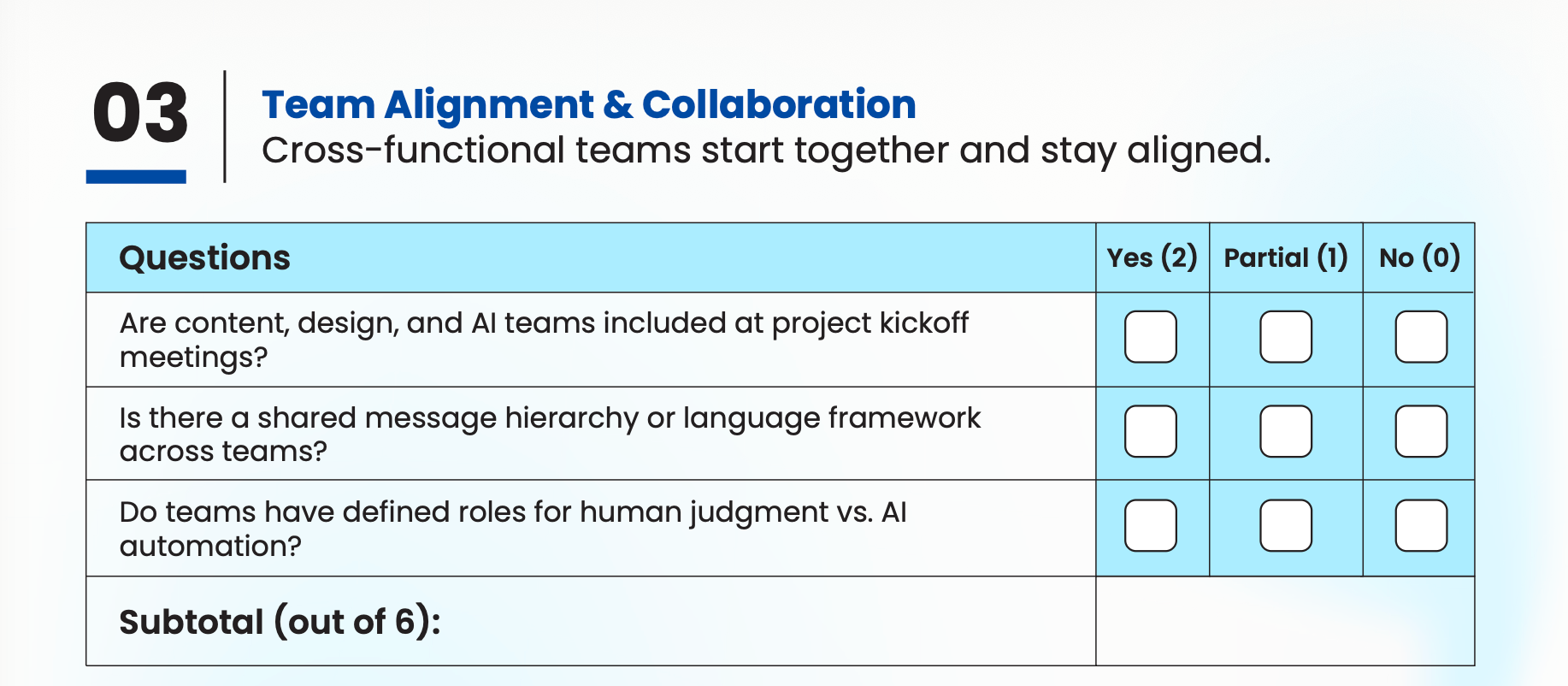
This section is checking whether the people handling content, design, and AI work as one coordinated team or like three neighboring countries with bad diplomacy and a simmering border dispute. It asks whether we bring those groups in at kickoff, whether we use a shared message or language framework, and whether roles are clear about what humans judge and what AI handles.
In plain language, it’s asking whether the right people start together with shared assumptions, or whether we all discover the plan one awkward meeting at a time.
Why This Matters For AI Readiness
AI readiness falls apart fast when we’re misaligned. If content, design, and AI teams aren’t involved from the start, each group optimizes for its own thing—design for flow, AI for model behavior, content for clarity and accuracy—and the result is a fragmented experience followed by enthusiastic finger-pointing after launch.
This section shows whether we can build AI experiences that feel coherent to users. Strong scores suggest we align early, share a language, and know when to automate and when humans still need to step in. Weak scores suggest we’re stitching things together from separate agendas, which is how you end up with a polished interface delivering confused answers.
What Tech Writers Should Pay Attention To
Technical writers should pay close attention to this section because collaboration failures usually show up in the content first. When we don’t share message hierarchy, terminology starts drifting, priorities collide, interface copy says one thing, documentation says another, support says a third, and the AI cheerfully invents a fourth to keep things interesting.
The roles question matters especially here. Many organizations are still fuzzy about what AI should generate, what humans should review, and what should never be automated without oversight. This section helps show whether we’ve actually defined those boundaries or whether we’re still pretending “we’ll figure it out” counts as governance.
What A Low Score Here May Indicate
A low score here may mean we’re still working in silos. Teams may be joining late, using different assumptions, and making decisions without a shared communication framework. It may also mean no one has clearly decided where human judgment ends and automation begins, which is a lovely way to invite avoidable errors into production.
This is often how the usual corporate drama starts: the tool worked, the output was wrong, and somehow everyone acts surprised.
What A High Score Here May Indicate
A high score suggests we understand that AI readiness is a team sport. It means content, design, and AI teams are involved early, working from shared assumptions, and making deliberate choices about responsibility and review. That won’t eliminate conflict, but it does lower the odds that users will experience the result as a pile of disconnected parts wearing a fake mustache and calling itself a system.
It also suggests we understand something many companies still don’t: alignment isn’t a soft skill. It’s infrastructure.
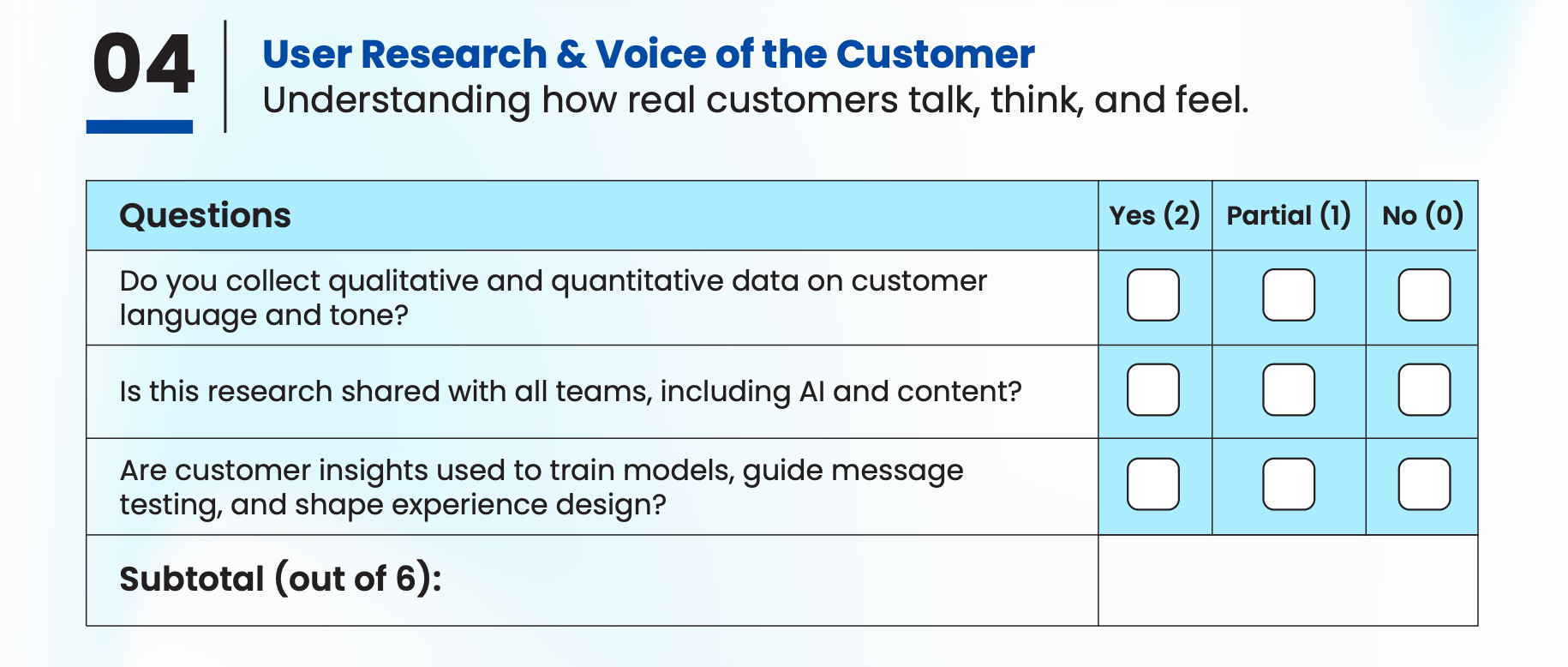
This section checks whether our organization understands how customers actually speak, what they expect, and how they describe problems — or whether we’re still writing for an imaginary user invented in a conference room by people who haven’t touched a support ticket in years. It asks whether we collect real customer language data, share it across teams, and use it to train models, test messages, and shape the experience.
In plain language, it’s asking whether we know how real people talk, or whether we’re feeding AI a corporate hallucination of the customer.
Why This Matters For AI Readiness
AI systems don’t just need content. They need context. If our source material and training signals don’t reflect how customers actually ask questions, describe tasks, get confused, or interpret instructions, the output may sound smooth while still missing the point. That’s how we end up with responses that are grammatically correct, brand-approved, and useless to anyone not sitting at headquarters.
This section shows whether our AI efforts are grounded in reality. Strong scores suggest we’re gathering real customer language, sharing it across teams, and using it to shape both human-written and machine-assisted communication. Weak scores suggest we may be building content and AI experiences around internal assumptions instead of external evidence.
What Tech Writers Should Pay Attention To
Technical writers should pay close attention to this section because user language is one of the strongest signals we have for making documentation easier to find, understand, and use. If customers use one set of words and our product, docs, support content, and AI assistant use another, people don’t experience that as a vocabulary mismatch. They experience it as friction, confusion, and distrust.
The question about sharing research across teams matters especially here. User insight loses value when it sits in one department like a guarded family recipe. For AI readiness, customer language has to circulate. It needs to shape documentation, interface copy, search tuning, message testing, and model behavior. Otherwise, our AI may get very good at repeating internal language customers never use.
What A Low Score Here May Indicate
A low score here may mean we’re guessing. We may lack reliable insight into customer language, or we may collect research and then fail to share it with the people shaping content and AI systems. It may also mean we’re building AI experiences on polished brand language while customers keep asking messy, human questions in the messy, human way people do.
That usually ends with someone wondering why the assistant can’t find the answer, even though it’s technically there three clicks deep under a heading no customer would ever think to use.
What A High Score Here May Indicate
A high score suggests we’re listening to customers and actually using what we learn. It means user research isn’t just collected and filed away to die quietly. We use it to improve messaging, test content, inform design, and guide how AI interprets and responds to real-world language.
That doesn’t guarantee perfect answers. It does suggest we’re building from the vocabulary of the people we serve, not the decorative instincts of the people approving slide decks.
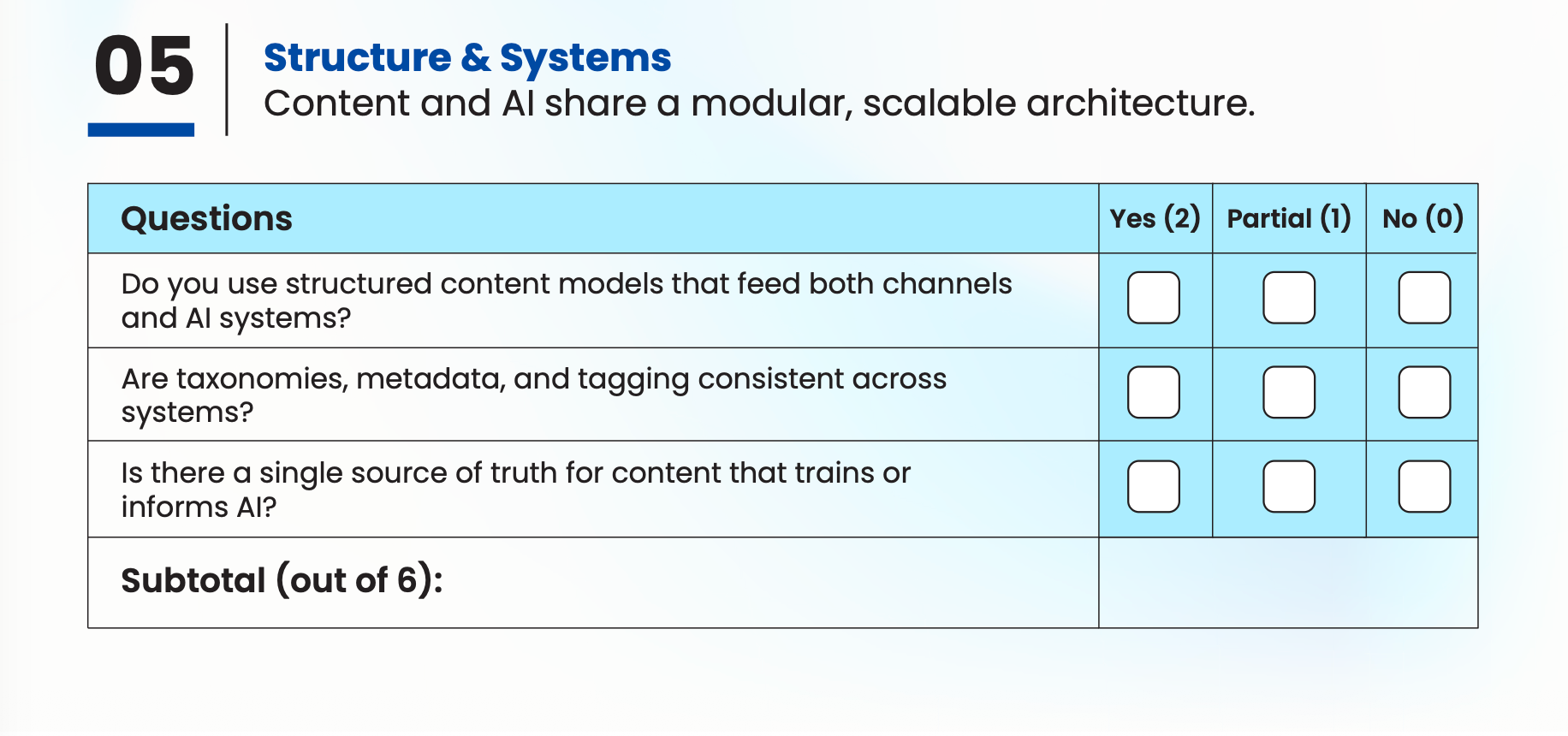
This section checks whether our organization has built content in a way machines can actually use, govern, and scale — or whether everything is still scattered across disconnected systems like a yard sale of half-related assets. It asks whether we use structured content models for both delivery channels and AI, whether our taxonomies, metadata, and tagging stay consistent across systems, and whether we have a single source of truth for content that trains or informs AI.
In plain language, it’s asking whether our content systems make AI easier to trust, or quietly set it up to misunderstand everything.
Why This Matters For AI Readiness
This is one of the most important sections in the scorecard because AI readiness depends heavily on content architecture. If our content isn’t structured, tagged consistently, and governed from a reliable source, AI will struggle to retrieve the right information, keep context straight, or tell current guidance from outdated leftovers still haunting the system like a former employee’s abandoned SharePoint folder.
Strong structure gives AI something solid to work with. It improves retrieval, reuse, filtering, personalization, and consistency across channels. Weak structure does the opposite. It raises the odds that the model will pull the wrong fragment, mix incompatible versions, or confidently stitch together an answer from content that was never meant to meet.
What Tech Writers Should Pay Attention To
Technical writers should pay close attention to this section because this is where many of our old best practices suddenly become visible to people who spent years ignoring them. Structured authoring, metadata, taxonomy, reuse, and source control aren’t just efficiency topics anymore. They’re trust topics.
The single-source-of-truth question matters especially here. If the content informing AI is scattered across multiple systems with inconsistent governance, the assistant may learn from whatever is easiest to reach instead of whatever is most accurate. That’s not intelligence. That’s content roulette.
This section also gives us a useful way to explain why structure matters. Not because XML is a delight at parties. Not because metadata makes our hearts sing. Because AI needs clean signals, stable relationships, and reliable source content if it’s going to produce answers anyone should trust.
What A Low Score Here May Indicate
A low score here may mean our content systems are fragmented, our metadata is inconsistent, our taxonomy discipline is weak, or we have no authoritative source feeding AI. It may also mean we built content mostly for human page reading, without enough structure to support retrieval, recombination, or machine interpretation.
That’s often when people discover the AI can answer a question — just not the right one.
What A High Score Here May Indicate
A high score suggests we’ve done the less glamorous but deeply necessary work of building scalable content architecture. It means our content models are structured, our metadata is managed with at least some adult supervision, and our AI systems are learning from governed source content instead of a digital junk drawer.
That doesn’t make us invincible. It does mean the foundation is strong enough to support useful automation without requiring cleanup after every clever little experiment.
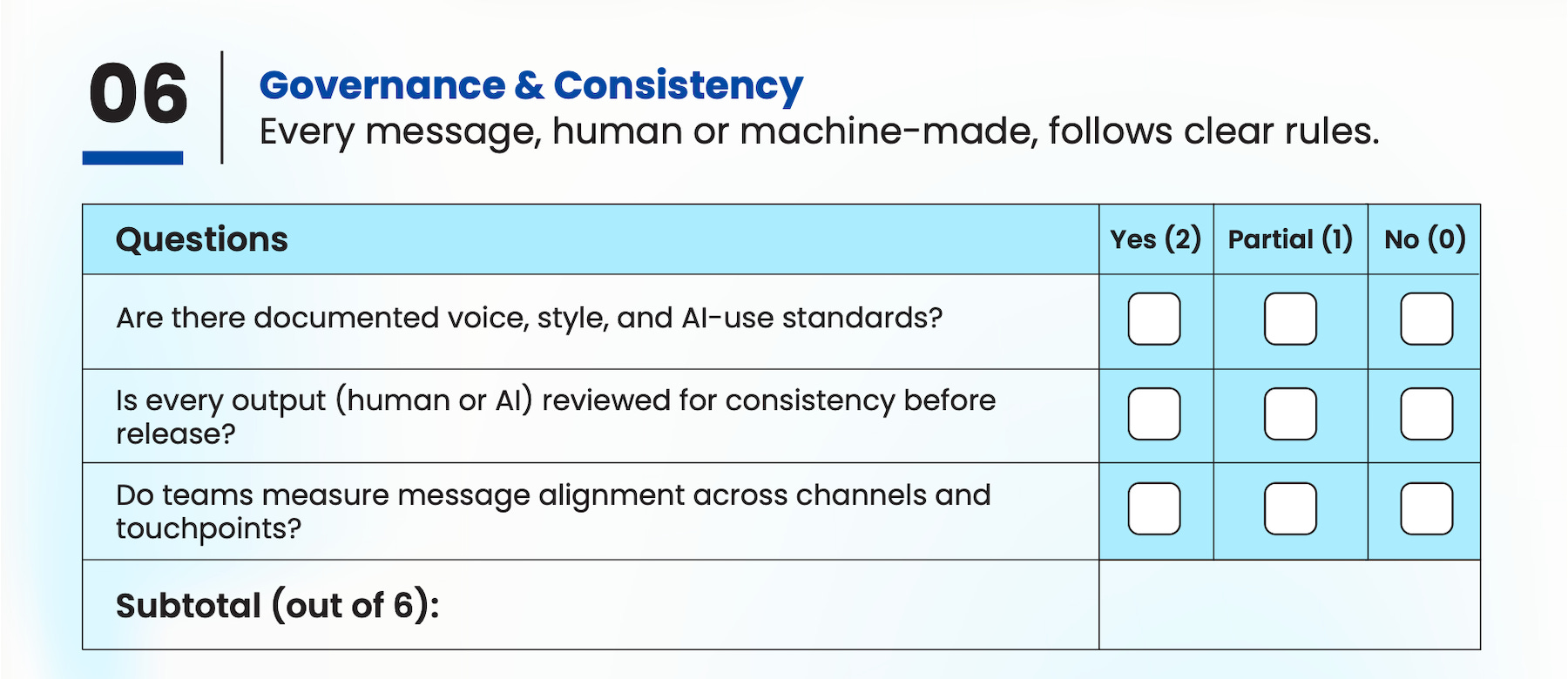
This section checks whether our organization has clear rules for how content should sound, how it gets reviewed, and how AI-generated output is supposed to behave — or whether we’re all still freelancing our way toward “consistency” and praying no one notices the seams. It asks whether we have documented voice, style, and AI-use standards, whether outputs are reviewed before release, and whether we measure message alignment across channels and touchpoints.
In plain language, it’s asking whether we have real standards and enforcement, or just a shared fantasy that everything somehow sounds on-brand.
Why This Matters For AI Readiness
AI readiness depends on governance far more than many organizations want to admit. Without clear standards, AI tends to amplify whatever inconsistencies already exist — conflicting terminology, uneven tone, unsupported claims, policy drift, and answers that sound like they were assembled by three departments and one overcaffeinated intern in under seven minutes.
This section shows whether our organization has the rules and review discipline needed to keep human and machine-generated communication aligned. Strong scores suggest we have defined standards, review mechanisms, and some way to check whether messaging stays consistent across the customer experience. Weak scores suggest we may be letting AI produce content in an environment where no one has clearly defined what “good” even means.
What Tech Writers Should Pay Attention To
Technical writers should pay close attention to this section because governance is where content quality stops being a personal virtue and becomes an organizational practice. Many writers already maintain style guides, terminology lists, editorial standards, and review workflows. What this section does is connect that familiar work directly to AI reliability.
The review question is especially important. It asks whether outputs are reviewed for consistency before release, regardless of whether a human or AI produced them. That is a useful reminder that AI should not get a special exemption from editorial discipline simply because it types faster than Kevin from marketing.
The question about measuring alignment across channels matters too. It is one thing to have standards written down. It is another thing to know whether the product UI, knowledge base, support scripts, chatbot, onboarding emails, and AI assistant are all following them. If they are not, users experience that inconsistency as confusion, not as an interesting internal process problem.
What A Low Score Here May Indicate
A low score here may mean we lack documented standards, don’t review AI-assisted output consistently, or have no practical way to measure whether communication stays aligned across touch points. It may also mean standards exist in theory but not in daily practice, which is how style guides end up spending their final years as neglected PDFs opened only in moments of shame.
That usually leads to drift. Tone drifts. Terminology drifts. Policy language drifts. Then AI shows up and turns all that drift into speed.
What A High Score Here May Indicate
A high score suggests we’ve done the important, usually thankless work of defining standards, applying them consistently, and checking whether they hold across channels. It suggests we’re introducing AI into an environment with rules, review, and accountability, not a free-range content pasture where anything that sounds plausible gets released.
That doesn’t mean every output will be perfect. It does mean we’re at least working from a known set of expectations, which is a much better starting point than “we’ll know it when we see it.”
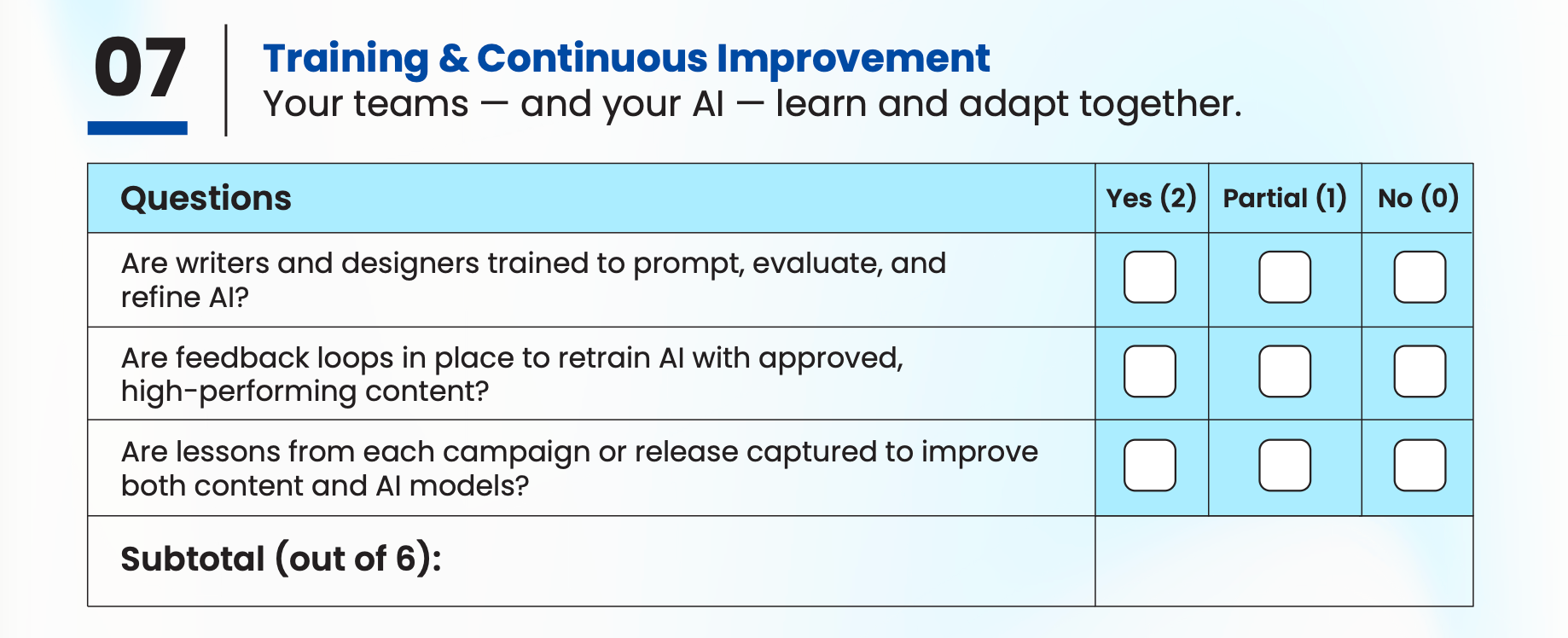
This section checks whether our organization is learning from experience and improving over time, or treating AI like a one-time rollout followed by months of crossed fingers and selective memory. It asks whether we train writers and designers to prompt, evaluate, and refine AI, whether feedback loops retrain AI with approved, high-performing content, and whether we capture lessons from each release to improve both content and models.
In plain language, it’s asking whether our people and systems are getting smarter together, or whether we’re just repeating the same mistakes at machine speed.
What Tech Writers Should Pay Attention To
Technical writers should pay close attention to this section because it shows where content quality stops being a personal virtue and becomes an organizational habit. Many of us already manage style guides, terminology lists, editorial standards, and review workflows. This section connects that work directly to AI reliability.
The review question matters especially here. It asks whether outputs are checked for consistency before release, whether a human or AI produced them. That’s a useful reminder that AI shouldn’t get a free pass just because it types faster than Kevin from marketing.
The alignment question matters too. It’s one thing to write standards down. It’s another to know whether the UI, knowledge base, support scripts, chatbot, onboarding emails, and AI assistant are actually following them. If they aren’t, users experience that as confusion, not as some fascinating internal process issue.
What Tech Writers Should Pay Attention To
Technical writers should pay close attention to this section because it shifts AI adoption from a tool question to a practice question. The issue isn’t whether we have access to AI. It’s whether we know how to use it well, judge what it produces, and improve the system when it falls short.
The feedback-loop question matters most. If approved, high-performing content isn’t used to refine AI behavior, the system doesn’t really learn from success. It just keeps producing output at scale and waits for someone to notice when it wanders off the rails. Technical writers already understand revision, pattern recognition, and editorial learning. This section applies that same mindset to AI operations.
The final question matters too. Many organizations still treat each launch like a one-night stand — lots of activity, very little reflection, and no real plan for what comes next.
What A Low Score Here May Indicate
A low score here may mean we haven’t trained people to work well with AI, our feedback loops are weak or missing, and we’re not capturing lessons in ways that improve future output. It may also mean we’re treating AI like a productivity shortcut instead of a capability that needs stewardship, refinement, and adult supervision.
That usually leads to a familiar pattern: the first demo looks exciting, the real-world output gets messy, and then everyone quietly stops mentioning it unless a vendor is in the room.
What A High Score Here May Indicate
A high score suggests we understand that reliable AI depends on ongoing learning. It means teams are being trained, feedback is being used productively, and both content and models are improving through deliberate iteration. That doesn’t mean we’ve solved everything. It does mean we’re building the habits needed to keep quality from sliding backward the minute attention wanders.
In other words, it suggests we may finally understand that “continuous improvement” is not just something people slap on strategy slides to make neglect sound ambitious.🤠
[On-Demand Webinar] A Framework For Untangling Messaging Misalignment
Sarah Johnson, Founder and Strategic Consultant at Content-first Design, as she introduces the content-first double diamond framework; a practical approach for stopping meaning drift before it disrupts your user experience. You’ll learn what meaning drift is, why it happens, and how unchecked misalignment in messaging impacts both customers and teams.
Sarah will walk you through actionable steps to implement a content-first mindset, share real-world case studies of organizations who’ve succeeded with this method.