

Every few years, technical communicators hear that some new approach will finally solve the Subject Matter Expert (SME) problem — the documentation bottleneck that happens when the people with the needed knowledge are not the people responsible for producing the content.
SMEs know the product, process, customer edge cases, risks, and technical truth. But they’re often busy, hard to schedule, not trained as writers, and not rewarded for documentation work. So tech writers wait for answers, reviews stall, drafts rely on assumptions, and content becomes late, incomplete, or wrong.
Wikis were supposed to let experts write directly. Agile development, Continuous Integration / Continuous Development [or Deployment] (CI/CD), and Docs-as-Code promised to bring writers and developers closer together. AI systems now promise to summarize meetings, draft procedures, and answer questions.
Yet tech doc projects continue to be delayed for reasons that would’ve sounded familiar 20 years ago:
👉🏾 The engineer is working on a production issue
👉🏾 The product manager is on maternity leave
👉🏾 The support lead is handling an escalation
👉🏾 The meeting was postponed
👉🏾 The review sits untouched because the release date moved — again
Most tech writers know this phrase by heart: “We’re waiting for the SME.”
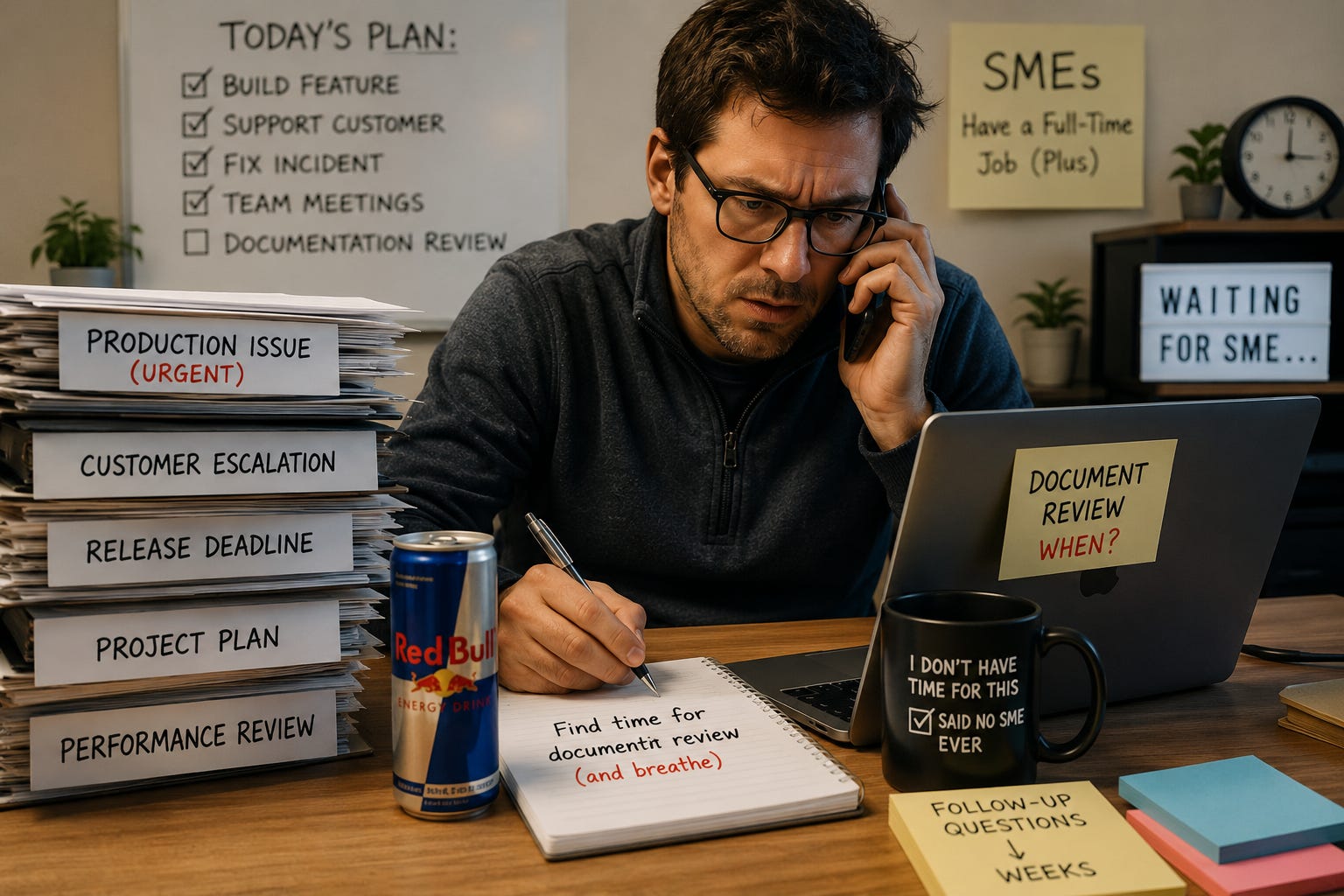
SMEs Already Have A Full-Time Job
The majority of SMEs were hired to build products, support customers, manage systems, or solve technical problems. Helping to create documentation becomes something they do in the remaining spaces between meetings, deadlines, incidents, and projects. Documentation reviews often survive on goodwill, leftover calendar time, and whatever caffeinated beverage (probably this one) remains in the refrigerator.
Documentation competes with work that affects release dates, customer commitments, operational issues, and performance evaluations. The review of a draft procedure rarely wins that competition.
Many writers find that while arranging an interview is a quick task, the real bottleneck happens when waiting weeks for follow-up answers.
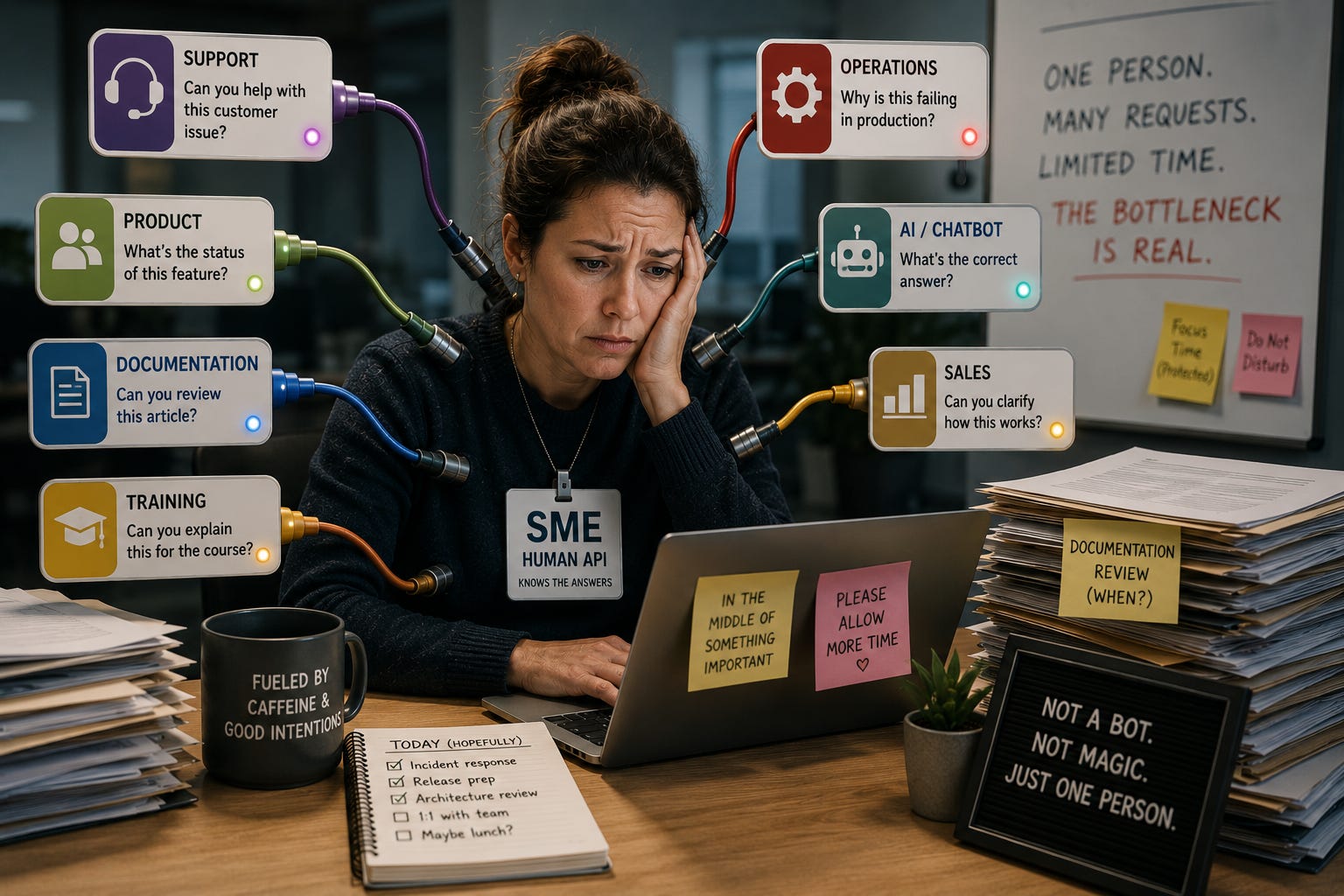
We’ve Been Trying To Solve This For Years
The approaches that promised to improve documentation also promised to reduce the distance between writers and SMEs. Agile teams placed writers closer to developers. CI/CD encouraged documentation updates to move alongside software releases. Docs-as-Code put documentation into the same repositories, workflows, and tools used by engineering teams.
Developers could submit pull requests, review content, and contribute changes without leaving the comfort of their familiar digital ecosystem. The underlying assumption made sense. If writers and experts worked more closely together, documentation delays would become less common.
Co-location worked for some, but not all. Many organizations still struggled with overloaded engineers, late reviews, and stalled documentation. Proximity improved collaboration, but it didn't solve the problem of competing priorities.
Knowing Something And Explaining Something Are Different Activities
When you know a subject inside out, you tend to skip the basics. The missing steps seem obvious, the jargon feels natural, and the foundational assumptions fade into the background.
Experts struggle to predict what non-experts don’t know. Camerer, Loewenstein, and Weber’s classic study found that better-informed people (think SMEs) are unable to ignore what they know when judging what less-informed people will understand.
Tech writers witness the fallout of this gap every day. We see product demos stall, support teams use unwritten workarounds, and three different experts give completely different explanations of the exact same process. An engineer explains the architecture, a support rep explains the user reality, and a product manager explains the vision. The actual procedure is buried somewhere in the middle. Translating that chaos into clarity is exactly why we exist.

Organizations Create Their Own Bottlenecks
Company knowledge is almost never spread out evenly. Usually, it’s trapped in the brains of a handful of people: the engineer who actually built the integration, the admin who knows the permissions inside out, the support rep who remembers why things changed years ago, and the project manager who tracks all the weird exceptions.
When every department constantly interrupts them for answers, calendars fill up with endless meetings. But calling these experts “bottlenecks” is unfair. They are forced to act as the company’s historical archive, tech support, and approval authority all at once. The real problem? The organization didn’t build a scalable system; it built a workflow that entirely depends on a handful of overloaded people.
When a single person becomes the source of truth, their calendar becomes part of the documentation process.
Tech Writers Already Know This Problem
Experienced technical writers rarely depend on isolated interviews. They validate information by cross-referencing release notes, analyzing support trends, observing demonstrations, and executing procedures themselves.
They look for discrepancies in terminology across departments and leverage hands-on demonstrations to uncover gaps.
Ultimately, information gathering is just as critical as content creation. This investigative approach helps writers build an "organizational radar," allowing them to identify unverified data, obsolete procedures, and conflicting expert perspectives.

We Keep Asking The Wrong Question
Companies love to ask how they can free up more time for their SMEs. But here’s the reality: those experts don’t have any more time to give.
Instead, we should ask why we keep making them repeat themselves. If support asks for the same breakdown every release, the docs are missing something. If onboarding requires a hand-holding session for a basic process, the documentation isn’t clear. If customers keep calling about the same glitch, the fix is too hard to find.
The expert isn’t being used for their technical skill; they’re being used as a human search engine. Tech writers fix this by turning individual expertise into public record. When info is accessible and reliable, fewer questions have to travel back to the same overloaded people.
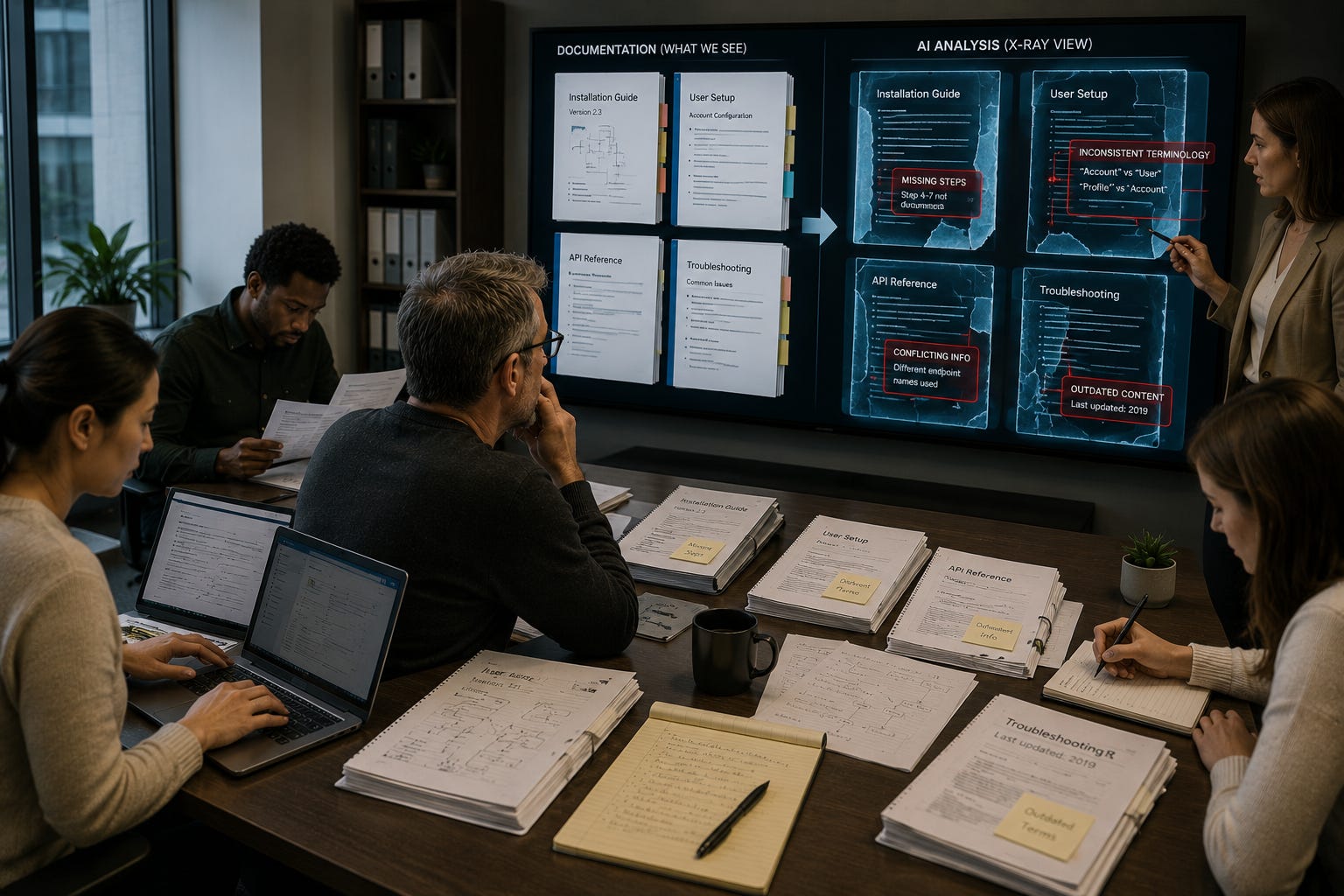
AI Has Exposed Our Content Debt
Many leaders are learning the hard way that their shiny new AI chatbot only knows as much as their documentation does.
For instance, if an installation step was never written down, the AI can’t divine it. If our customer support and product teams use different jargon, the chatbot’s answers will be a messy contradiction. And if an article has been abandoned for years, the AI may confidently serve up that expired data as today’s gospel.
AI didn’t create these flaws; it just stumbles into them at lightning speed. Now, instead of writing, experts are stuck babysitting AI drafts, validating chatbot outputs, and fixing errors caused by poor source material.
The tasks look new, but the headache is exactly the same: the company is still entirely dependent on a handful of people to explain how things actually work.
The Real Goal
SMEs are vital to organizational success. As products advance and regulatory environments evolve, their deep expertise becomes even more critical. The objective is to optimize their time by eliminating repetitive inquiries.
When documentation is current, standardized, and properly governed, organizations naturally reduce the burden on their SMEs. Internal teams resolve issues faster, onboarding timelines shrink, and customer self-service rates improve.
Tech writers have driven these operational efficiencies for decades. Ultimately, the rise of AI has simply provided organizations with a compelling new reason to recognize the value of structured knowledge management. 🤠