

In 2007, I served as executive director of a new professional membership organization called Content Management Professionals (CM Pros). We worked to bring together knowledgeable and experienced practitioners to advance the discipline of content management and the emerging practice of content strategy.
While CM Pros accomplished some of the things we set out to do, several items on our to-do list still haven’t been completed nearly two decades later. Content-producing organizations continue to struggle to agree on basic things; like terms and what they mean. That lack of shared understanding affects more than just those who document products, it also impacts technology decisions, which far-too-often fail to reflect the needs of those who create, manage, and use information.
One organization taking on a similar set of problems today is the MACH Alliance.

Enter The MACH Alliance
The MACH Alliance is a vendor-neutral industry organization focused on enterprise technology. They produce technical standards and certify vendors and implementation partners that meet those standards. And, they publish research and insights and offer a learning platform to help those of us trying to make enterprise systems easier to connect and change.
Download report: AI: From Pilot To Production
MACH (pronounced “mack,” to rhyme with “snack”) is an acronym for microservices-based, API-first, cloud-native SaaS, and headless. The Alliance’s current framework places those characteristics under three broader principles: enterprise technology should be open, composable, and connected.
This list of three principles sounds a lot like architecture mumbo jumbo, but they matter if we want to understand how our systems work, change one part without breaking another, and move data where it needs to go.
In MACH Alliance parlance:
Open means documented interfaces and standards that let us observe how technology operates and connect it with products from other vendors.
Composable means capabilities we develop, deploy, or replace independently, without rebuilding everything around them.
Connected means data moves across the enterprise through APIs and shared protocols instead of staying trapped inside a single software application.
These principles give business and technology teams a practical way to evaluate products. They help us look beyond whether a feature exists and ask whether we can access and move our own data, change one capability without affecting others, and connect our product with other technologies.
Documentation content operations is a useful place to see those questions play out.
Heretto, where I serve as Content Strategy Evangelist, recently joined the MACH Alliance, and its membership shows how these principles apply to technical documentation. The Alliance now lists Heretto as a MACH Certified independent software vendor, describing the company as the provider of an enterprise component content management system (CCMS) for creating and delivering technical documentation. In its membership announcement, the company said it was the first documentation CCMS admitted to the organization.
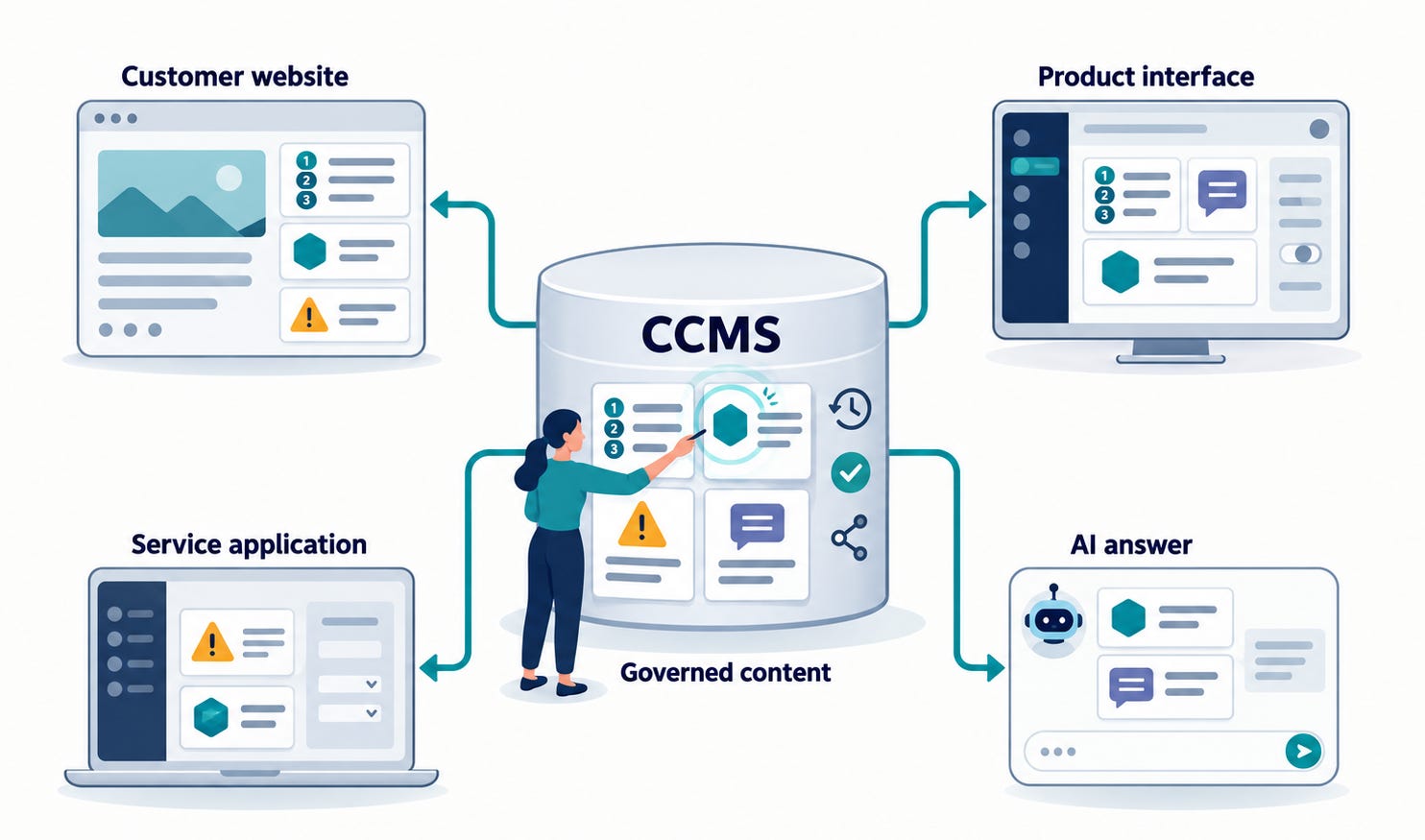
What A CCMS Actually Does
Often described as specialized tools for tech docs teams, a CCMS isn’t in any way limited to managing documentation. They can deliver information to customer websites, push content into product interfaces, service applications, and fuel AI-generated answers. Product docs are part of nearly every company’s information ecosystem, whether they treat it that way or not. And a CCMS can (and often does) play a critical role in producing trustworthy content at scale that can be repurposed and redeployed to multiple channels.
Heretto manages content as modular components and delivers it through APIs in an open, predictable way. Its MACH certification means the Alliance reviewed their architecture and found that it meets the standards required of technology providers.
The MACH membership also brings a documentation CCMS vendor into the wider conversation about composable architecture. AI agents and applications need reliable access to trusted, well-managed enterprise information. That gives documentation systems an important role far beyond publishing help sites.
I still think about those CM Pros meetings. People from documentation, marketing, and IT would sometimes realize they were talking about the same problem but using different terms. Those a-ha moments stuck with me long after my role with CMPros ended. And, it contributed to my decision to co-edit The Language of Content Strategy (XML Press) with content solutions strategist, Rahel Anne Bailie, a book intended to give content pros a shared vocabulary for discussing our work.
The MACH Alliance addresses a related coordination problem at the architectural level. Shared terminology helps content pros describe their practices. Shared technical standards give organizations a basis for evaluating how systems exchange information (interoperability) and accommodate change.
It’s still unclear whether these standards will change how documentation technology is evaluated. Heretto’s MACH certification raises a broader (and perhaps equally important) question:
Should organizations judge a CCMS only by what writers can do in the authoring interface, or also by how well its content connects with the rest of the organization’s information systems? 🤠