

Suppose your company makes a family of five countertop stand kitchen mixers: three tilt-head models and two bowl-lift models (one with a timer). Four are for home cooks and bakers and one is for professionals.
Each kitchen mixer model needs its own manual, but much of the text overlaps. For instance, the exterior cleaning instructions are exactly the same across all five machines.
Because the team maintains separate manuals for each model, those cleaning instructions are duplicated five times. And that’s just the English language versions. The docs are written in English and translated into four other languages. If the cleaning steps change, writers must update all five English copies and send each one out for translation again. That means republishing 25 documents for a single edit. If they miss just one, some customers end up with outdated information.
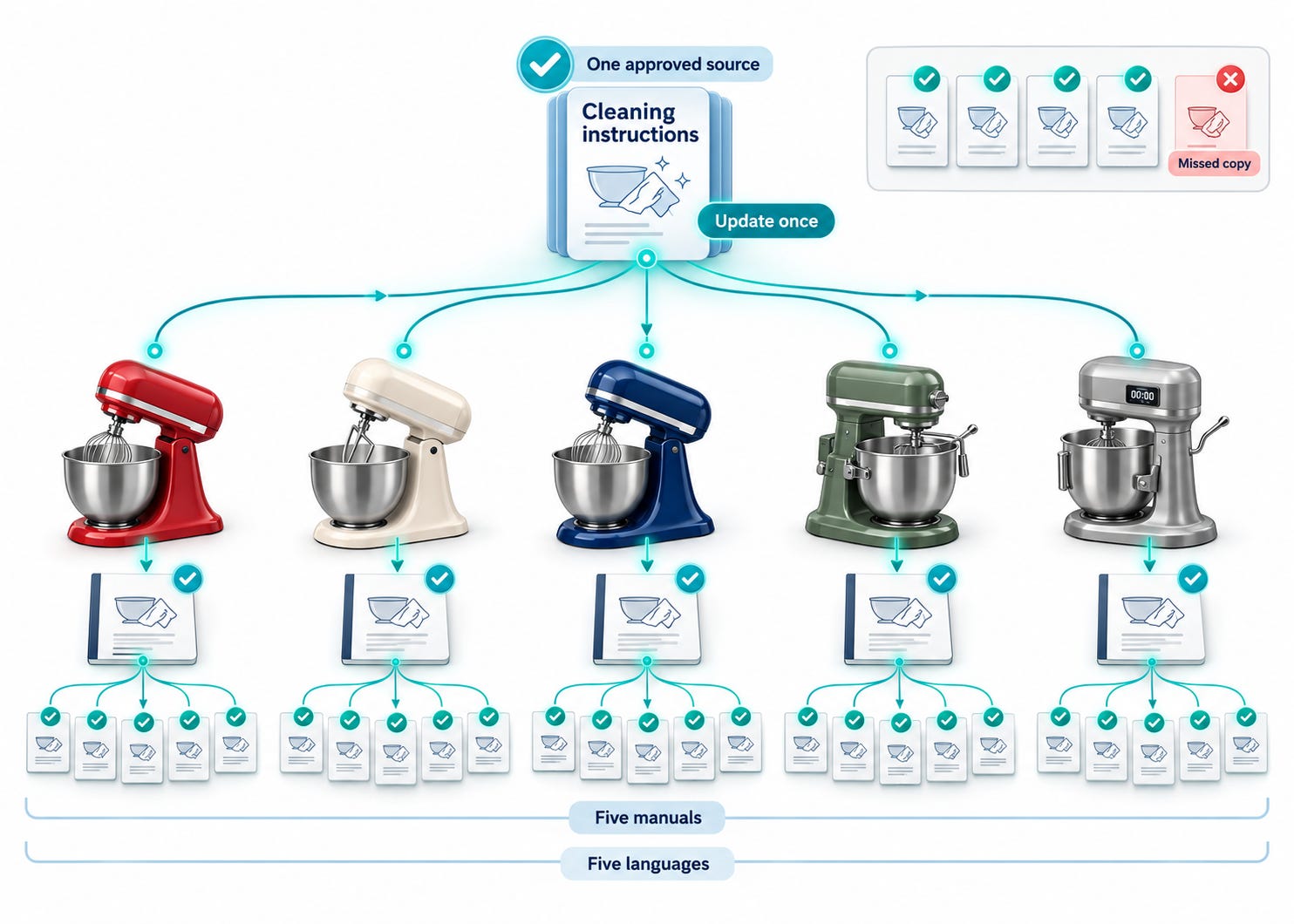
A component content management system (CCMS) fixes this by replacing those duplicates with a single shared file. The docs team writes the instructions once, and every manual links to it.
If the text changes, writers make updates to that central source file. The system knows which manuals use it, making it easy to update and republish them all at once.
The improvements are easy to describe. Getting them funded is harder, because the cost it reduces doesn’t appear anywhere on the mixer company’s financials.
Leadership likely sees that the docs were delivered on time. But they seldom see the wasted hours or the frustratingly tedious workarounds required to keep 25 separate documents perfectly synced without someone pointing these things out.
To get funding for a CCMS, a documentation leader has to expose hidden costs and show the company leadership what it stands to gain by eliminating them.
What Does A CCMS Manage?
A CCMS manages content in pieces that can be maintained and reused on their own, such as a procedure or a safety warning. These pieces are called components. A publication, such as a printed manual or a support website, is assembled from the components its readers need, in the order they need them.
Here is how the mixer company’s content could be divided. Assume the manufacturer has verified where each set of instructions applies.
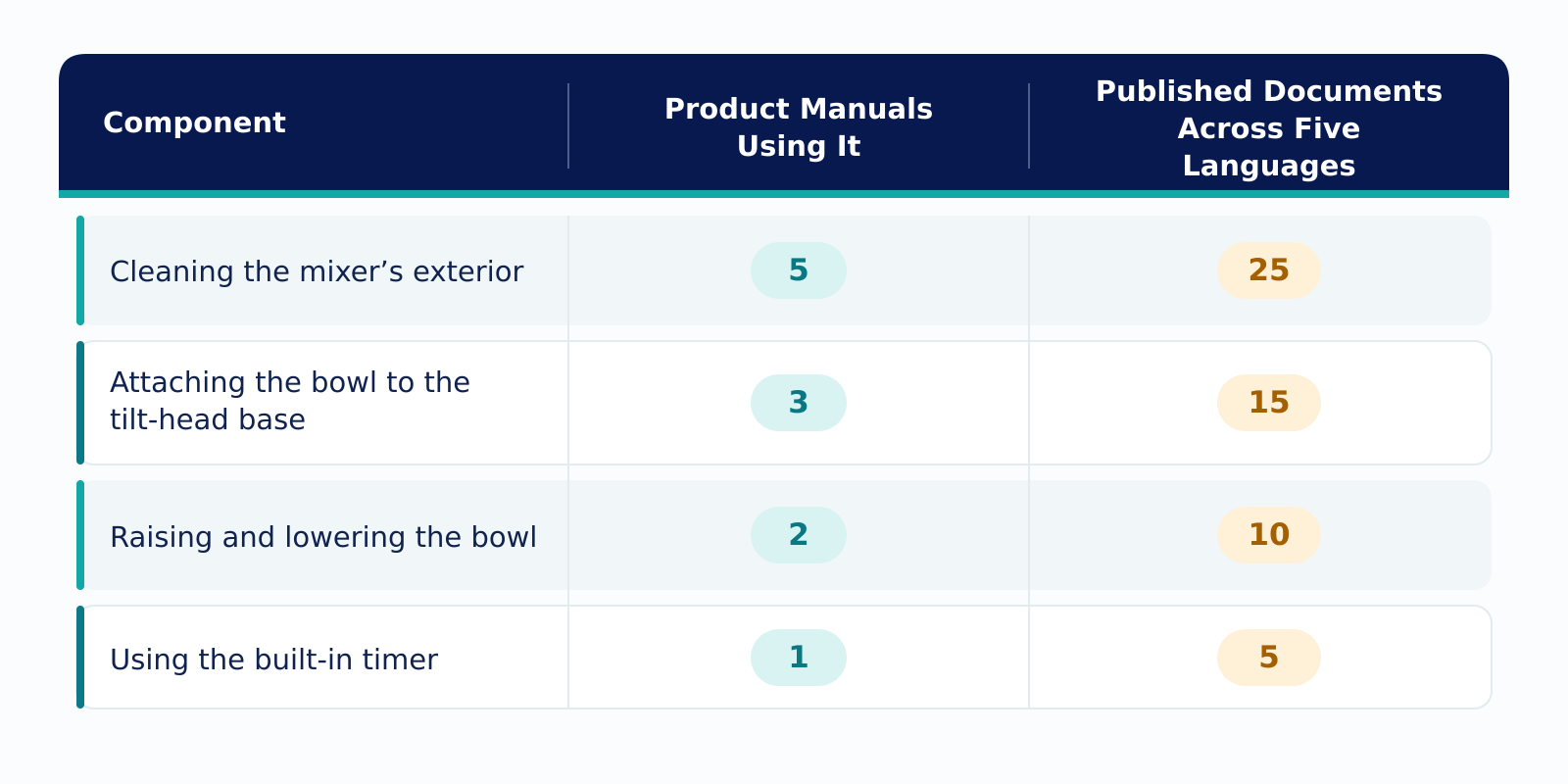
Each manual combines the components its model requires. Writers reuse an entire procedure or, where it makes sense, a smaller component inside one, such as a single warning. Reuse in a CCMS works through references. A pasted copy becomes one more text that someone has to maintain, while reusing content by reference keeps every manual tied to the same managed source. The CCMS serves as the single source of truth, recording where each component is used and keeping its version history, so a writer can see what a change will affect before making it.
Ann Rockley describes this approach to linked reuse in Managing Enterprise Content: A Unified Content Strategy.
Editing a component does not publish anything by itself. The team decides which revision belongs in each manual and releases it through its approved review and publishing workflow.
Where Do Structured Content And DITA Fit?
Reuse works best when the cleaning instructions have an internal organization that software can recognize. A procedure might identify any preparation required, followed by numbered steps. Structured authoring gives writers defined places for those kinds of information and rules for how they fit together. Separate publishing rules decide how the content looks in a printed manual or on a support website, so writers don’t format each output by hand.
A word-processing document can look well organized without telling software which part is a step and which part is a warning. Structured content makes those distinctions explicit. Moving to it also requires the team to decide how to divide its information into components that still make sense to readers.
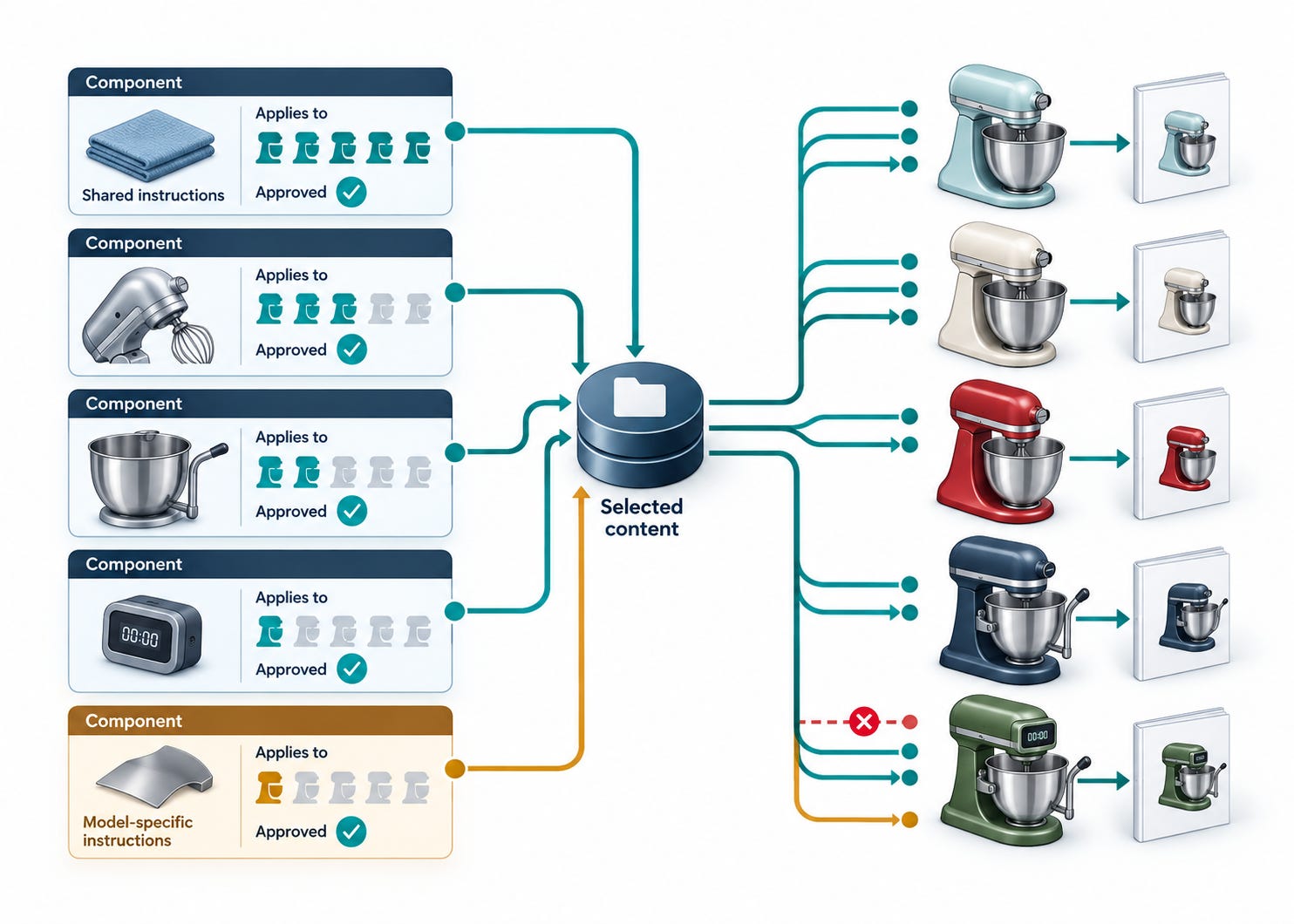
Information attached to a component, called metadata, can record which mixer models it applies to or whether it has been approved. The team uses metadata to organize content and to select the right material for each publication. Shared instructions must be accurate for every model that uses them. When one model needs different steps, the content has to preserve that difference rather than force a single version into every manual.
The Role DITA Plays
The Darwin Information Typing Architecture (DITA) is an open standard for organizing structured content. It defines topic types such as tasks, concepts, and references. In DITA, a component is usually a topic, and a publication is defined by a map.
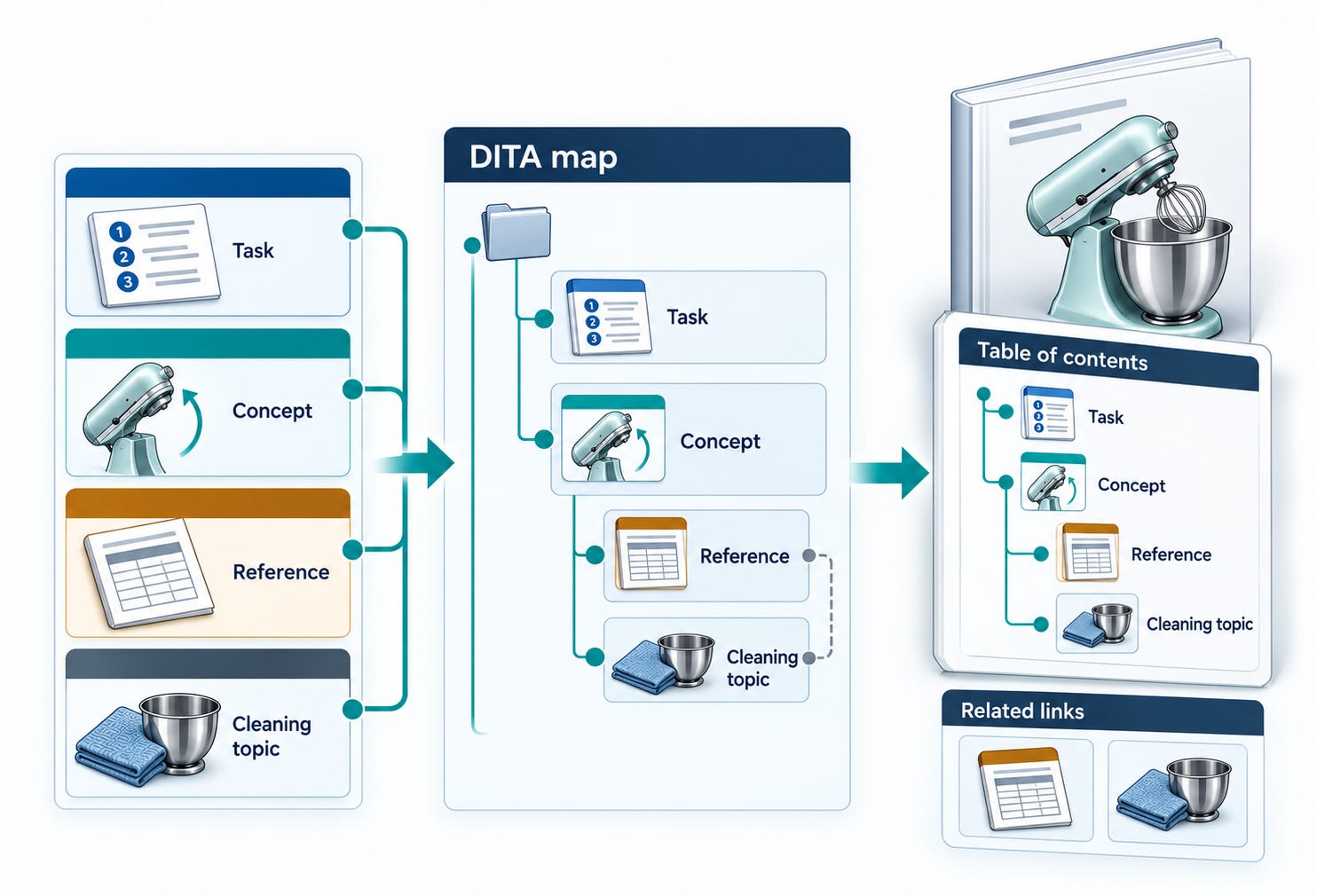
A map works sort of like a recipe. It lists which topics a publication needs, where each one is stored, and how they are ordered and nested. That order and nesting become the table of contents. Maps can record how topics relate to one another so the published output can include related links. It supplies context, too. The cleaning topic doesn’t name a model, so it can appear in any manual; the map for a tilt-head model is what places it in that model’s manual. The map never changes the topics it lists.
At publishing time, a publishing engine such as the open-source DITA Open Toolkit does the cooking. It reads the map, retrieves the topics it points to, and produces the PDF or website. Because a map is a set of instructions, the five mixer manuals can be five maps that point to the same cleaning topic without copying it.
A CCMS like Heretto provides the environment for authoring, reviewing, reusing, localizing, and publishing that content. DITA describes how the content is organized; the CCMS is where the team manages it.
Why Would A Team Change How It Produces Technical Documentation?
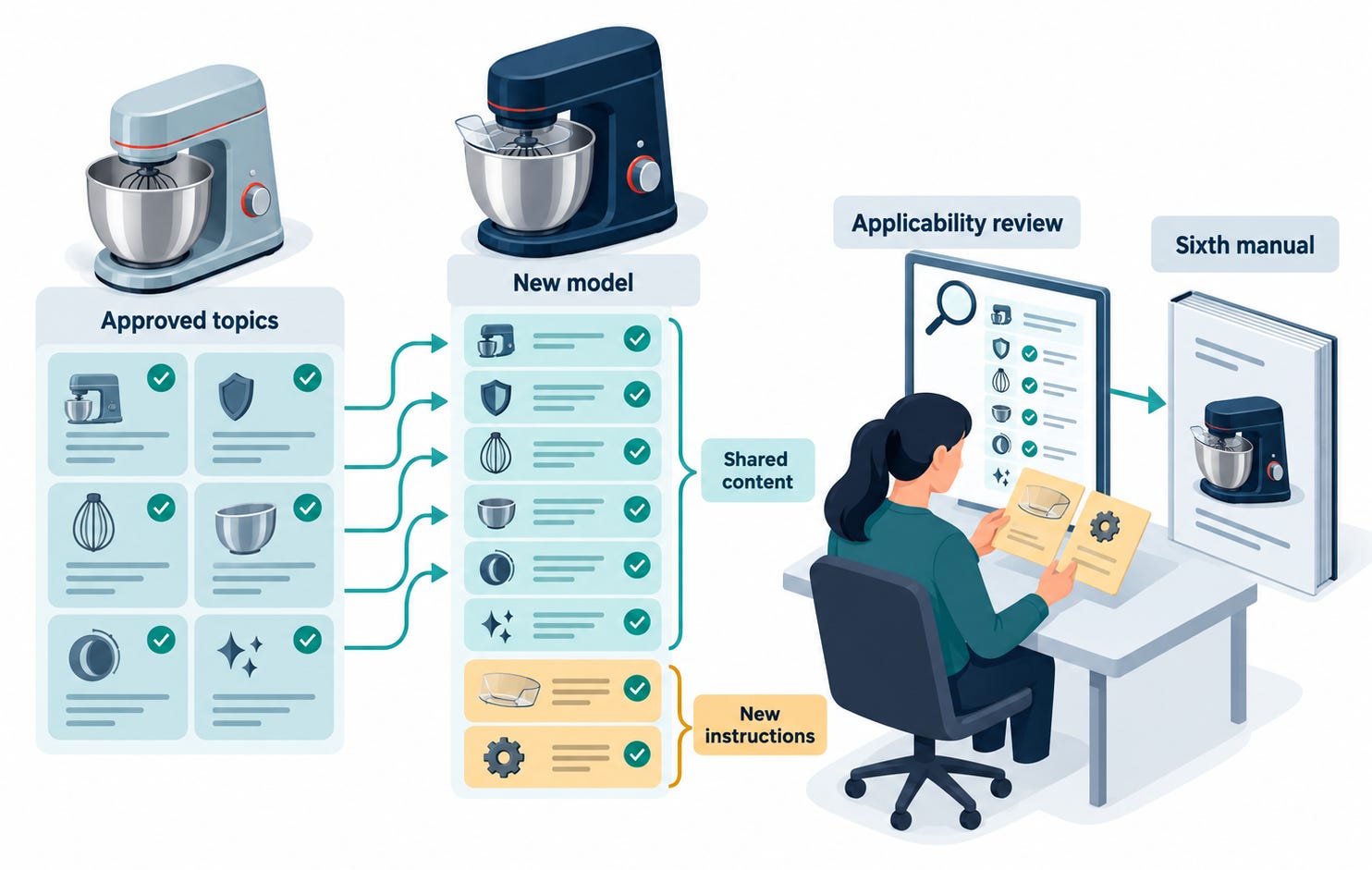
Now suppose the mixer company adds a sixth model that shares most of its features with an existing mixer. With managed components, the team creates a map for the new manual that points to approved topics and writes only the instructions for what is different. Reviewers focus on the new material and on whether the shared topics are correct for the new model, rather than treating the whole manual as a new document.
The benefit grows with the amount of shared content a team maintains across products, releases, and languages. Writers spend less time synchronizing copies and more time on content customers are waiting for.
Reuse is one reason to evaluate a CCMS, especially if the team needs to publish one source to several output channels, such as a PDF manual and a support website or documentation portal. Some teams may identify a need for better version control or a more reliable way to coordinate reviews and approvals. The business case depends on which production problems an organization has and how much they interfere with delivering documentation.
How Does Reuse Reduce Translation Costs?
Return to the 25 documents. While cleaning instructions stay unchanged, the company keeps using their approved translations. When the instructions change, a workflow that tracks components and their translations sends only the new or changed instructions for translation and they reuse existing translations of everything else. Translators receive one revised procedure per language rather than five copies.
Translation memory, a database of earlier translations, lets translators reuse sentences they have translated before. Source reuse adds a different benefit: shared instructions remain identical across publications. Separately maintained copies can drift apart, picking up small wording differences that create extra translation and review work. Keeping a common source prevents that drift.
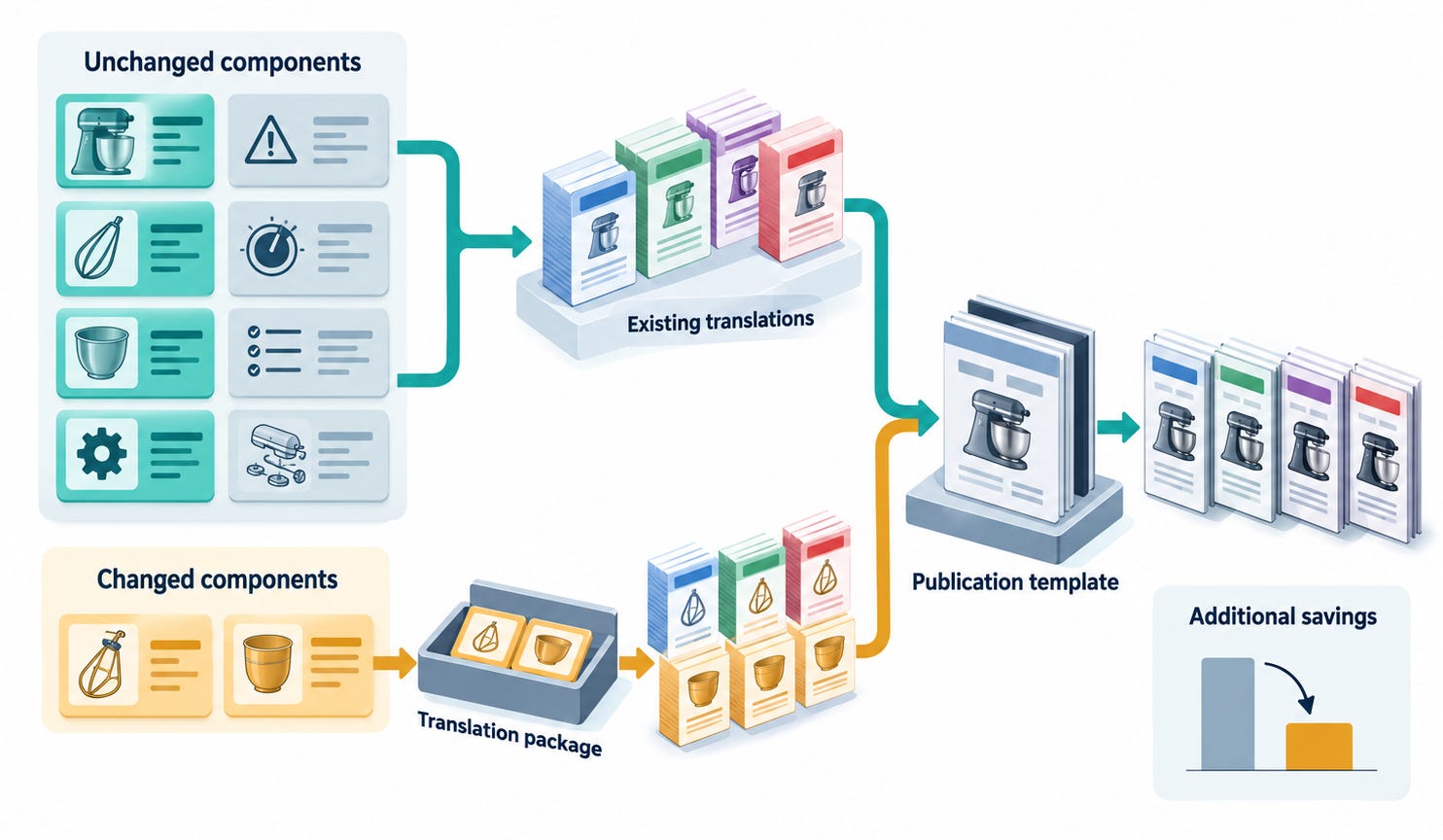
In DITA Metrics 101 (XML Press), Mark Lewis explains that many translation vendors charge, at a lower rate, to process text that matches an existing translation. Leaving unchanged, previously translated components out of the translation package can avoid those charges. In Managing Enterprise Content, Ann Rockley adds that separating content from formatting can reduce the work of laying out translated publications.
To estimate the financial benefit, the mixer company would compare its current translation and formatting charges with the expected charges under the new workflow, counting the translation-memory discounts it receives today. The difference shows the additional savings that come from changing how the company manages its source content.
