

Governance isn’t sexy. Nobody gets promoted because a review schedule was followed, duplicate topics were consolidated, or an obsolete support article was finally retired. Those jobs are routine, mostly invisible to leadership, and easy to postpone because there’s always another release to document and another feature waiting for emergency attention.
These jobs are also becoming some of the most important work documentation teams do today. As AI assistants increasingly answer customer questions using our technical documentation, knowledge bases, and support content, they don’t distinguish between information that’s carefully maintained and managed and information everyone forgot (or never knew) had been published online. They retrieve whatever is available — accurate or not.
That means governance is no longer just an internal publishing concern. It’s become one of the factors that determines whether AI gives customers accurate answers.
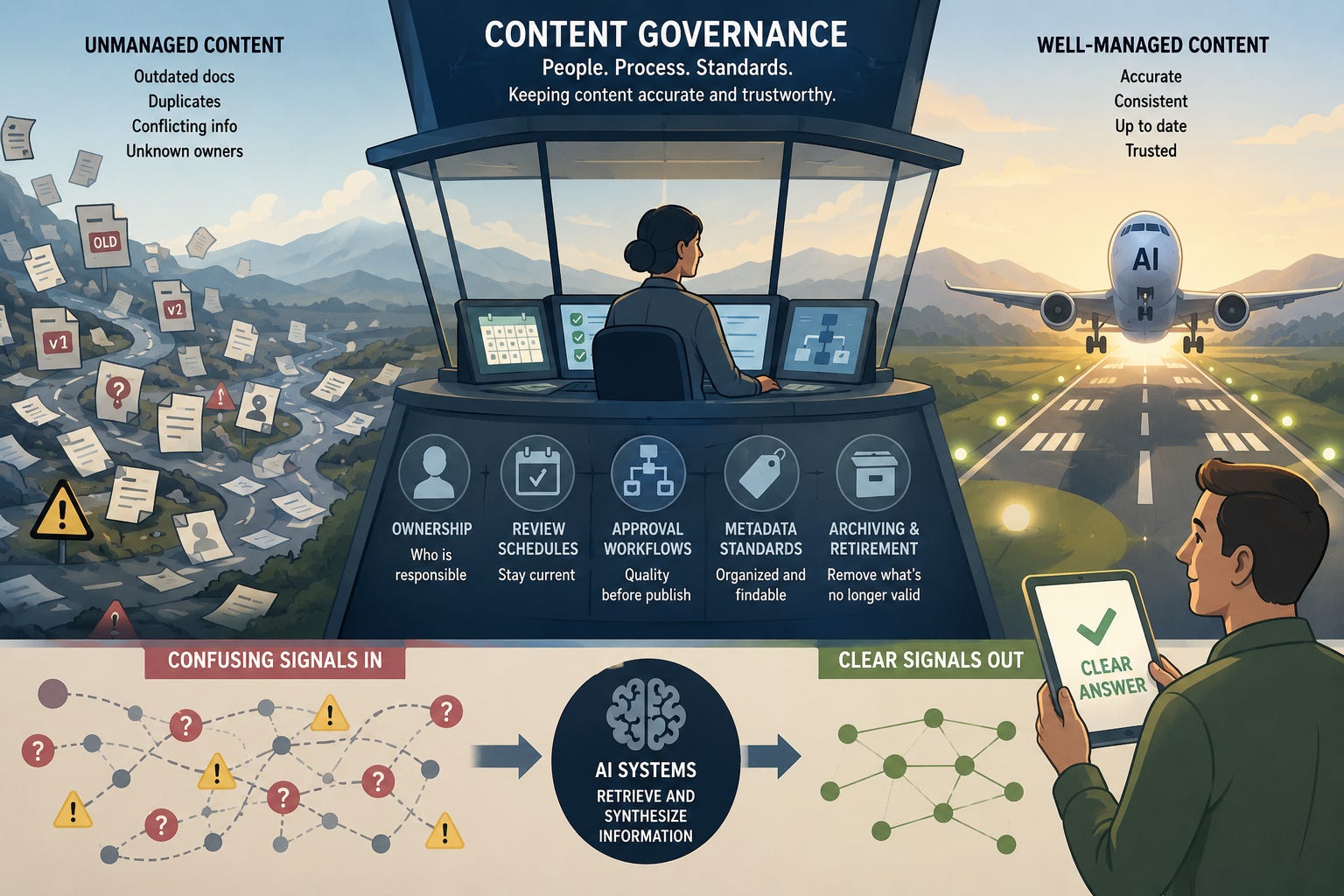
What Is Content Governance?
Content governance defines how information is managed throughout its lifecycle. It establishes ownership, review schedules, approval workflows, publishing standards, metadata practices, and archiving and retirement policies so our docs remain accurate as our products evolve.
Governance work often sits behind the visible parts of documentation, which makes it easy to overlook until conflicting or outdated information reaches a customer. The value isn’t in the process itself. It’s that our customers never have to wonder which of our installation guides is current or whether two procedures describing the same task are equally valid.
AI depends on those same signals.
Why AI Raises The Stakes
Traditionally, our prospects and customers searched documentation one topic at a time. If they found conflicting information, they often recognized the inconsistency and continued searching until they found a better answer.
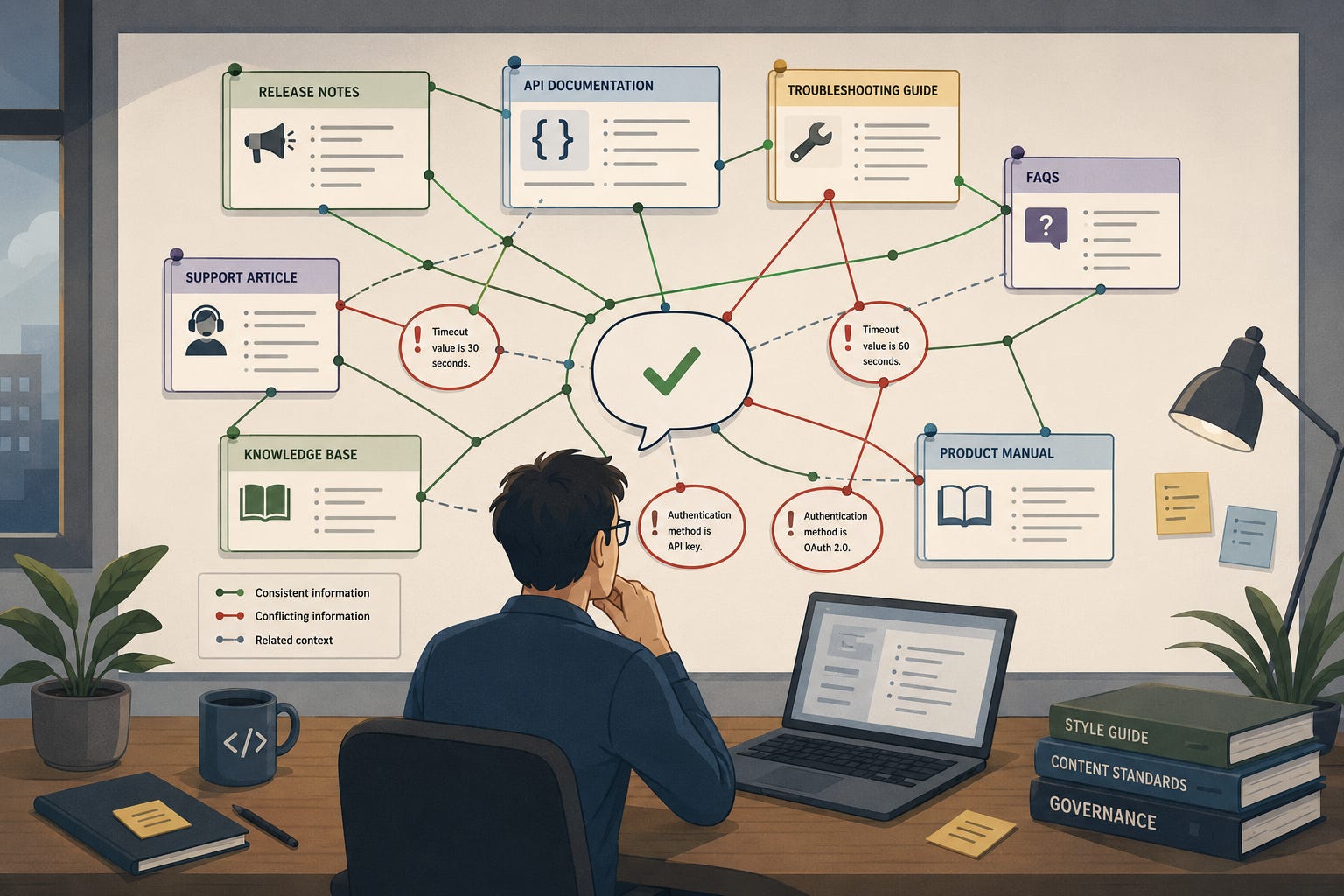
Retrieval systems approach the problem differently. Before generating a response, they may retrieve info from product documentation, release notes, support articles, troubleshooting guides, FAQs, and knowledge base content. The model then generates a response from the retrieved context, even when that context includes sources that disagree.
When documentation is well managed, that process usually works well. But, when a variety of sources describe the same feature differently, the answer generator may confidently blend information that should never have appeared together.
That’s often described as an AI problem. In reality, it’s frequently a content governance problem that AI has exposed.
AI Doesn’t Know Which Docs Everyone Trusts
Documentation teams usually know where the source of truth lives. They’ve learned through lived prior experience. Software doesn’t have any such awareness.
Imagine the engineering team updates the installation guide, the customer support staff publishes a temporary workaround, product marketing simplifies the feature description on our web page, and an older version of the docs remains publicly accessible because removing it might break existing links. Uh-oh.
An experienced tech writer can quickly identify which docs reflects the current product. A retrieval system, however, sees several differing sources of information discussing the same topic. Unless ownership, metadata, publishing controls, and lifecycle management clearly identify the authoritative version, it has little basis for deciding which information deserves the most confidence.
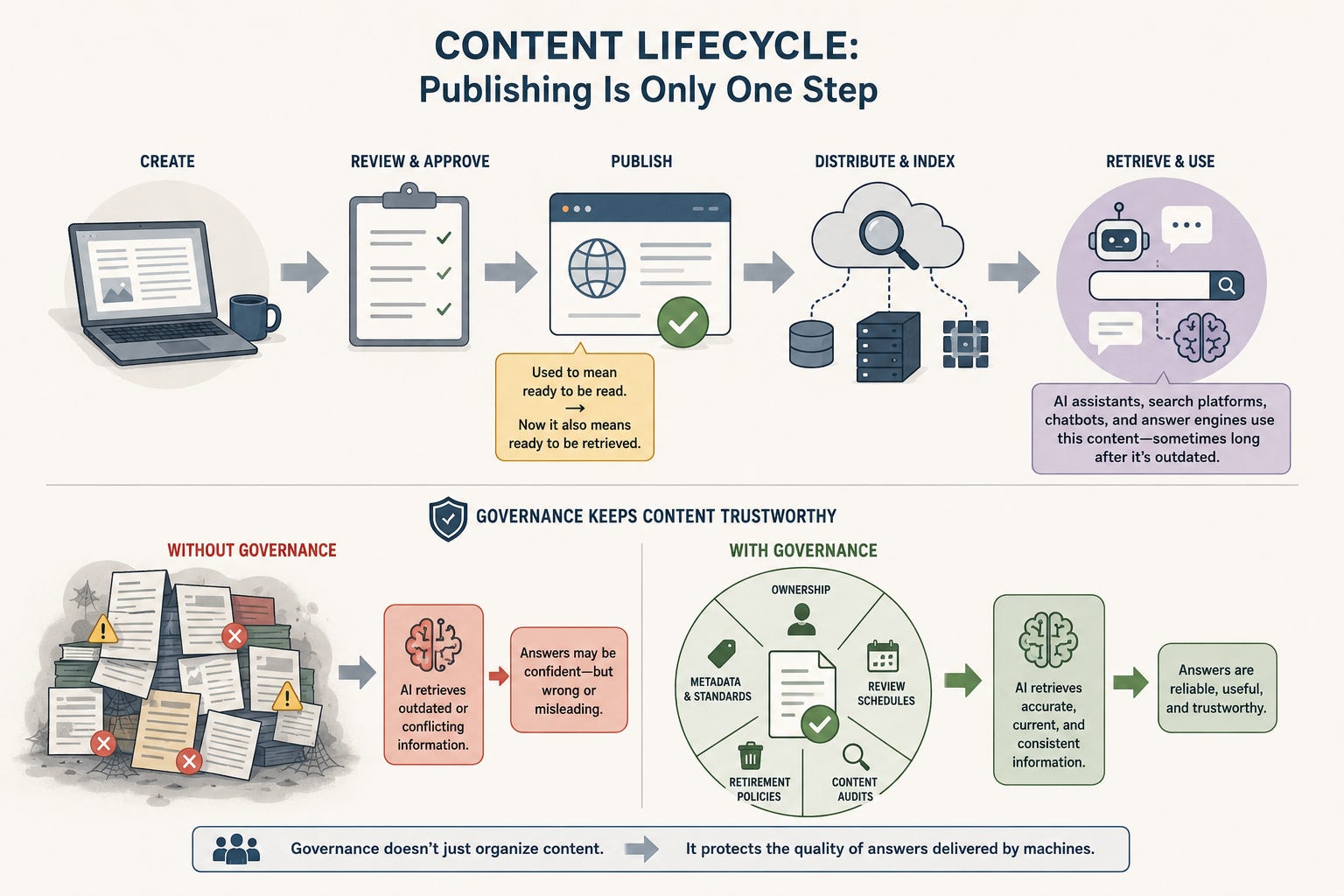
Publishing: One Step In The Content Lifecycle
Publishing used to mean our docs were ready to be read by our prospects and customers. Now it also means it’s ready to be retrieved by machines.
Once our content is published, AI assistants, enterprise search platforms, support chatbots, and answer engines can begin indexing and retrieving it. They may continue using that information long after our product has changed unless someone — us — keeps our content current.
That’s where governance comes in. Review schedules, content audits, ownership, metadata, and retirement policies don’t just help our documentation team stay organized. They reduce the chances that outdated or conflicting information remains available for retrieval. They won’t make an AI model smarter, but they can make the information it retrieves substantially more reliable.
Governance Improves AI Without Changing The AI
Most organizations won’t build their own large language models. They’ll use commercial AI systems that retrieve information from existing documentation.
That shifts the conversation in an interesting direction.
If answer quality depends heavily on the information being retrieved, then improving AI doesn’t always begin with changing the AI. It often begins with improving the content ecosystem feeding it.
Clear ownership reduces abandoned documentation. Consistent terminology reduces ambiguity. Regular reviews reduce stale content. Controlled publishing reduces conflicting versions of the same information.
None of those improvements requires a larger model or a better prompt.
They require better documentation operations.
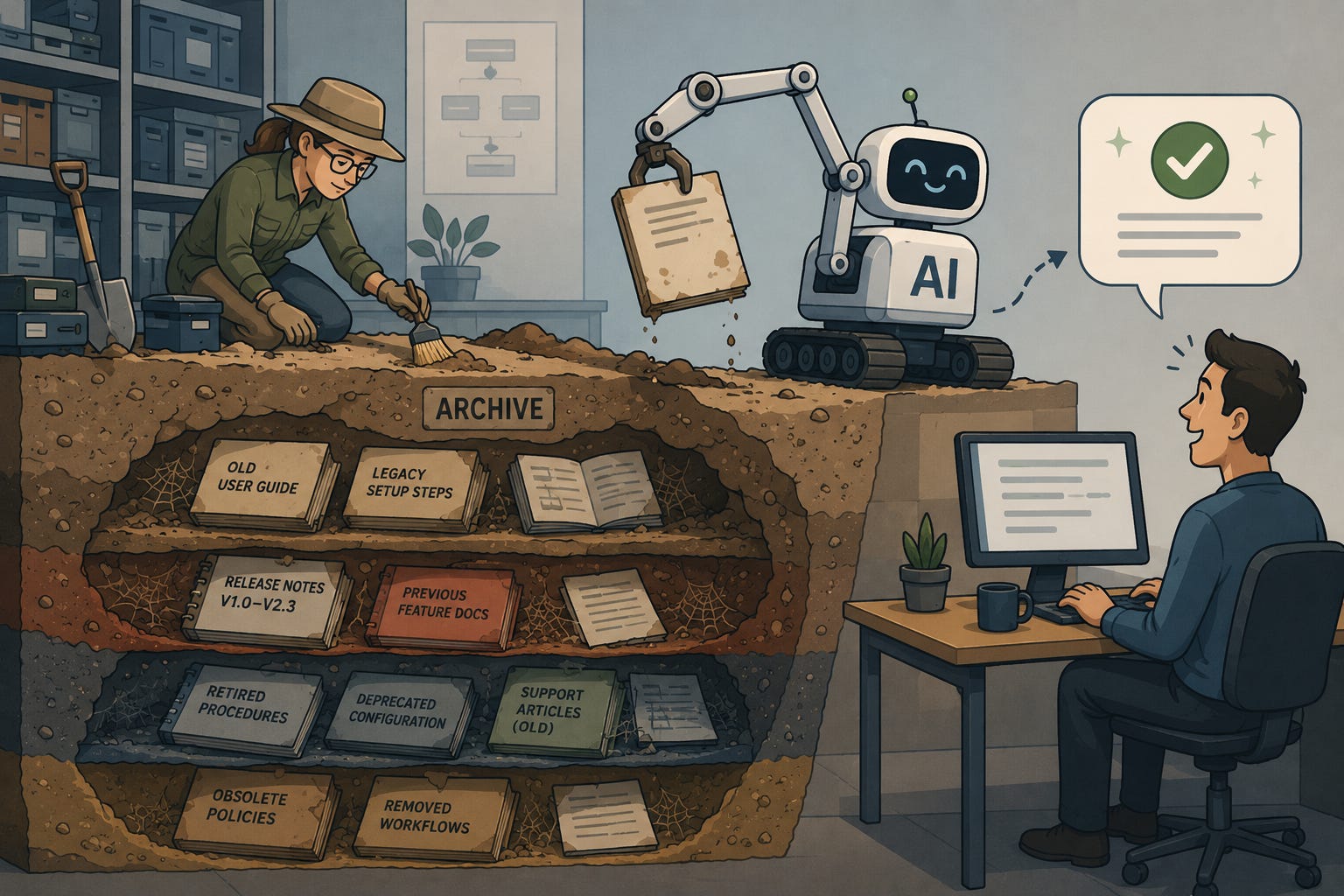
Regulated Industries Have Been Preparing For This For Years
Organizations in healthcare, financial services, aerospace, defense, manufacturing, and life sciences (and other industries with concern for avoiding liability and ensuring regulatory compliance) don’t invest in governance because they enjoy documentation reviews. They do it because inaccurate information creates preventable financial, regulatory, and safety risks.
AI expands that business case.
An outdated dosage recommendation, compliance requirement, installation procedure, or configuration step no longer has to be discovered by someone digging through archived documentation. If the content remains available, AI may retrieve it.
Even organizations outside heavily regulated industries face a similar challenge. Customers generally don’t distinguish between an incorrect AI response and incorrect company information. From their perspective, the company gave the answer — and it was wrong!
Governance Is Part Of The Customer Experience
For years, governance existed behind-the-scenes. Documentation shops relied on it to manage change, assign ownership, retire obsolete content, and keep growing collections of information accurate over time.
Those same practices now affect every answer AI generates from our content. Long before our customer asks a question, governance has already determined whether the AI finds accurate, current information or outdated and conflicting documentation.
Customers don’t know — or for that matter, nor do they care — whether an answer came from our documentation portal, support chatbot, or an eager-to-please AI assistant. They assume it came from us. When the answer is wrong, they’re unlikely to blame the content governance process (or lack thereof). They’ll blame our brand.
That’s why governance has become more than an internal publishing discipline. It’s one of the ways organizations improve the quality of the answers AI delivers without changing the AI itself. 🤠