

In a single meeting, Nicole Michaelis heard that someone had “one-shotted” a prototype, that the team should spin up a “tiger team,” and that the customer needed a “forward-deployed engineer.” Nobody blinked. She nodded along without knowing what she had agreed to, then looked into the terms’ origins. She reports what she found in “Who gets to name the future?”
Michaelis credits Palantir with coining “forward-deployed engineer,” drawing on the military idea of a soldier posted close to the action. She cites a 1964 aerospace paper as the earliest documented use of “tiger team.” She links “frontier model” to Vannevar Bush’s 1945 case for science as “the endless frontier,” a metaphor she says was borrowed from the closing of the American West. In her account, “cracked” and “one-shotted” come from gaming slang, while “AI native” remixes “digital native,” a term Marc Prensky introduced in a 2001 article.
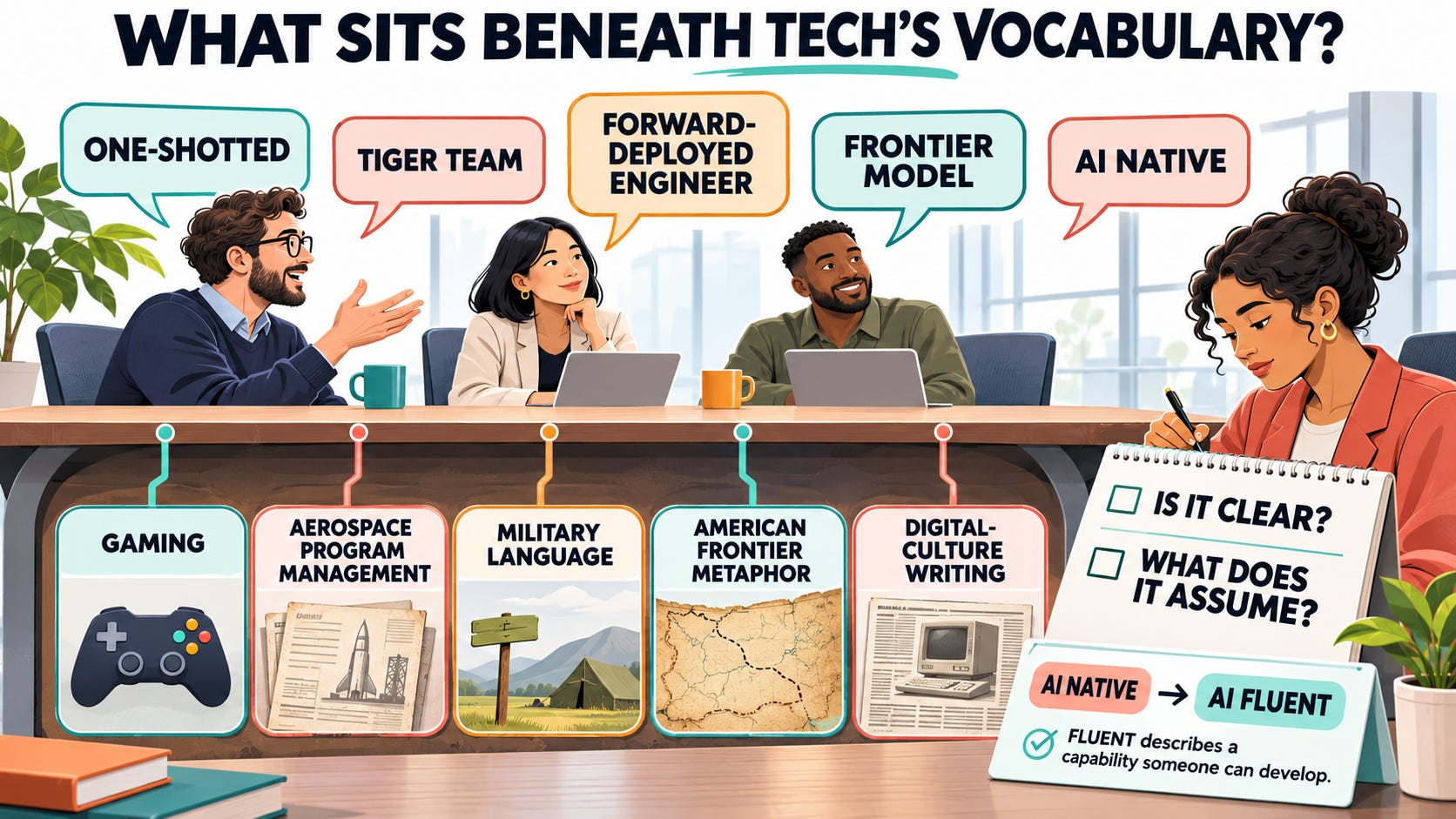
Michaelis argues that these AI vocabulary words carry assumptions about who belongs in tech (and who doesn’t). She isn’t claiming the words cause the gaps she describes in AI hiring and use, though she suspects they don’t help. She also points to women whose work shaped computing and went unrecognized. Six women programmed the Electronic Numerical Integrator and Computer (ENIAC), and they weren’t introduced at the machine’s public unveiling in 1946. Fei-Fei Li was first author of a 2006 paper on one-shot learning, which Michaelis credits with putting the idea on the AI map.
I advocate for inclusive language and worked on a chapter about it for an upcoming book on plain language in business. One plain-language question is whether readers can understand a term. Michaelis’s essay adds a second: what does the term assume about its reader? A term can be clear and still suggest who belongs.
We tech writers choose product terms, so the second question applies to our work too. Michaelis suggests “fluent” in place of “native”: a skill people develop, rather than an identity some people are presumed to have.
Terminology reviews should ask both questions:
1) Is this label clear, and
2) What does it assume about the person reading it?
Read Michaelis’s full post, and share it with someone who names or reviews product language. 🤠