

I recently reviewed a support topic published by SimpliSafe that attempts to explain how customers can update their home security system firmware. At first glance, the topic seems perfectly reasonable. The writing is clear and concise. A human reader can probably complete the update process without much trouble.
That’s what makes the example a useful teaching aid for tech writers looking to make the tech docs content easier for AI answer engines to process.
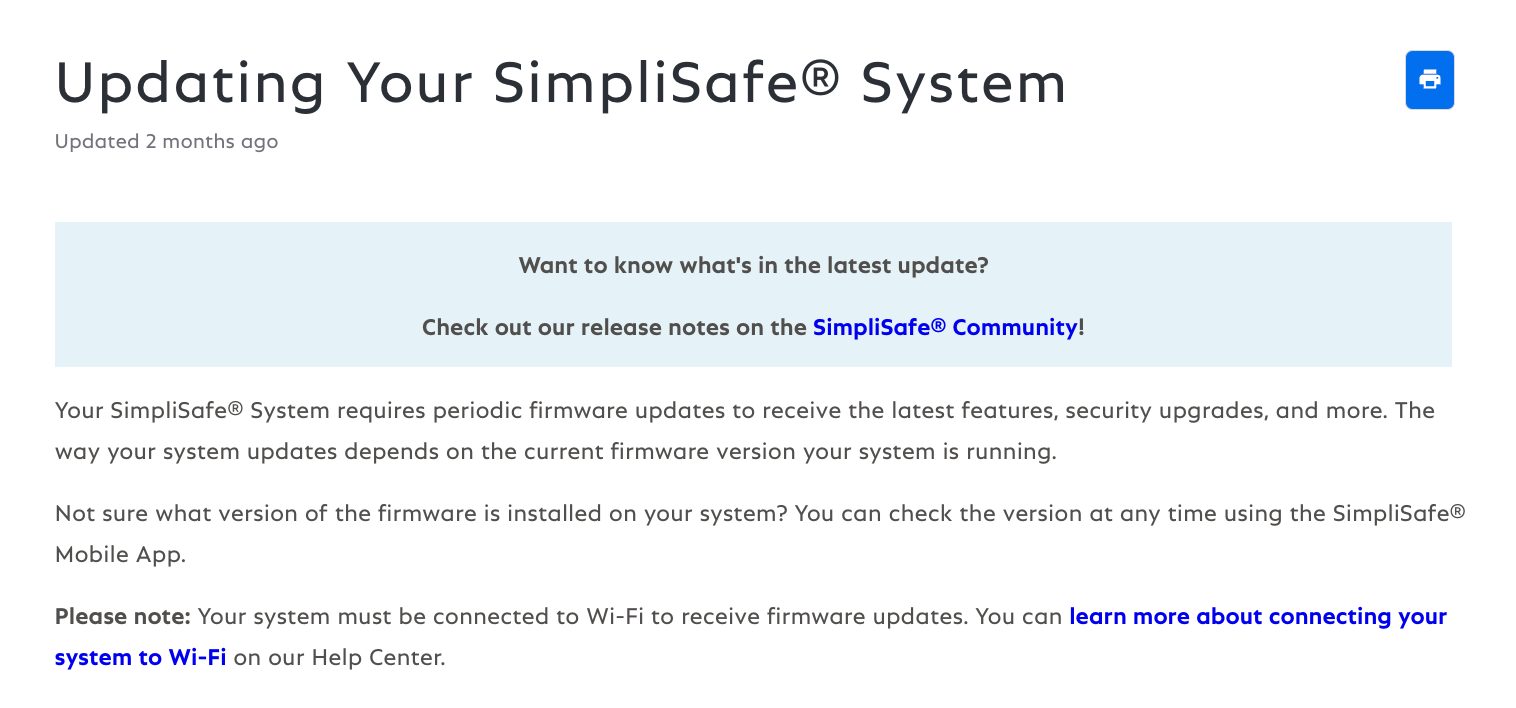
The topic highlights a growing problem in tech docs — content that works adequately for humans can still be highly ambiguous when AIs consume it.
Humans are remarkably good at filling in missing context. We infer relationships automatically, and we assume causality. We understand implied actors and unstated conditions because we’ve spent our entire lives navigating incomplete communication.
AI systems don’t actually “understand” any of those relationships. In lieu of understanding, they infer them probabilistically. That distinction matters.
The SimpliSafe topic contains several examples where operational context is implied instead of modeled explicitly. Those gaps create opportunities for retrieval errors, procedural confusion, and AI hallucinations.
The original topic is here: SimpliSafe: Updating Your SimpliSafe System
I evaluated the topic using TRACE, a framework I’ve been developing to identify contextual signals AI systems need in order to generate reliable answers.
TRACE looks for:
Tasks
Roles
Actors
Conditions
Events
The goal isn’t to make documentation sound robotic. It’s to reduce ambiguity by making operational context explicit enough that AI systems don’t have to guess.
Here’s where the topic begins to break down.
1. The Actor Is Implied Instead of Explicit
The documentation states:
“Updates will occur automatically after you disarm your system.”
That sounds fine to a human. But who performs the update?
👉🏾 The cloud service?
👉🏾 The Base Station? The mobile app?
👉🏾 The keypad firmware manager?
The actor is missing from the instructions. Often, humans will attempt to infer the answer. AI systems often will invent one.
Before
“Updates will occur automatically after you disarm your system.”
After
“The SimpliSafe Base Station automatically installs firmware updates after the homeowner disarms the security system.”
The revised version explicitly identifies the:
👉🏾 actor performing the update
👉🏾 human role involved
👉🏾 triggering condition
That reduces inference dramatically.
2. Conditions Are Mentioned But Not Modeled
The topic references Bluetooth requirements in prose:
“You’ll need to make sure Bluetooth is enabled…”
That sentence contains a critical operational dependency, but it’s buried conversationally instead of treated as a formal condition. AI systems frequently miss this kind of implied prerequisite during retrieval and summarization.
Before
“You’ll need to make sure Bluetooth is enabled…”
After
Required Conditions
Bluetooth enabled on the mobile device
User located within Bluetooth range of the Smart Lock
Smart Lock battery above minimum operating threshold
Internet connectivity available
This structure makes operational dependencies explicit and machine-readable.
3. Triggering Events Appear In Prose Instead Of As State Changes
The topic explains that updates occur after disarming the system, but it never explicitly models the state transition itself.
That matters because AI systems often flatten event sequences into vague summaries.
Before
“Updates will occur automatically after you disarm your system.”
After
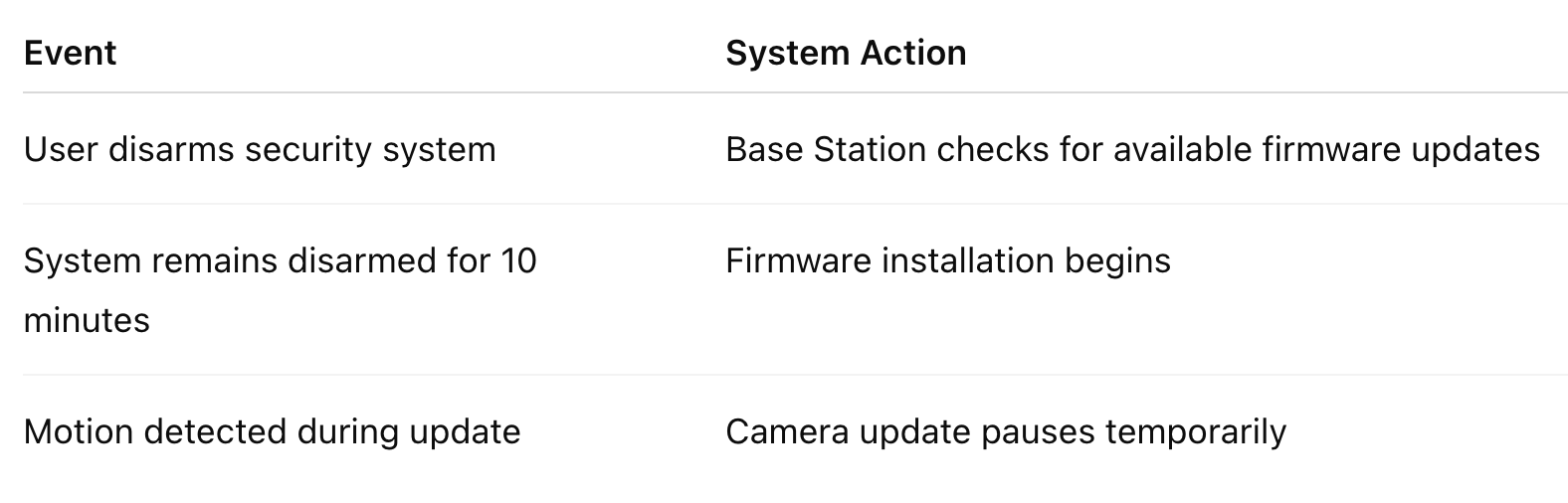
This version identifies:
the triggering event
the resulting system behavior
the operational sequence
That’s much easier for retrieval systems and LLMs to interpret correctly.
4. Process Boundaries Blur Together
The topic mixes:
Base Station updates
Smart Lock updates
camera updates
troubleshooting
firmware behavior
into one broad workflow.
Humans can usually untangle this. AI chunking systems often cannot.
That increases the likelihood of retrieval contamination where instructions for one device or process get incorrectly applied to another.
Before
One large topic covering multiple update workflows.
After
Separate topics:
Updating the Base Station Firmware
Updating Smart Lock Firmware
Updating Camera Firmware
Troubleshooting Failed Firmware Updates
Each topic should define:
actors
triggering events
required conditions
expected outcomes
failure states
This creates cleaner semantic boundaries for both humans and AI systems.
5. Failure States Collapse Into Generic Troubleshooting Language
The topic says:
“If your system fails to update…”
But that phrase hides multiple distinct failure conditions:
firmware download failure
interrupted installation
unsupported firmware version
connectivity timeout
Bluetooth pairing failure
device synchronization problems
Humans may eventually figure out the difference.
AI systems frequently collapse all of those into generic troubleshooting advice because the documentation never differentiates them clearly.
Before
“If your system fails to update…”
After
Firmware Download Failure
Occurs when the Base Station cannot retrieve the update package from the SimpliSafe update service.
Installation Timeout
Occurs when firmware installation exceeds the allowed completion window.
Bluetooth Pairing Failure
Occurs when the mobile device cannot establish a Bluetooth connection with the Smart Lock.
Connectivity Interruption
Occurs when Wi-Fi connectivity is lost during firmware download or installation.
Now the system can distinguish between failure states instead of treating “update failed” as one ambiguous condition.
The Important Thing Here Isn’t That The Documentation Is “Bad”
It isn’t. The topic is fairly typical support documentation. Most tech writers would recognize the style immediately. Many customers probably complete the process successfully.
That’s exactly why this example matters. The docs were written for human interpretation, not AI retrieval and generation.
Humans tolerate implied context extremely well. AI systems don’t. When operational relationships remain unstated, large language models compensate probabilistically.
That’s where hallucinations often begin:
👉🏾 assigning actions to the wrong actor
👉🏾 merging unrelated workflows
👉🏾 skipping conditions
👉🏾 flattening event sequences
👉🏾 inventing causal relationships
The industry keeps talking about “AI-ready content” as if structure alone solves the problem. It doesn’t.
A DITA topic can be perfectly valid XML — see Well-formed XML — while still omitting the operational context AI systems need to generate reliable answers.
That’s the problem I’m working to expose. 🤠