

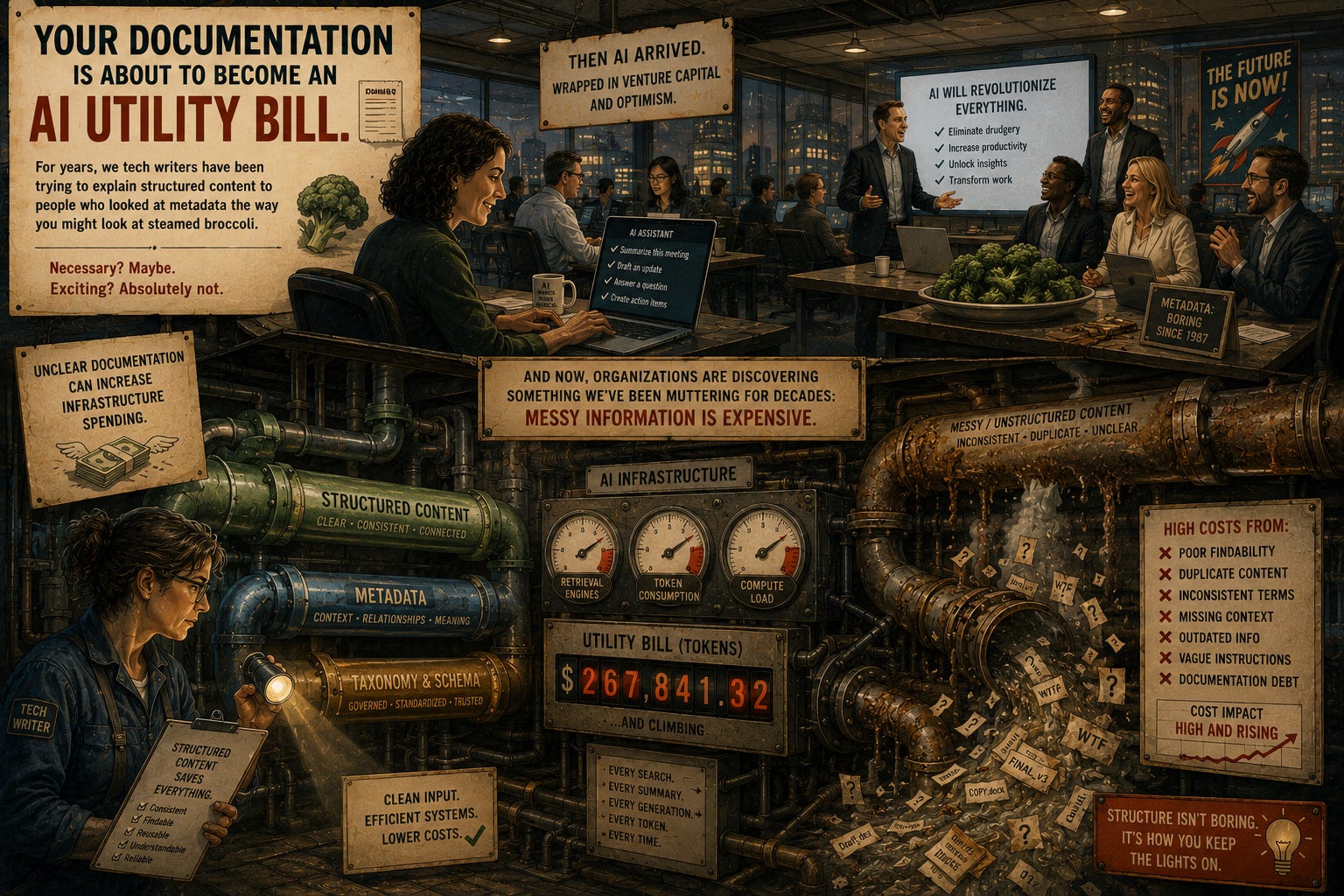
Content ambiguity can increase AI operating costs because AI systems often have to work to retrieve and process more information when important context is missing or unclear. As organizations begin measuring AI costs and consumption more closely, content design decisions may become part of the cost conversation.
Most discussions about AI costs focus on language models. That’s understandable. Models have names, rankings, benchmarks, pricing pages, and marketing campaigns.
Content gets far less attention. That’s surprising because AI systems spend much of their time looking for information before they generate an answer.
That distinction becomes more important as organizations move beyond experimentation and begin deploying AI-powered support systems, internal assistants, knowledge portals, and agentic search experiences at scale.
Stripe, the online payments company that processes transactions for millions of businesses, recently caught my attention for exactly that reason. The company announced AI usage billing, a capability that charges customers in proportion to what they consume (e.g., tokens processed, compute seconds, API calls, agent actions) rather than a flat fee.
The announcement wasn’t about model quality. It was about consumption. How many tokens were used? Which application consumed them? How should those costs be allocated? How should they be recovered? By whom?
Once organizations can see AI consumption, they’re eventually going to ask why some AI-powered experiences cost more to operate than others. In many cases, part of the answer may be the content itself.
Why Does Content Ambiguity Increase AI Costs?
AI systems often consume more resources when documentation leaves important context unstated.
Tech writers have always worried about ambiguity because it frustrates readers. AI systems introduce another reason to care.
Suppose a procedure says:
“Approve the request after validation completes.”
Most people working in that environment can probably figure out what’s happening. They know who performs the approval and they understand what validation means. They probably know what event signals validation completion.
AI systems don’t share that background knowledge.
If the role, condition, or triggering event isn’t documented, the AI system often searches for that information elsewhere. As documentation repositories grow, those searches become more expensive. The answer may already exist, but the system may retrieve multiple documents, compare competing explanations, and evaluate additional context before it can decide which information to use.
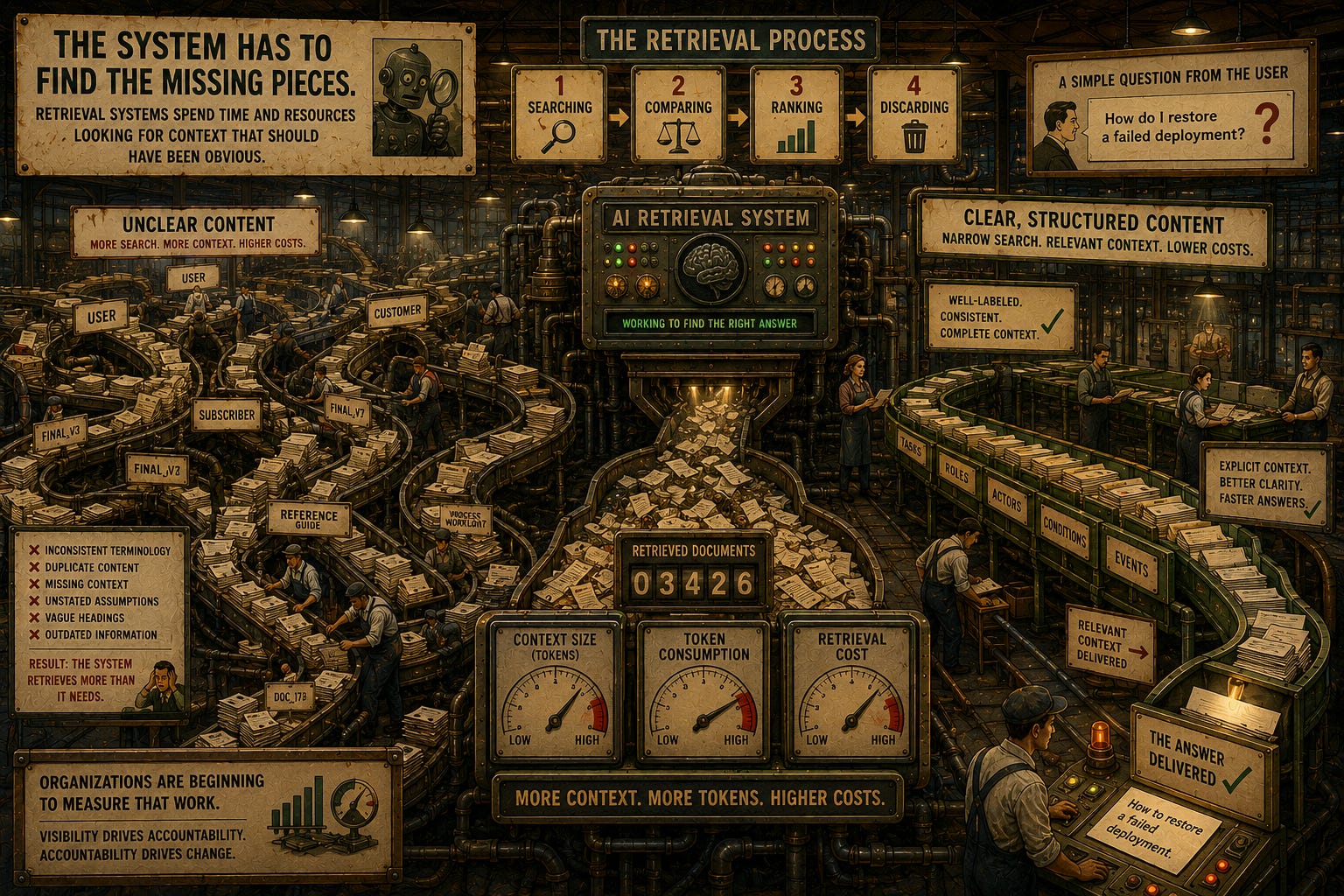
The System Has To Find The Missing Pieces
Retrieval systems often compensate for unclear content by pulling more information into the decision-making process.
Many organizations assume AI works like a very fast employee who already knows where everything is. In reality, AI systems spend a surprising amount of time searching, comparing, ranking, and evaluating information before generating an answer.
A user asks a simple question. The retrieval system may pull multiple documents, compare overlapping explanations, evaluate terminology, identify the most likely workflow, and discard information that appears unrelated.
When our documentation is clear, the search narrows quickly. But, when our content contains inconsistent terminology, undocumented assumptions, duplicate information, or missing workflow context, the system often retrieves more material than it otherwise would.
Organizations are beginning to measure that work.
What Does TRACE Have To Do With It?
TRACE helps expose context that AI systems often spend time trying to infer.
TRACE stands for Tasks, Roles, Actors, Conditions, and Events. The framework grew out of an observation I’ve encountered repeatedly in documentation reviews: many problems aren’t caused by missing information. They’re caused by missing context.
👉🏾 The task is described, but nobody identifies the role responsible for it.
👉🏾 The workflow is documented, but the triggering event isn’t.
👉🏾 The actor changes halfway through the process without being identified.
👉🏾 The conditions that determine success or failure exist only as assumptions.
Human readers often work around those gaps because they already understand the environment.
TRACE became interesting to me because it highlights exactly the information retrieval systems often go looking for. When tasks, roles, actors, conditions, and events are explicit, the system has stronger clues about what a topic is describing and how it relates to other topics.
Technical Documentation Has Entered the Cost Conversation
Organizations that measure AI consumption may eventually discover that content quality influences operating costs. 💰
For years, tech writers justified structured content using familiar arguments around reuse, consistency, metadata, governance, localization, and maintainability. Those arguments still hold up today.
What’s changing is the audience for the discussion. As organizations start tracking AI consumption, content issues may begin appearing in conversations that previously focused on infrastructure, support operations, and technology spending.
We’ve spent years cleaning up duplicate content, arguing about terminology, and chasing down missing workflow details. Those activities may sound unrelated to AI operating costs. They probably aren't.
Those same issues may also increase the amount of work AI systems perform before it can answer a question.
Five years ago, most conversations about structured content focused on publishing efficiency, governance, and reuse. AI may pull the discussion into a different part of the organization, the people responsible for operating budgets.
Why Tech Writers Should Pay Attention
Organizations are building AI systems on top of documentation repositories, knowledge bases, support portals, and content collections that were never designed for machine consumption. Some of those systems will work remarkably well. Others will consume more resources than expected because the underlying content requires constant interpretation.
We’ve been talking about context, consistency, terminology, and structure for years. If organizations begin tracking AI consumption the way they track cloud spending, those conversations may start happening in different meetings with different stakeholders. 🤠
For years, we tech writers have been trying to explain structured content to people who looked at metadata the way you might look at steamed broccoli. 🥦
Necessary? Maybe. Exciting? Absolutely Not.
Then AI arrived, wrapped in venture capital and optimism, promising to revolutionize the way we work and eliminate our drudgery.
And now, suddenly, organizations are discovering something painful we tech writers have been muttering for decades: Messy information is expensive. 💰
Welcome to the strange new world where unclear docs and inconsistent product information can increase infrastructure spending.
Tokens: The Invoices Nobody Talks About
Let’s start with tokens because the AI industry throws the word around as though everybody understands it.
A token is basically a chunk of language an AI model processes. Not exactly a word. They’re more like fragments of words, punctuation, symbols, spacing, and linguistic bits the model consumes while reading and writing.
Every time an AI system:
reads a prompt
retrieves documentation
processes instructions
accesses a service
searches for references
remembers conversation history
generates a response
…it consumes tokens. And tokens cost money. 💴
At small scale, the costs feel trivial. A chatbot rewrites our awkward email message. A support assistant summarizes a customer support case. Somebody in marketing asks AI to “make this sound more dynamic” and receives three paragraphs that sound like a regional bank trying to flirt.
No big deal, right?
But organizations aren’t deploying AI for one interaction. They’re deploying it everywhere for all sorts of reasons.
Customer support
Internal search
Knowledge retrieval
Workflow automation
Developer assistance
Sales enablement
Training systems
Agentic orchestration
That’s where the meter starts spinning.
Related reading: AI can cost more than human workers now

AI Doesn’t Understand Our Documentation
This is important. AI models don’t “understand” our content the way humans do.
Humans are remarkably forgiving creatures. We can infer meaning from terrible prose, missing context, vague terminology, and screenshots that look like they were captured during a small electrical fire 🔥.
AI systems aren’t really understanding anything (in the human sense). They’re processing statistical language patterns and attempting to assemble probable meaning.
Which means ambiguity creates work. And work creates token consumption.
Suppose a user asks:
“How do I restore a failed deployment?”
Now imagine the AI retrieves:
six overlapping procedures
two outdated workflows
contradictory terminology
troubleshooting mixed into conceptual overviews
outdated screenshots from 2019
a release note pretending to be task guidance
an unlabeled warning block that reads like a hostage note
The system now has to process all that material trying to determine what’s actually relevant.
💰 Costs start to rack up quickly.
Retrieval of data costs tokens. Ranking what it found and reasoning across it costs more. Generating an answer adds — you guessed it — more expense.
Then the agent may decide it’s uncertain and retrieve even more content.
Because your documentation repository has become the informational equivalent of a kitchen junk drawer filled with expired coupons, tangled charger cables, mystery batteries, and three keys nobody recognizes but nobody dares throw away.
Agentic AI Makes the Problem Worse
Traditional chatbots were comparatively simple. They answered a question and moved on with their lives.
Agentic AI systems are different.
These systems often:
interpret intent
reformulate questions
retrieve multiple content chunks
compare sources
invoke tools
summarize results
validate outputs
retry retrieval
generate next actions
Every step burns tokens.
And the less explicit your documentation is, the harder those systems must work.
This is where technical writers should become deeply interested in the economics of ambiguity.
Because the AI industry increasingly profits from uncertainty.
The more your content forces AI systems to infer meaning, the more compute gets consumed.
And now companies like Stripe are openly building systems to meter, monitor, bill, and even profit from AI consumption costs.
That’s not science fiction anymore. That’s accounting.
https://techcrunch.com/2026/03/02/stripe-wants-to-turn-your-ai-costs-into-a-profit-center/
The AI industry is quietly transforming tokens into a utility model.
Like electricity.
Or water.
Or those suspicious resort fees hotels add while pretending the hallway Wi-Fi is a luxury experience.
This Is Why Structured Content Matters Again
Technical writers have spent years talking about:
reuse
taxonomy
metadata
controlled language
modularity
governance
Usually while someone from another department asks whether we can “just put it in Confluence.”
Now AI has accidentally made all those conversations financially relevant.
Structured content reduces retrieval waste.
Clear topic types help AI systems distinguish between:
tasks
concepts
references
troubleshooting
policies
Consistent terminology reduces ambiguity.
Metadata narrows retrieval scope.
Reuse reduces duplicate processing.
Governance improves precision.
The goal is no longer just helping humans find information.
The goal is helping AI retrieve the smallest amount of information necessary to generate a reliable answer.
That’s token efficiency.
And token efficiency is becoming operational cost control.
PREA Makes AI Work Less
This is where PREA becomes especially interesting.
DITA already gives organizations structural consistency. But structure alone doesn’t always expose operational meaning clearly enough for AI systems.
A topic can validate perfectly while still leaving important relationships implicit.
PREA — Process, Role, Event, Actor — helps make those relationships explicit.
Instead of forcing AI systems to infer:
who performs an action
what triggers a workflow
which actor changes a system state
when a process starts or ends
…the content tells the system directly.
That matters enormously in agentic retrieval systems.
Without PREA, an AI may retrieve dozens of vaguely related chunks because it’s relying mostly on keyword overlap and statistical proximity.
With PREA-informed content, retrieval becomes narrower and more precise.
The AI reads less because the documentation says more.
That’s the magic.
Not magical in the “wizard sparks and unicorn tears” sense.
More like the deeply satisfying magic of finally labeling storage bins in the garage after years of opening random boxes looking for extension cords.
Every Vague Heading Creates a Tiny AI Tax
This may sound dramatic, but it’s true.
Every ambiguous title.
Every duplicated procedure.
Every overloaded topic.
Every inconsistent term.
Every undocumented workflow transition.
Every “Important Information About Setup” heading quietly increases computational effort.
One isolated retrieval operation costs almost nothing.
Millions of retrieval operations across thousands of users become a budget discussion.
And organizations are going to start noticing.
Especially once finance departments realize AI systems don’t merely consume software licenses.
They consume language.
Technical Writers Are Quietly Becoming Infrastructure People
Nobody entered technical communication dreaming of optimizing inference efficiency.
Yet here we are.
The role is changing.
Technical writers are no longer just producing documentation for human readers.
We’re increasingly designing information environments for machine consumption too.
That means our choices affect:
retrieval precision
context size
inference efficiency
hallucination risk
orchestration overhead
operational AI costs
Which is honestly a bizarre career development.
Somewhere in 1998, a technical writer was carefully adjusting bullet indentation in Microsoft Word while eating yogurt from a desk drawer and worrying about printer drivers.
That person probably didn’t imagine future writers would one day influence enterprise AI infrastructure economics.
And yet.
Here we are.
Because in the age of agentic AI, content isn’t merely communication anymore.
It’s fuel.
And fuel costs money.
Good point, and it's something we've run into directly.
A bad output doesn't always mean the model got it wrong, most of the time it's garbage in, garbage out. We've been training our employees to use AI with that in mind. Juniors bring the speed and the comfort with AI tools, but we pair them with seniors who bring the experience, so someone's actually checking whether the result makes sense before it goes anywhere.