

By Scott Abel, The Content Wrangler
If you’ve spent the last two years working to convince executives that generative artificial intelligence (genAI) is not a magical oracle that can decode your company’s content chaos into helpful customer experiences, congratulations — you’ve already glimpsed the future that the newly formed Kinetic Council is preparing us for.
Of course, artificial intelligence (AI) isn’t the problem. The problem is that we’re feeding AI systems content the way a toddler feeds a DVD player — shoving in whatever fits and hoping something delightful happens.
Instead, we get mishaps, hallucinations, compliance failures, broken customer journeys, and outputs that read like the chatbot is having an existential crisis.
AI augmentation (think adding semantic metadata) and structural transformation aren’t “nice to have” any longer. They are the cost of entry for intelligent experiences.
And the savvy pros who know how to build this foundation — content strategists, technical writers, data modelers, taxonomists, ontologists — are suddenly more essential than ever. So essential, in fact, that they just got a new professional home.
Enter the Kinetic Council, a freshly minted 501(c)(3) nonprofit built for this moment of upheaval, transformation, and (dare we say) opportunity. Think of it as the guild for the era of intelligent systems. A place where the people who design, structure, model, and operationalize knowledge can build the future together instead of quietly fixing everyone else’s messes from the shadows.
A Professional Landscape in Freefall
The Kinetic Council didn’t appear because someone thought, “What the world really needs is another association.” It appeared because the institutions that once served knowledge professionals collapsed. The Society for Technical Communication (STC) — a foundational organization for more than 70 years — shut down. The Special Libraries Association also shuttered. Two pillars of the knowledge industry vanished just as AI reshaped everything about how knowledge distribution works.
As Cruce Saunders, the Council’s founder and chair, says, “The death of STC isn’t just an ending. It’s a signal that we’re ready for something new.”
For decades, content creators, data architects, and semantic specialists were treated like separate species who occasionally shared a conference hallway but rarely a strategic conversation. AI shattered that illusion.
Today, every functioning intelligent system depends on the convergence of these domains. Content professionals shape what humans need. Data professionals shape how information flows. Semantic professionals shape how concepts relate and how systems reason.
These worlds are no longer adjacent. They are — as Peter Morville of Semantic Studios declares — intertwingled.
We Need “Kinetic” Content Because Static Knowledge Doesn’t Power AI
The Council’s name reflects a foundational shift. Nothing is static anymore (not content, not data, not user intent, and certainly not the systems delivering knowledge). We’ve moved from publishing to orchestrating. From structured documents to continuously adapting knowledge flows. From managing information to engineering the substrate that AI relies upon to behave responsibly.
The Council expresses this as a “golden thread”: Human structured content → semantically enriched → powering intelligent AI systems
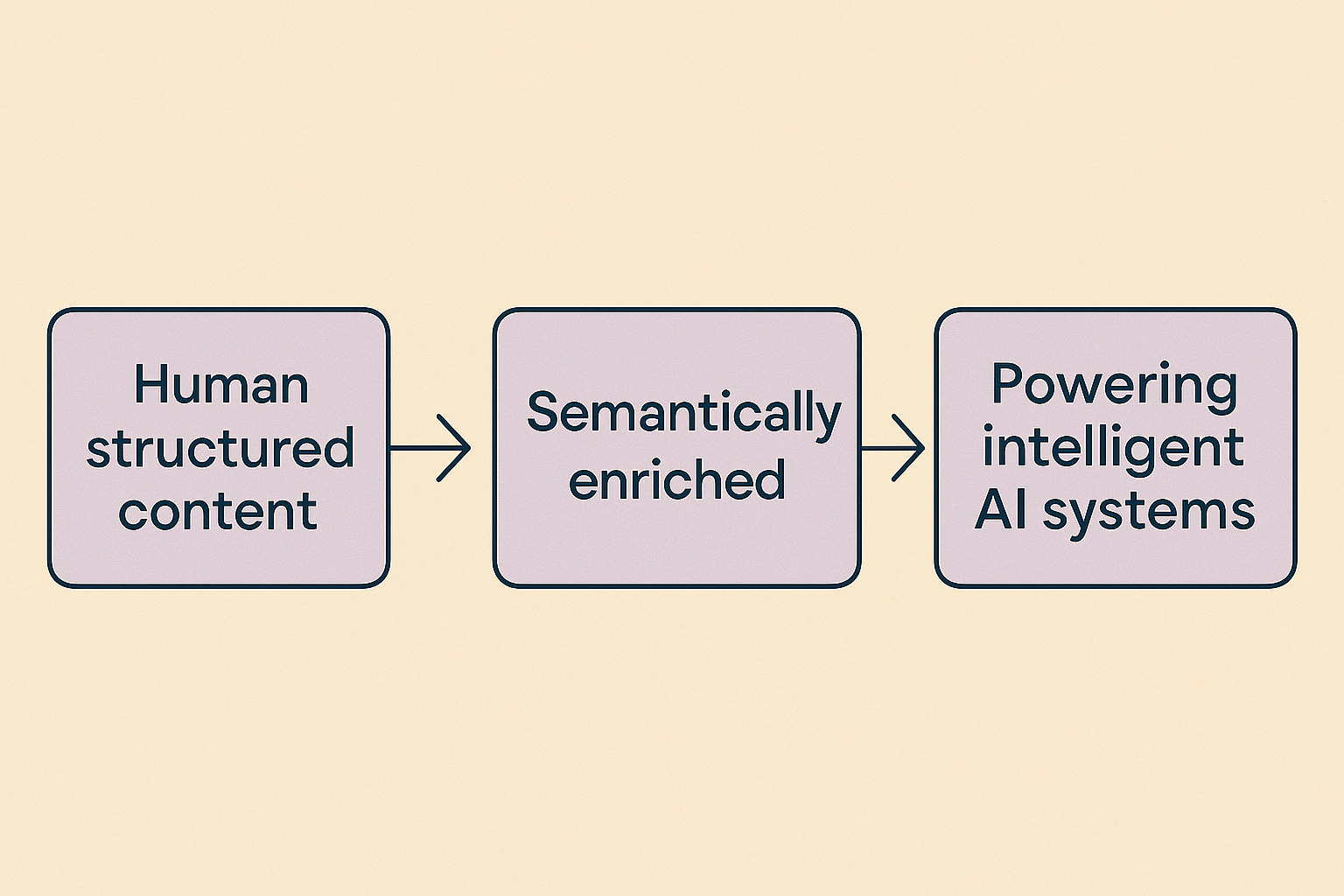
This isn’t poetry. It’s the architectural reality behind every AI system that actually works.
Why This Organization Is Needed Now
Three forces collided that made the Kinetic Council not just useful, but necessary.
1️⃣ The first is AI anxiety — a workplace epidemic that has left many professionals wondering whether automation will erase entire career paths. Despite the bold claims circulating in Silicon Valley, the idea that AI can replace the people who build, manage, and maintain the knowledge layer is fantasy.
AI is only as reliable as the structure and semantics that guide it. Without them, organizations simply scale risk faster.
2️⃣ The second is an enormous skills gap. Traditional educational pathways don’t prepare professionals to design knowledge graphs, orchestrate multi-agent workflows, or establish the governance frameworks needed to prevent AI systems from drifting into nonsense.
Most organizations don’t even know how to hire for these capabilities yet.
3️⃣T he third is the collapse of professional infrastructure. With STC gone, thousands of practitioners needed a place to gather, learn, collaborate, and evolve. The Kinetic Council stepped into that vacuum.
What the Kinetic Council Actually Is
The Council brings together professionals across content, data, and semantics — recognizing that these are no longer discrete career tracks but interdependent components of a single field. Its leadership includes long-standing figures in content, strategy, and semantic design: Deane Barker as president, Cruce Saunders as founder and chair, Hilary Marsh as secretary, Rahel Bailie guiding communications, and Larry Swanson shaping semantic and ontology frameworks.
It is, in effect, a professional big tent for those who architect knowledge systems.
A Certification for the Intelligent Era
One of the Council’s most significant contributions is the upcoming Knowledge Architecture Professional certification (launching in 2026 with Virginia Tech). It is intended for practitioners who already know how to structure content or model data and want to understand how those skills translate into AI-enabled knowledge systems.
The program introduces kinetic information concepts, schema and content model development, semantic layering, taxonomy and ontology work, and foundational knowledge graph design. A capstone integrates these components into a real-world challenge.
If you have ever found yourself explaining to a colleague that the reason a chatbot is hallucinating is because the system doesn’t understand the distinction between a concept, a component, and a configuration setting, you are already qualified for this curriculum.
Why CX, EX, DX, and Marketing Leaders Should Care
Leaders should care because customer experience is now mediated by AI in more ways than most organizations acknowledge. And AI, despite its fluency, is brittle. It depends not on clever prompts or model size but on well-structured, semantically rich, well-governed knowledge.
This is why the Kinetic Council’s mission matters so deeply to leaders in digital experience and customer experience. AI will not save you from your content debt. It will shine a spotlight on it. The foundation for trustworthy AI isn’t the model — it’s the knowledge architecture behind it.
Companies deploying AI without a semantic spine are discovering that you can scale hallucinations far more quickly than you can scale accuracy. The only safeguard is the people who understand structure, intent, governance, and meaning.
And those people now have a professional home.
The Future Role of Content Professionals
The Council isn’t preserving past identities. It’s articulating future ones.
Technical communicators and content strategists are no longer only creating content. They are designing the systems through which content becomes knowledge and knowledge becomes action. They are moving from producing artifacts to orchestrating ecosystems. From writing documents to mapping the logic that determines how AI decides what to generate, when to generate it, and why.
Saunders puts it this way: “We are not being displaced by AI. We are being called to guide AI toward serving human flourishing.”
That shift is already underway in organizations everywhere. The Council simply names it, formalizes it, and supports the people living it.
How To Participate
If you work in digital experience, customer experience, content design, or marketing, the shifts the Council is responding to are already shaping your work. Your systems are getting smarter (on good days) and more unpredictable (on most days). Your teams are hungry for clarity and guidance. And your content and data foundations are under unprecedented strain.
You can participate in several ways. You can join the Council’s community, contribute your own expertise, and collaborate with others who are defining best practices for AI-era knowledge work. You can explore the educational programs, mentor emerging practitioners, or advocate in your organization for the structural investments your AI initiatives truly require.
What matters most is taking part in shaping the profession that will define the next decade. The silos that dominated this landscape for 20 years are gone. A new, integrated field is emerging. And the Kinetic Council is the first organization building the infrastructure for it.
Be Part of Architecting What’s Next
AI is rewriting the landscape of digital experience, but it isn’t rewriting the laws of knowledge. Organizations that place structured content, semantic clarity, and knowledge architecture at the center of their AI strategies will define the next era of trustworthy, human-centered intelligent systems.
The Kinetic Council didn’t arise to preserve what was lost. It arose to architect what comes next.