

In the documentation field, technical communicators often use words like taxonomy, metadata, controlled vocabulary, and knowledge graph interchangeably. They are not the same thing.
An ontology sits above all of them.
If AI systems are now reading, interpreting, and speaking on behalf of our documentation, understanding what an ontology is—and what it is not—becomes essential.
A Plain-Language Definition of Ontology
In the context of technical documentation:
An ontology is a formal model that defines what things exist in our domain, what they mean, and how they are allowed to relate to one another.
It does not store content. It does not store prose. It defines meaning and rules.
Why “Meaning” Matters More Than Ever
Traditional doc systems assume a human reader. Humans infer meaning from context, tolerate inconsistency, and notice when something feels “off”.
AI systems do none of that reliably. They need meaning to be explicit, not implied; exactly what an ontology provides.
What An Ontology Actually Contains
In technical documentation, an ontology typically defines four things.
1. Concepts
The things that exist in your product and documentation universe.
Examples:
Product
Product version
Feature
Component
Task
Configuration
Warning
Error message
API endpoint
User role
An ontology answers: “What kinds of things are we allowed to talk about?”
2. Relationships
How those concepts connect to each other.
Examples:
Feature is part of Product
Task configures Feature
Warning applies to Task
Feature is deprecated in Version
An ontology answers: “How are these things allowed to relate?”
3. Constraints
Rules that prevent invalid combinations.
Examples:
This feature only applies to certain product versions
This task is only valid for admin users
This configuration is incompatible with another feature
This warning must appear whenever a specific condition exists
An ontology answers: “What must never be combined or inferred incorrectly?”
4. Terminology control
Shared understanding of language.
Examples:
Preferred terms vs. synonyms
Deprecated terms
Acronyms and expansions
An ontology answers: “When we say a word, what do we mean—and what do we not mean?”
Ontology vs. Taxonomy vs. Metadata
These are related, but not interchangeable.
Taxonomy
A taxonomy organizes things into hierarchies.
Example:
Product
Feature
Sub-feature
Taxonomies answer: “How do we group things?”
Metadata
Metadata describes individual content objects.
Example:
Product = X
Version = 4.2
Audience = Admin
Metadata answers: “What attributes does this piece of content have?”
Ontology
An ontology defines the rules behind both.
It answers:
What counts as a Product?
What is the difference between a Feature and a Configuration?
Can a Task apply to multiple Products?
When is something invalid, deprecated, or incompatible?
Without an ontology:
Taxonomies drift
Metadata becomes inconsistent
AI systems guess
Why Ontologies Matter Specifically For Technical Documentation
1. They prevent concept drift
Over time, teams start using the same word to mean different things.
Ontologies force alignment:
A feature is not a task
A task is not a concept
A version boundary is real, not optional
This clarity improves both human comprehension and AI accuracy.
2. They enable trustworthy AI answers
AI systems that rely on documentation increasingly use semantic retrieval and generation.
Without an ontology:
AI retrieves text that sounds relevant
Answers may combine incompatible concepts
With an ontology:
AI retrieves content that is conceptually valid
Constraints prevent nonsense answers
This is the foundation of ontology-grounded RAG.
3. They elevate the role of technical writers
Ontologies surface a truth many organizations ignore:
Documentation is not just content. It is a knowledge system.
Technical writers are uniquely qualified to:
Define concepts clearly
Establish boundaries and intent
Model relationships humans understand intuitively
Ontologies make that expertise visible and strategic.
See also: What Is Ontology-Grounded Retrieval-Augmented Generation?
What An Ontology Is Not
An ontology is not:
A style guide
A glossary (though it may reference one)
A CMS configuration
A single diagram created once and forgotten
An ontology is a living semantic contract between:
Content
Tools
AI systems
Humans
When Do You Need An Ontology?
You especially need an ontology if:
Your products are modular or platform-based
You support multiple versions simultaneously
You are building or buying AI assistants
Your documentation feeds chatbots or copilots
Consistency and trust matter
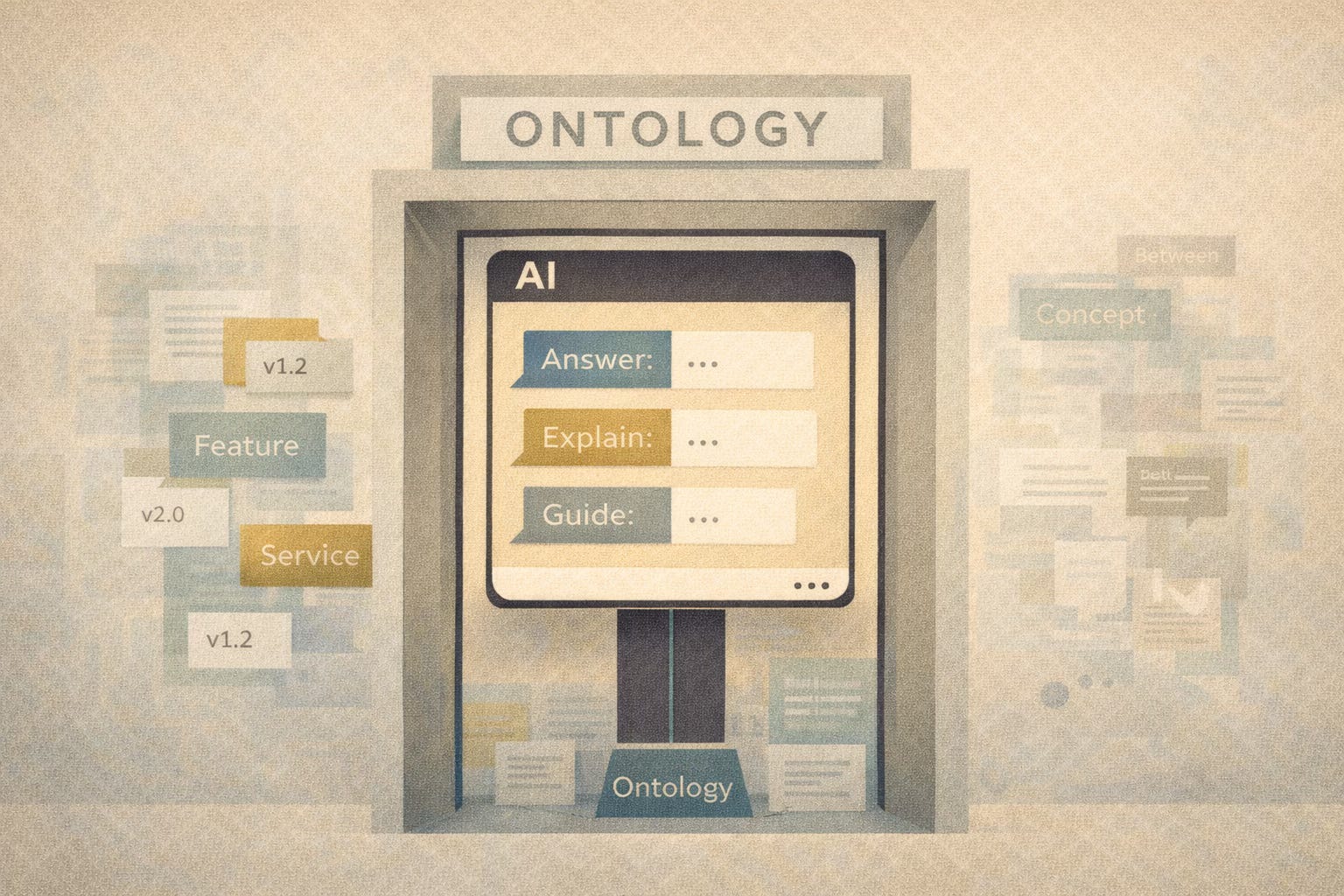
If AI is now the front door to our documentation, an ontology is the lock that keeps the wrong answers out.
The Takeaway For Tech Writers
In technical documentation, an ontology answers the hardest question of all:
“What does this actually mean — and what is it allowed to mean?”
Writers who help define and govern ontologies shape how:
Content is retrieved
Answers are generated
Products are understood
As AI becomes the voice of your documentation, ontologies decide whether that voice is informed — or improvising.
And improvisation is not a strategy. 🤠