The past two centuries represent an extraordinary leap in scientific discovery and technological innovation across virtually every domain of human endeavor. The preoccupation of scientists and researchers during that era was, understandably, to document and explain these phenomena (they were genuinely novel, and capturing them was paramount). This has always been the nature of knowledge: record it, explain it, and pass it on from one generation to the next.
But does our current era resemble that past? Should we continue producing the same kind of output: text-based documentation, mathematical equations, and static diagrams? At a minimum, perhaps things will proceed regardless.
Yet today, science and technological advancement are no longer external discoveries that arrive for the first time; they are embedded in the very fabric of society. We live and work within them. This growing familiarity changes the equation. When technical content continues to be delivered in the same mode that once served a world encountering these ideas for the first time, it inadvertently signals that the subject is still unfamiliar, still demanding, still requiring special mental preparation.
The Content Wrangler is a reader-supported publication. To receive new posts and support my work, consider becoming a free or paid subscriber.
This has practical consequences at several levels in education, training, and technical writing:
Comprehension without ownership: Someone can understand information perfectly well and still never feel like it’s really theirs. They may follow it, repeat it, even use it correctly, without ever feeling invited to build on it, question it, or do anything creative with it. Traditional technical content often does this by treating knowledge as something to hand over, not something to step into. Research on motivation and learning backs up the broader point: the way information is framed affects whether people feel agency, engagement, and room to think for themselves.
The psychological weight of the “technical” aesthetic: Technical content often looks like it expects you to brace yourself before you even start. Dense paragraphs, cramped tables, and diagram-heavy pages can signal, at a glance, that this is going to take work. That look alone can raise the mental cost of entry. The issue isn’t just style. Research on cognitive load shows that the way information is designed and presented affects how hard it is to process, and interface design research shows that presentation choices can either support thinking or make it harder.”
The non-technical stakeholder gap: Technical content is often built for the specialists in the room and then shown to everyone else as if that were good enough. It usually isn’t. Project managers, business leaders, and other non-technical stakeholders may catch the outline while missing the substance, which leaves them less able to challenge assumptions, spot risks, or contribute with confidence. Research supports the broader point that clearer, more accessible presentation helps people from different backgrounds understand complex material and participate more effectively in decisions.
A Different Framework: From Information Delivery To Experiential Communication
These three problems share a common root: they arise when technical content is designed as a delivery mechanism for information rather than as an experience that invites the reader in. Addressing this requires a shift in how we conceive the relationship between the reader and the material, from “information to be understood” to “information combined with emotional engagement.”
One promising approach toward this is what might be called 2D visual narrative storytelling in technical content. This encompasses both static 2D illustration and 2D animation as tools for the same communicative purpose.
This is not a replacement for conventional technical methods. Rather, it is a complementary layer: warm, simplified visual experiences that reach slightly beyond the purely technical function of the visual and connect the subject matter to the real-world context in which it exists.
Most technical subjects are physical and tangible (they involve real machines, real workers, real environments). Much of conventional technical documentation tends to abstract away that layer. Yet that contextual, human layer is precisely what enables people to construct a complete mental picture, not only of the technical subject, but of its meaning and relevance.
This falls broadly under what designers and communication researchers call the humanization of technology, a well-documented design principle concerned with reducing the cognitive and emotional distance between users and technical systems.
The Illustrative Principle: What Research Supports
Consider two examples that draw together several separately validated findings from the research literature, one using static illustration and one using 2D animation, each applying the same core principle.
Example One: Static 2D Illustration
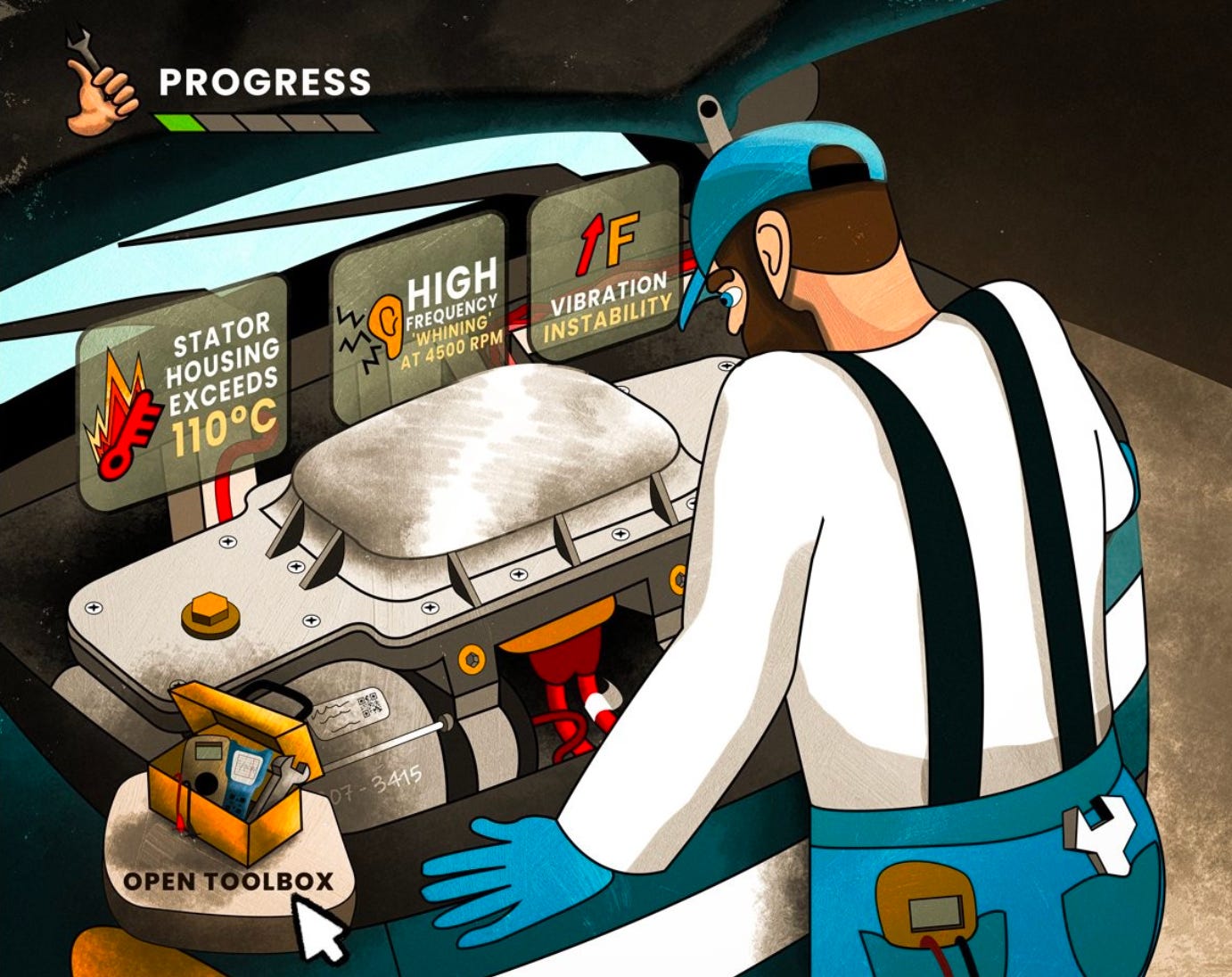
Rather than explaining a technical feature of an industrial machine through a 3D CAD model and data tables alone, imagine a 2D illustration that isolates the relevant component while fading surrounding parts into the background, places the machine within a recognizable industrial environment, and includes a human figure (a technician) positioned beside it in a contextually meaningful way, with clear technical annotations layered on top.
An illustration integrating the human element within a real engineering context, at the moment of initiating fault diagnosis.
Example Two: 2D Animation
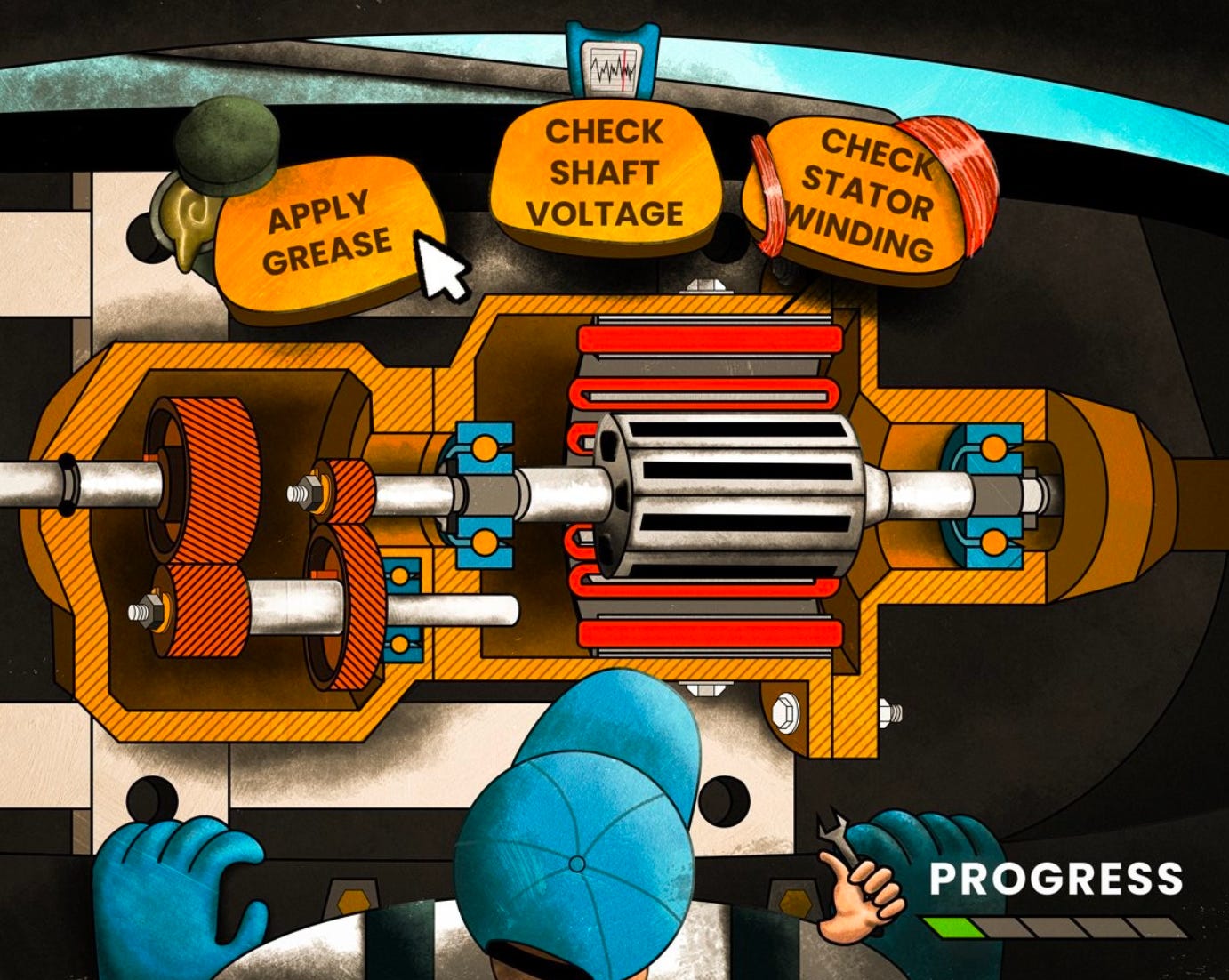
Consider a cutaway animation of an electric motor. A technician is shown inside the scene, replacing a component or diagnosing a fault. The animation is not merely instructional: the technician’s movements are deliberate and fluid, conveying a sense of confidence and mastery rather than confusion or mechanical routine.
The viewer watches someone who knows what they are doing, inside a system that is rendered transparent and comprehensible. The technical annotation appears at the right moment in the sequence, anchored to the action rather than floating in the abstract.
A frame from an interactive educational scene, showing the motor’s precise internal structure in a simplified style, with the technician in frame as they decide where to begin.
What Do Both Approaches Achieve, Compared To A Purely Abstract Technical Presentation
The answer, according to research across adjacent domains, is a qualitatively richer experience, supported by three distinct, research-validated mechanisms:
Narrative framing improves comprehension and efficiency: A 2024 study at the ACM CHI Conference found that data storytelling, combining visual elements with narrative structure, improved both the speed and effectiveness of comprehension tasks compared to conventional visualization alone.
Contextual and human elements reduce psychological distance:Research in human-centered design consistently shows that humanized interfaces and contextual framing reduce the cognitive load and sense of intimidation associated with unfamiliar technical material. Visual narratives in HCI have also been shown to democratize design processes and facilitate cross-cultural understanding in technical contexts.
Animation specifically supports self-efficacy and retention: Structured educational animations have been shown to improve not only knowledge acquisition and retention, but also learners’ self-efficacy, reducing the cognitive load associated with technical material and increasing the learner’s sense that the subject is within their reach. This is the precise psychological effect that the electric motor example above is designed to produce: not just understanding, but the felt sense of capability.
Emotional engagement strengthens memory encoding:Studies in visual narrative cognition confirm that narrative transport, meaning the process of being emotionally drawn into a visual story, produces stronger memory encoding and a greater sense of personal relevance.
These mechanisms (narrative framing, contextual humanization, animation-supported self-efficacy, and emotional engagement) have each been validated separately in the research literature. Their combination in the integrated format described above is a logical synthesis that awaits direct empirical testing as a unified intervention in technical documentation. This is a gap worth filling.
Why 2D Specifically?
The choice of two-dimensional illustration and animation over three-dimensional rendering is not arbitrary, though it is necessarily task-dependent. Research comparing 2D and 3D visualizations consistently finds that the optimal format depends on the nature of the task: for data interpretation and abstract comprehension, 2D representations tend to offer advantages in processing speed and accuracy; for spatial understanding of complex physical structures, 3D often performs better.
In the context of narrative illustration and conceptual communication (the primary purpose here), 2D’s simplicity, warmth, and accessibility make it a strong candidate. The absence of three-dimensional rendering complexity keeps cognitive attention focused on the subject and story, rather than on navigating a spatial model. This applies equally to static 2D illustration and to 2D animation: both formats use visual abstraction and deliberate hierarchy to direct attention, rather than overwhelming the viewer with realism.
Who Can Do This, and How?
Most tech writers are highly skilled at extracting what matters and expressing it precisely and clearly. Visual narrative in technical contexts, however, requires a dual competency: familiarity with both the technical domain and with visual communication, whether in the form of illustration or animation. In practice, this often calls for a collaborative team. It also opens a natural role for what might be called hybrid practitioners, that is, engineers or technical writers who have cultivated genuine visual skills alongside their technical expertise, and who can bring both to bear in producing content that is simultaneously rigorous and human.
This is not a common profile today, but it is an increasingly recognized one, reflected in growing fields like information design, data visualization, and UX writing. The emergence of these disciplines signals a broader recognition that technical clarity and human resonance are not in tension; they are complementary goals.
A Note On Practicality
Static 2D illustration will typically require more time than producing a standard CAD model or infographic, while 2D animation sits between static illustration and full 3D animation in terms of production time. The practical recommendation is therefore not to replace existing methods (which remain faster and well-suited to their purposes), but to integrate 2D visual narrative as a force multiplier: used selectively at key moments within a document’s or training module’s architecture to shift the reader’s relationship to the material. Even a small number of well-placed narrative illustrations or short animated sequences, embedded naturally within the flow of a document, can change the character of the experience from reception to recognition.
About the author:Mazen Alfaqi is a Mechatronics Engineer and a visual content creator in Cairo, Egypt specializing in bridging the gap between complex engineering and human experience through 2D visual storytelling and animation.