

For over twenty years, the Translation Automation User Society (TAUS) and the Localization World (LocWorld) conferences have invited me to participate. Both events usually took place in the same city within a few days of each other. So when I saw this press release announcing that they were joining forces to launch “Vancouver Localization Week,” my first thought was, “Finally.”
TAUS was founded by Jaap van der Meer. He’s the first person I remember telling me that translation would someday become ubiquitous. He meant it would eventually happen automatically, everywhere practical. You wouldn’t need to open an app or hire someone to translate words. Translation capability would be built into whatever you were using (tools, appliances, systems, automobiles, consumer electronics, medical devices — you get the picture).
Generative AI has made Jaap’s prediction feel less theoretical, which is why I’ve been noodling on this topic.
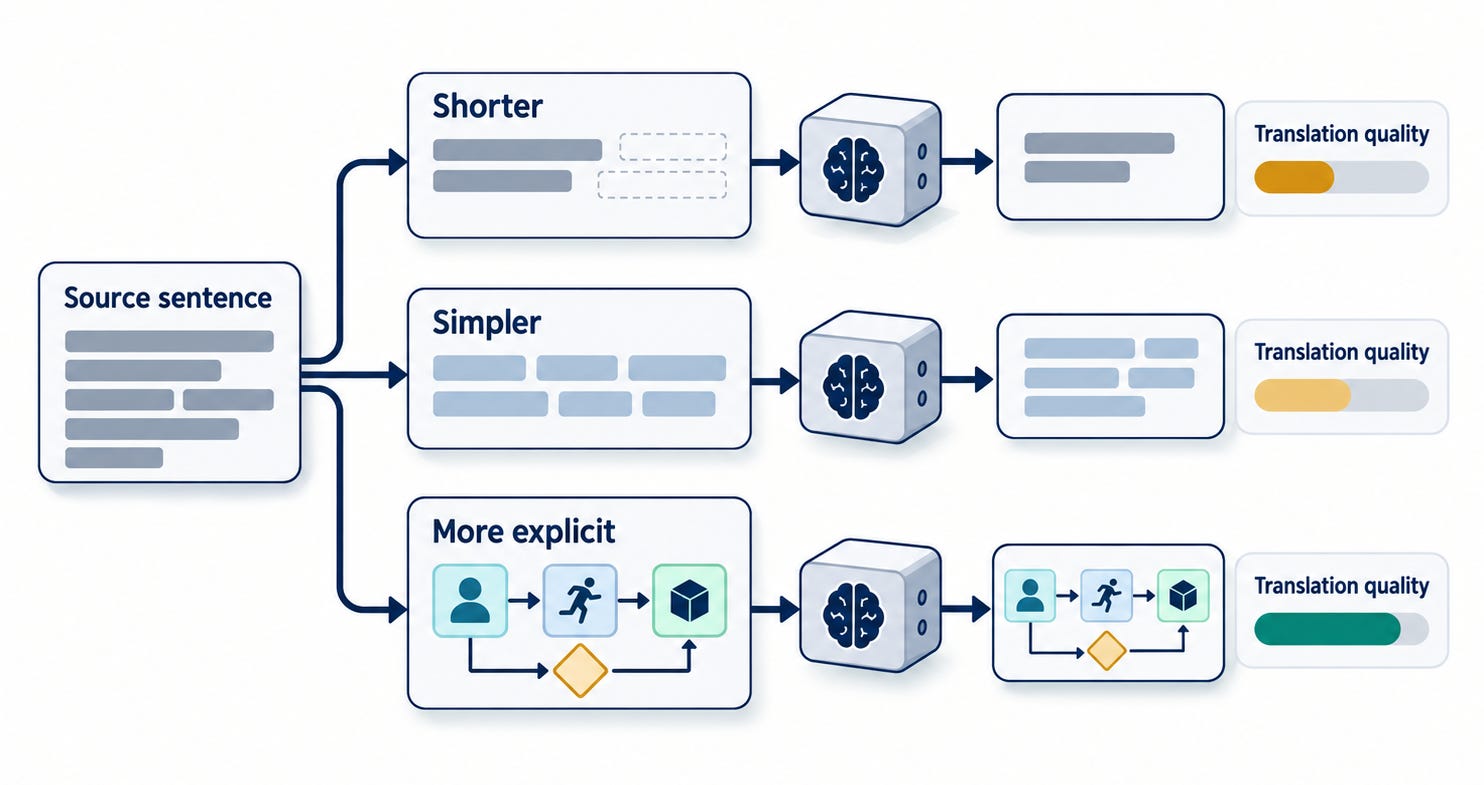
A 2021 study of neural machine translation pre-editing, by researchers Rei Miyata and Atsushi Fujita, found that making a source sentence’s meaning and structure more explicit improved translation quality more than making the sentence shorter or simpler.
The added explicit information isn’t always in prose itself. Translation systems can also gain insights from other sources (approved terminology lists, domain information, translation memory, document context, or other guidance) about how the source should be interpreted.
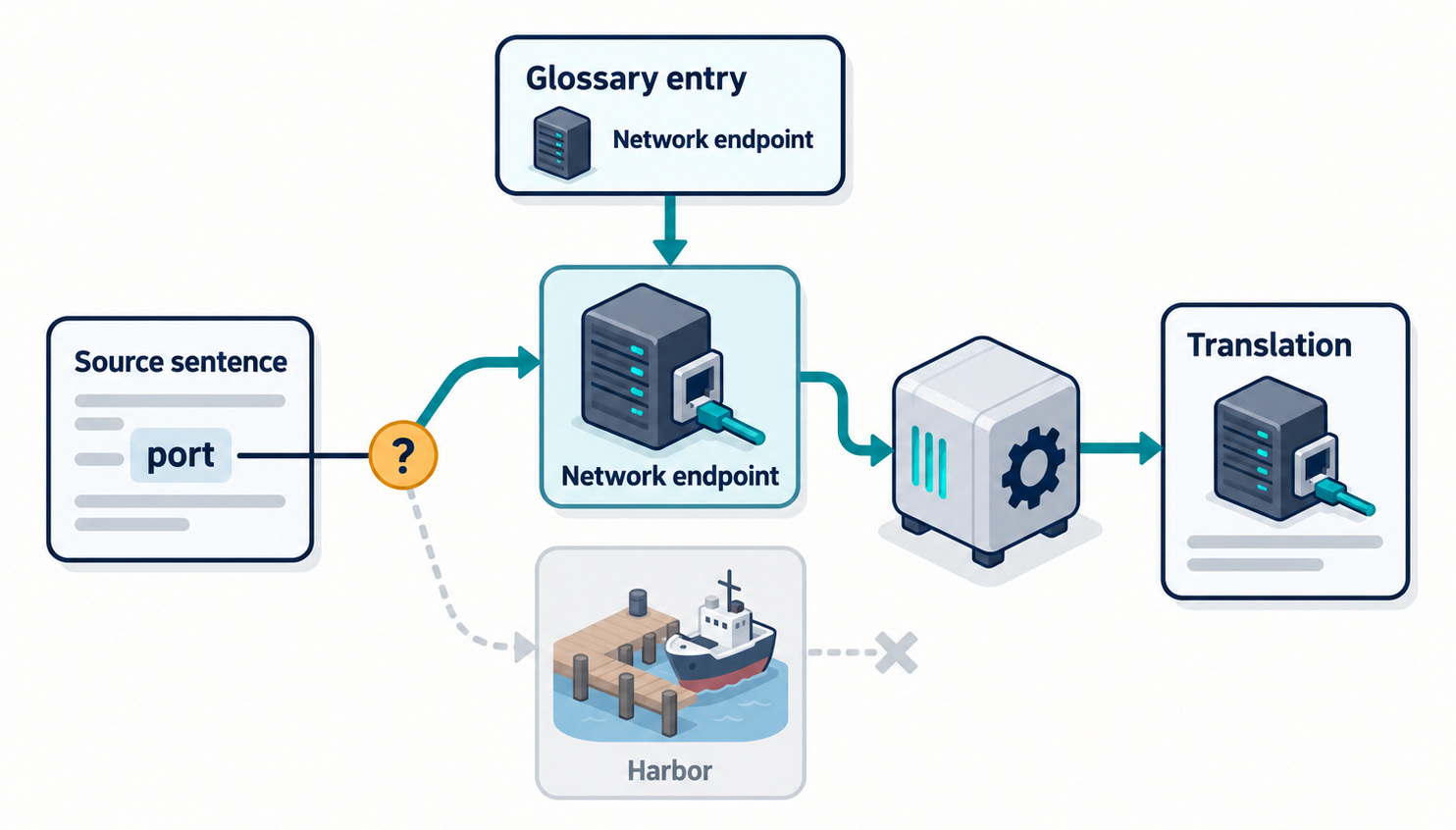
A glossary entry, for example, tells the system that “port” refers to a network endpoint rather than a waterside harbor; information the sentence being translated might not state explicitly.
Localization pros often work to discover this kind of missing information. Translators determine which product state applies, resolve an unclear reference, or check which term the company has approved for use. As more and more companies attempt to automate content translation and localization, it becomes increasingly useful to capture that context once and make it available to the automated systems that need it (instead of asking someone to reconstruct it every time.)
I saw an early version of this issue last year at LocWorld in Monterey, where I moderated two panels. The first one focused on using linguistic intelligence technologies to reduce localization cost in the era of AI, the other on the intersection of large language models and technical writing. Both discussions showcased the work that happens before translation begins. Things like source quality, terminology, context, and the decisions made while content is being created).
Problems Discovered During Localization Frequently Begin In The Source Content
Localization teams routinely encounter problems created before they start their work.
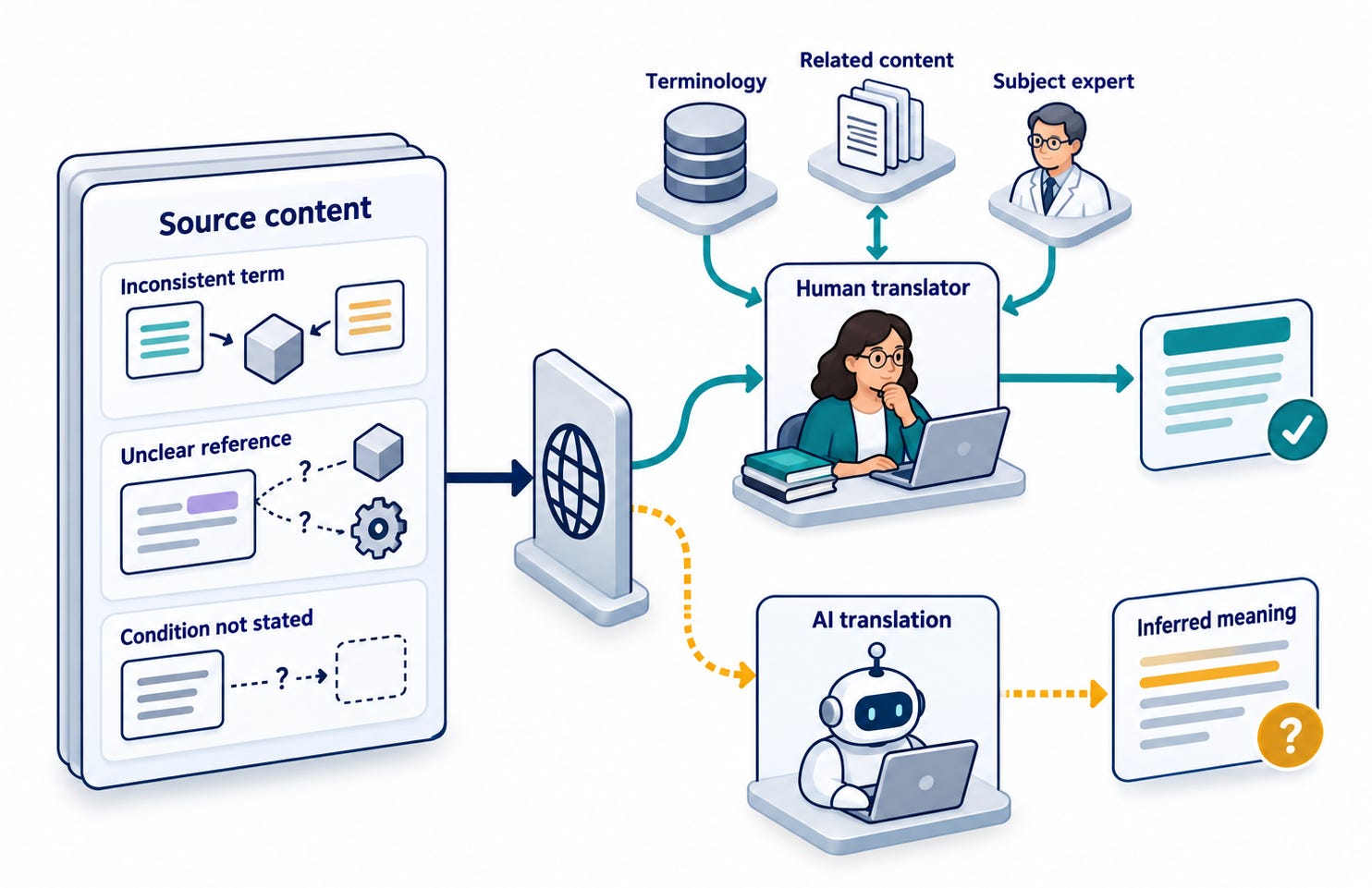
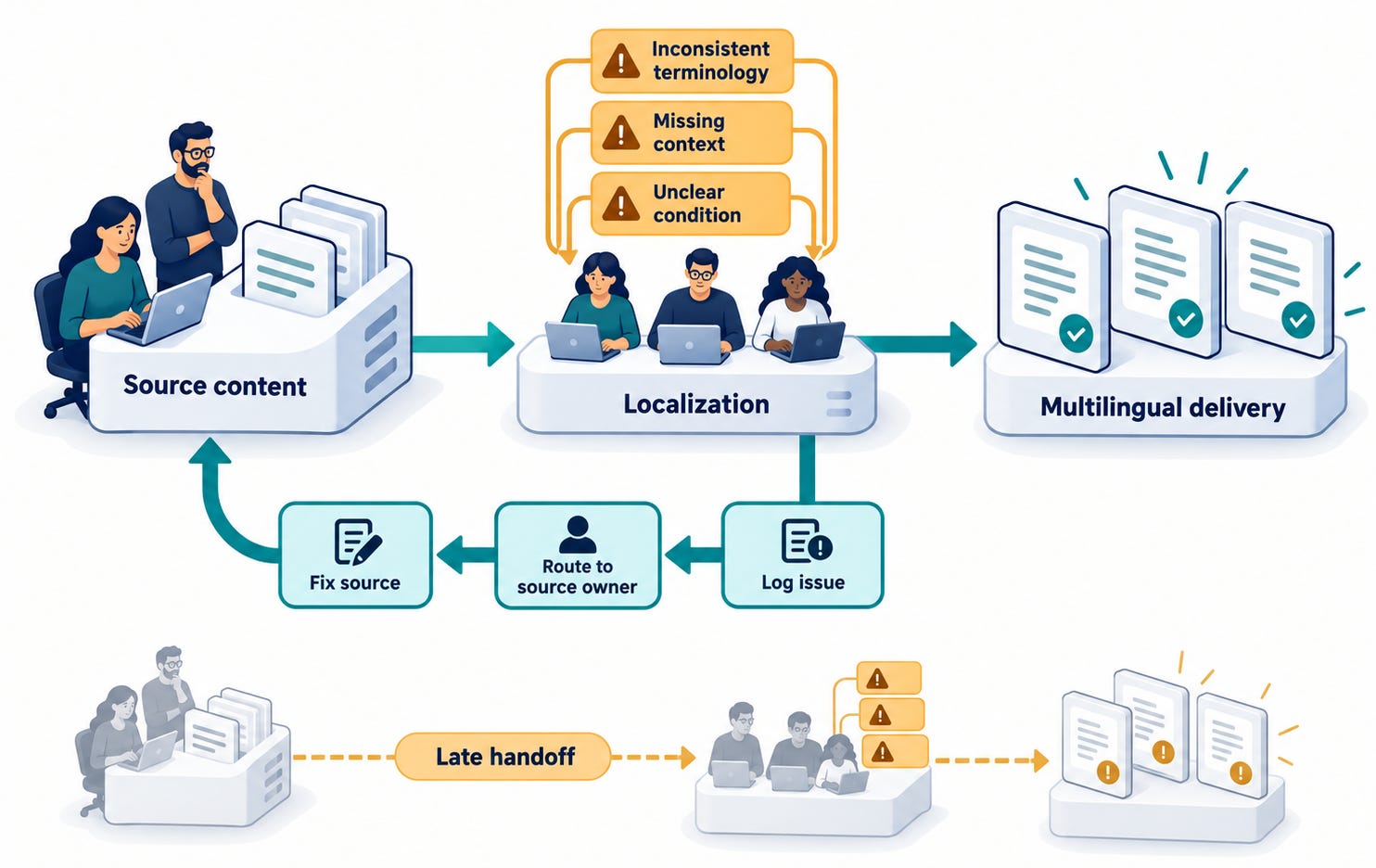
Inconsistent terminology. Sentences that depend on product knowledge that isn’t included in the content. For example, conditions may be implied rather than stated explicitly. Translators determine what pronouns refer to and whether or not a phrase we delivered to them has a specific technical meaning.
Experienced translators can often resolve these types of challenges using their deep experience. They do this by asking questions of the content, consulting terminology databases, comparing related content, or working with subject-matter experts.
AI systems don’t always have access to that additional knowledge. When a translation or answer-generation encounters the source content, it may have to infer what the writer left unstated. The accuracy and trustworthiness of the generated result depends partly on whether the system reaches the same interpretation a knowledgeable human translator would have.
Several sessions at LocWorld56 touch on this problem directly.
One examines how plain language and clearer source material affect AI-assisted translation.
Esri will describe using retrieval-augmented generation with translation memory, terminology, style guidance, and human feedback.
National Instruments will discuss whether years of existing technical documentation can support reliable AI-generated answers, including problems caused by fragmented content.
These may be localization-focused sessions, but they’re still of value to tech writers and much of the source material involved in these presentations is technical documentation.
Localization Teams Are Moving Upstream — Closer To The Source Content
Both programs also showcase how localization teams are positioning themselves to be involved earlier in the content lifecycle. At LocWorld, Life360 will describe moving localization upstream so the team can influence product decisions rather than receiving finished content after those decisions have been made. TAUS is examining related changes in translation technology, quality evaluation, and the systems used to manage multilingual content.
For tech writers, the interesting part is the feedback loop: if a localization team repeatedly has to clarify the same terminology, reconstruct missing context, or determine which condition applies, it has discovered something about the source documentation. That information can (and probably, maybe, definitely should) go back to the writers and content architects responsible for source content quality.
Teams could even treat recurring localization problems more like product defects:
log them
route them to the source owner, and
fix the source
Our Docs Now Have More Jobs To Do
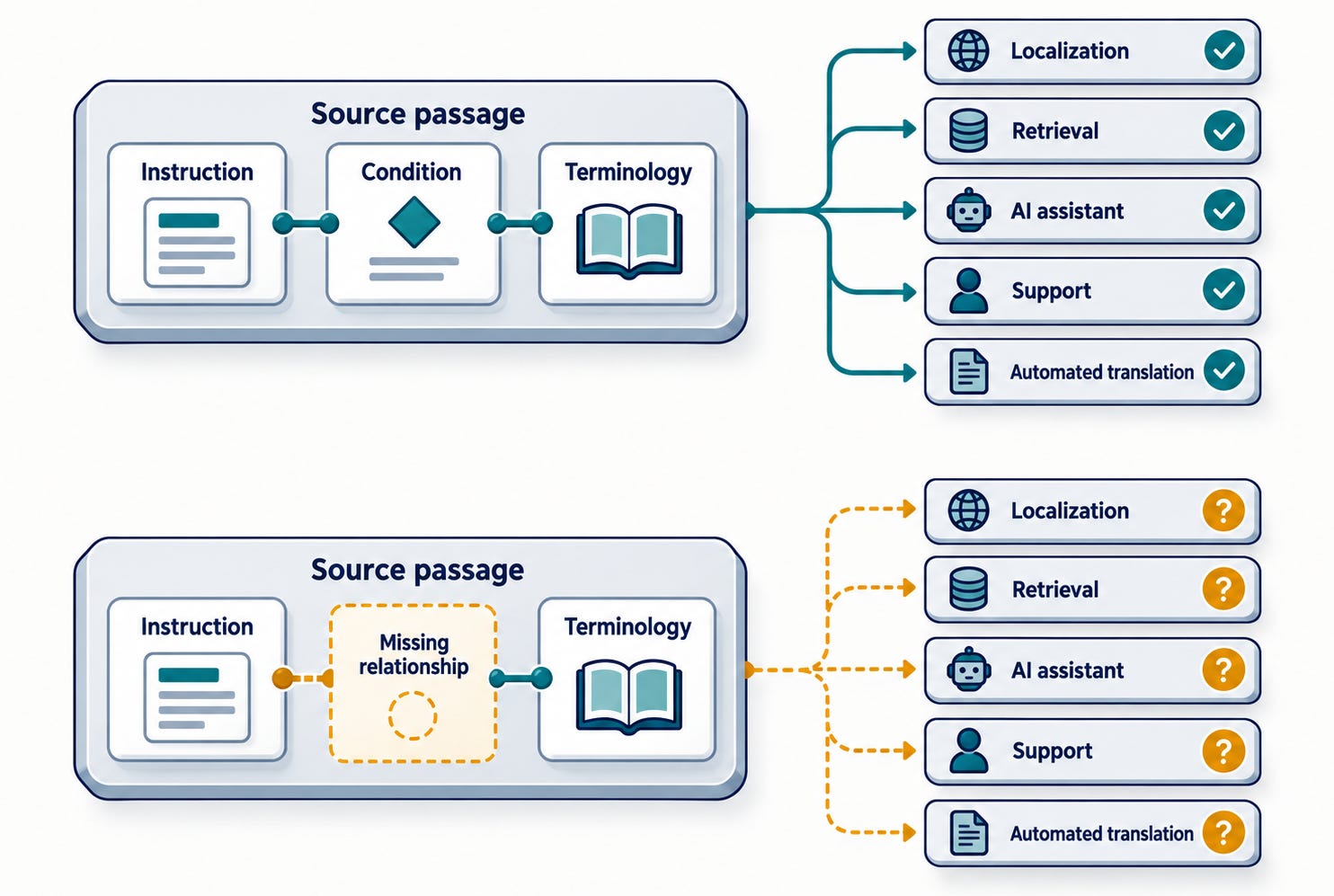
Multilingual documentation once made the connection between writing and localization fairly easy to see. The source content had to be clear enough to be translated. Now the same source content may also feed retrieval systems, AI assistants, support tools, and automated translation pipelines, and decisions made during authoring that content can affect more systems than they did previously.
A reused documentation topic, for example, still has to make sense when it appears somewhere other than on the help site web page where it was first used. If a product condition changes the meaning of our reused topic, that condition needs to travel along lockstep with the topic.
Terminology also needs enough consistency for people and machines to recognize when two terms refer to the same thing.
Structured content can help preserve documentation relationships, but structure cannot supply information the source docs never contained. A perfectly valid DITA topic can still leave an important dependency or critical condition unstated, which is where localization and product documentation increasingly meet.
I’ll Be Exploring That Overlap At LocWorld
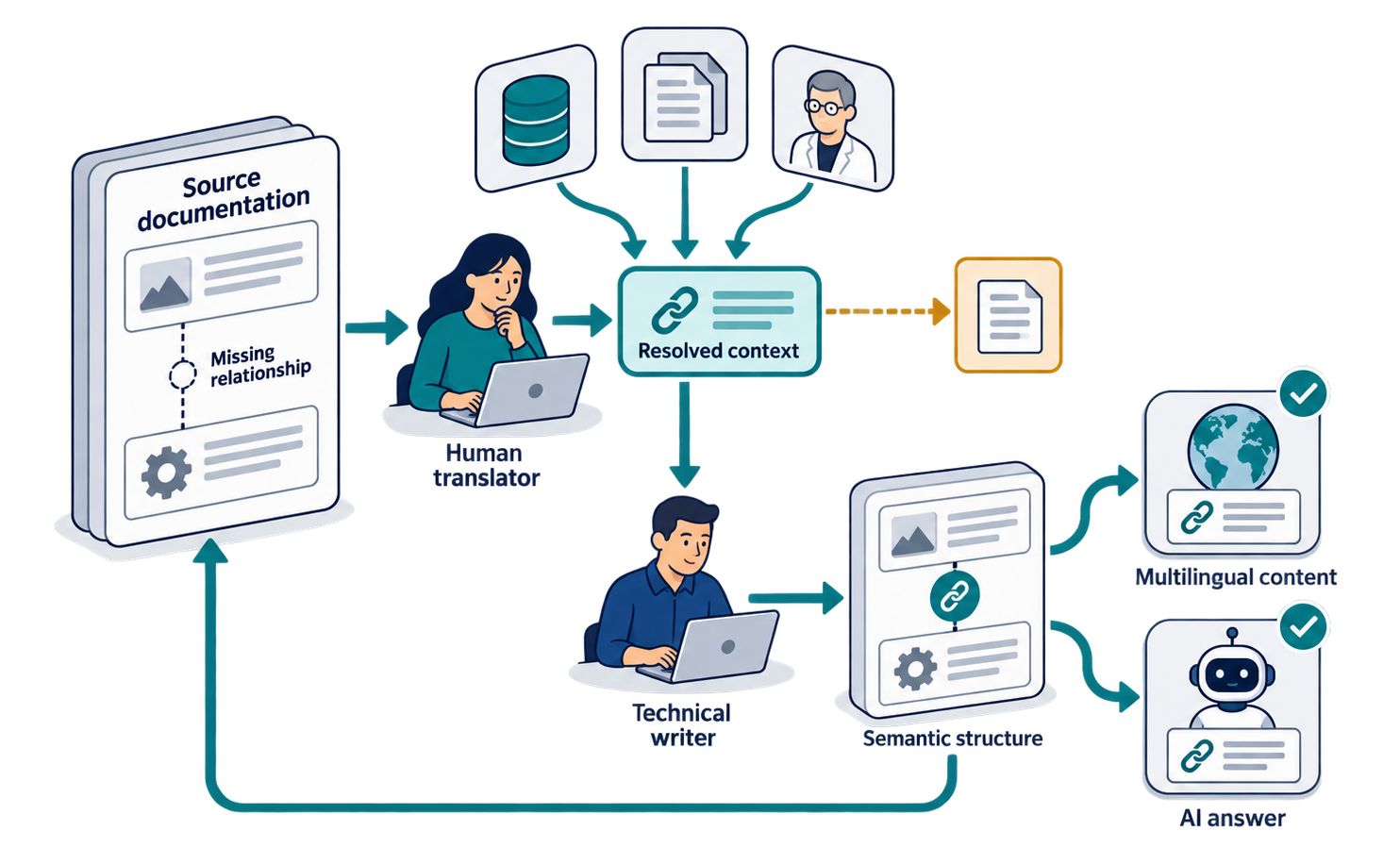
My session at LocWorld56 — “Make Inference Visible: How Localization Teams Can Help Customers Prepare Source Content for AI Answers” — focuses on something localization pros often encounter: source content that doesn’t contain enough information to support a confident interpretation.
A human translator may notice the gap and investigate, and that additional knowledge can help produce an accurate translation, but it doesn’t typically make its way back into the source documentation as it should. An AI system encountering the original content later may face the same missing information.
I’ll look at how localization pros can help identify missing relationships, how documentation teams can capture more of that knowledge in the source, and how semantic structured content can help us preserve context once we make it explicit.
Why Tech Writers Should Look Beyond Technical-Writing Conferences
Tech writers understandably spend most of their conference time around events that focus on documentation, APIs, structured content, content strategy, and content management. Localization conferences provide a different view of the same source material.
Localization pros see and understand deeply what happens after content leaves our documentation team, which sentences require clarification, where terminology breaks down, which content structures make automation harder, and when a human still has to step in.
If your company produces technical content in multiple languages, the localization team may already know things about your source documentation that the writing team doesn’t. That alone is a good reason for technical writers to spend some time in the localization conversation. Vancouver Localization Week puts both communities in the same city at a time when decisions made during documentation increasingly affect what happens during localization, and vice versa.
Logistics: Vancouver Localization Week runs October 14–21, 2026. TAUS Conference Vancouver takes place October 14–16 at the Sutton Place Hotel; LocWorld56 Vancouver follows October 19–21 at the Vancouver Convention Centre.
💰 Readers of The Content Wrangler get 10% off LocWorld registration — use code SA1056VAN at checkout on the registration page.