

It’s a truth universally acknowledged by every developer worth their salt: “You can never have too many resources when learning to code.” But here’s the kicker—of all the resources they use, the most indispensable is often the one they don’t praise enough: technical documentation. It’s like the water in the swimming pool that the lifeguard never mentions until you’re drowning.
The Underdog of Learning Resources
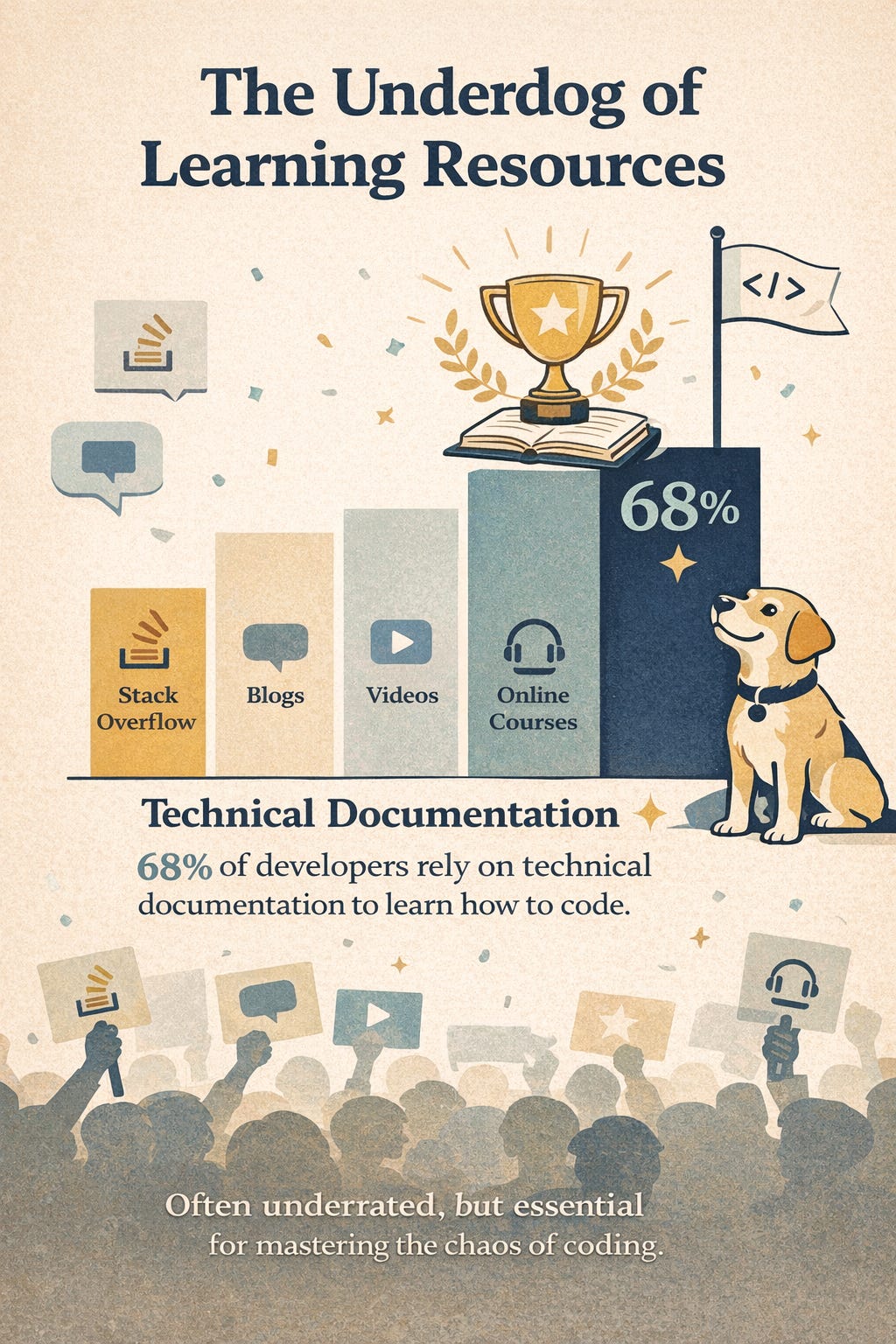
The 2025 Developer Survey paints an interesting picture. You’ve got your standard array of learning tools — Stack Overflow, blogs, online courses, and of course, videos. But lurking quietly in the background, capturing the attention of a staggering 68% of respondents, is technical documentation. It’s the often underappreciated rock star in a world obsessed with quick fixes and instant gratification.
Let’s break it down. Of the 33,454 developers who were polled (76% of them being the true “professional” variety and an additional 15% falling into the aspirational or adjacent developer category) there was a strong consensus. You need technical documentation to learn how to code. Let that sink in.
It’s clear we tech writers are holding the reins of knowledge, quietly helping software developers avoid the chaos of poorly understood libraries and buggy frameworks.

The Developer’s Best Friend: Technical Documentation
Now, we all know that developers have a way of loving their code more than they love life itself. 😆 Still, these same developers (mostly aged between 25 and 44) are relying on our docs to make sense of their tools, libraries, and frameworks. There’s a good reason why a significant 68% of survey respondents preferred it over other resources. It’s simple. It works.
While Stack Overflow answers might solve an immediate issue, they don’t explain why things work the way they do (and even when they do, there’s no guarantee it'‘s accurate). Enter technical documentation (the unsung hero of the coding world). Developers, especially those with less than 10 years under their belts, might not be able to remember every edge case for every function call, but the doc we produce help them get it when it matters most.
It’s the difference between frantically Googling “why does my program crash every time I try to run it?” and confidently consulting well-organized reference material that tells you what you’re doing wrong and how to fix it. It’s like the difference between using a map and wandering aimlessly.

Why Documentation Is the Bedrock of Success
Okay, I’ll admit that documentation isn’t exactly the glamorous, party-loving cousin of a slick YouTube tutorial or a rapid-fire Stack Overflow answer, but it is where foundational knowledge lives. For most developers, especially those in the 35% who have been coding for fewer than 10 years, learning to code with solid documentation means building a robust, scalable understanding that no quick fix or trendy blog post can replace.
The Case for Appreciating Technical Writers
So, dear tech writers, it’s time we stand tall and claim our rightful spot at the table of essential resources. Developers might use other tools for a quick fix, but when it’s time to dive deep into understanding and mastering a framework, they’re coming to us. Documentation isn’t just a reference; it’s the bedrock of their continuing success.
And to all the developers reading this: Next time you’re diving into a technical topic, remember that the person behind those docs aren’t just throwing a bunch of words into a file. They’re saving your proverbial butt one detailed, well-organized, thoroughly tested section at a time. And in a world where most things come with a “don’t ask, just Google it” disclaimer, isn’t that worth a little appreciation? 🤠