

by Helmut Nagy (with some help from the Graphwise Knowledge Graph in Claude)
Documentation isn’t created solely for people anymore. It’s created to be read by machines (AI assistants) as well as by humans. Chatbots, search tools, and agents should be able to use it, find the right topics, combine them, and generate trustworthy answers to questions asked of them. When terminology and metadata are inconsistent across information sources, those AI-generated answers become incongruent too, even if each topic is correct on its own.
This is one reason many AI pilots work well in a demo but become unreliable at scale. A semantic backbone addresses the problem by giving content a shared, machine-readable layer of meaning.
This post explains the concept and what it means for documentation teams, with a short example from the Graphwise Knowledge Hub.
What Is A Semantic Backbone?
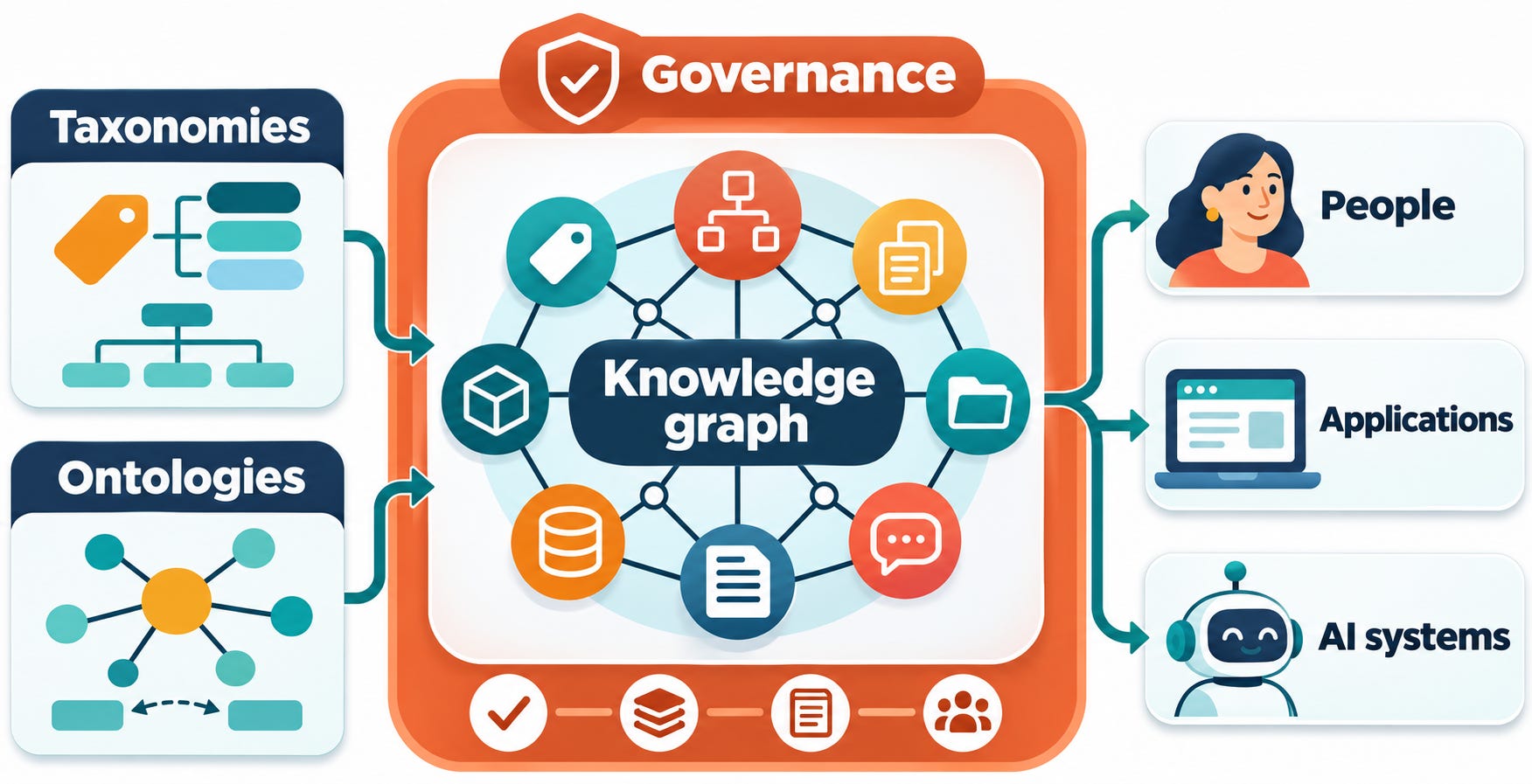
A semantic backbone is a shared knowledge infrastructure. At its core, it’s an enterprise knowledge graph: a network of the organization’s language, business concepts, entities, and the relationships between them. Taxonomies, ontologies, and rules govern the graph, so that people, applications, and AI systems work all with the same definitions.
In practice, a semantic backbone can be described in terms of four building blocks:
Taxonomies organize the organization’s language. They manage things like preferred terms and synonyms and also how concepts are related. SKOS is the common W3C standard for them.
Ontologies describe an organization’s business concepts and how they are related and described. OWL is the common W3C standard for them.
The knowledge graph connects these models with actual content and data: documents, products, components, and support cases. There are existing schemas like iiRDS and DITA that can help with that.
Governance keeps the backbone reliable through validation rules, provenance, policies, and human review. SHACL is the W3C standard for expressing validation rules in the knowledge graph.
This distinguishes a Semantic Backbone from a simple metadata or reporting layer. It is not a thin set of mappings for one tool, but a governed model of meaning that any system can reuse.
Instead of building separate semantic layers for each app, a single backbone serves search, analytics, content delivery, and AI tools. The Graphwise Semantic Backbone whitepaper describes the backbone’s architecture in six layers (Fig. 1) with a cross-cutting Trust layer for governance.
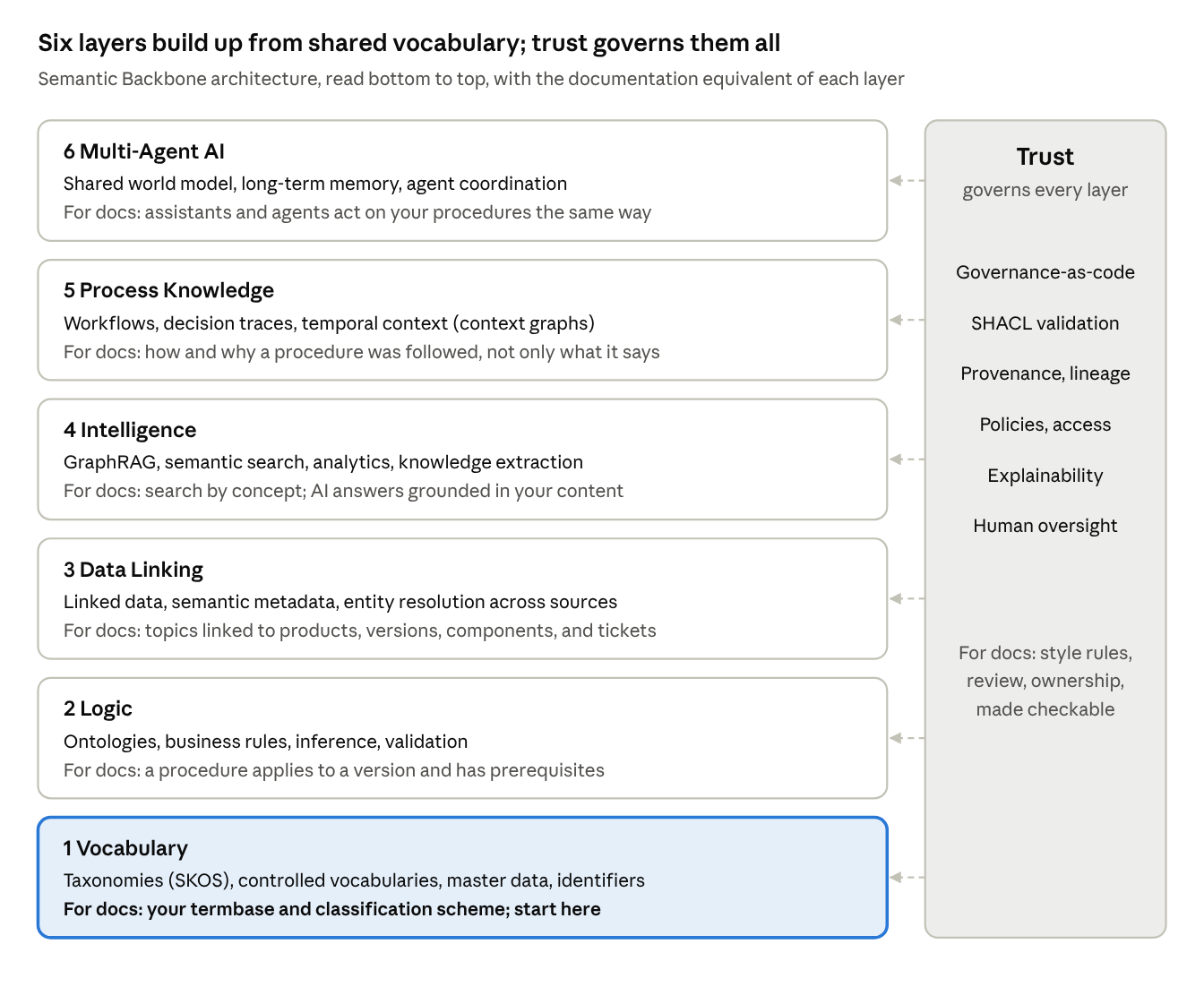
Fig. 1: Semantic Backbone architecture · 6 layers + Trust
For AI systems, well-structured product information can provide grounding: relevant, trustworthy evidence that helps tie answers to their sources.
In a Graphwise benchmark on multi-hop questions, this approach reached about 95% accuracy, compared with 79% for vector-based RAG, roughly four times fewer wrong answers.
What This Means For Documentation Teams
Tech docs teams already do much of the groundwork required. Our termbases, topic types, metadata schemes, and reuse strategies are the raw material of the backbone’s lower layers. Teams that already work with structured content, such as DITA XML, are one step away from producing semantic documentation: components enriched with governed concepts and linked in a graph.
In practice, this affects five areas:
Terminology: each concept is managed once in a Simple Knowledge Organization System (SKOS) vocabulary, with its preferred term, synonyms, and translations.
Reuse: topics linked to products, versions, and components show where a concept is used, so changes can be traced across all content.
Metadata: fields such as applicability, audience, and lifecycle state refer to governed concepts rather than free text.
Findability: search works by concept, so a query for one term also finds content that uses a synonym.
Quality checks: validation rules, for example in Shapes Control Language (SHACL), can be configured to check required metadata or flag deprecated terms.
An Example: The Graphwise Knowledge Hub
Graphwise built a semantic backbone for its Knowledge Hub, with technical documentation as one of the teams involved. They started with SKOS, a common data model for sharing and linking knowledge systems that includes taxonomy for consistent tagging, ontologies, and automated ingestion that tags and links content from DITA, DocBook, Markdown, PDF, and tools such as Paligo, Heretto, Wordpress and Google Drive.
AI assistants answer questions from the graph using GraphRAG. About 5% of the backbone was built manually; graph automation and LLM support handled the rest.
Getting Started
A semantic backbone doesn’t need to be built all at once. It’s best built incrementally, starting with a high-value use case. For content-heavy environments such as technical documentation, building a taxonomy is typically the initial step; for structured data, an ontology may come first. Linked content and AI applications follow, so each step delivers value on its own. For doc teams, an existing termbase and metadata scheme are natural starting points.
You can try the Graphwise Knowledge Hub at ask.graphwise.ai. Related assistants are available in the Graphwise documentation at help.graphwise.ai and at graphwise.ai/ask-marta.
Webinar: In our November 19, 2026 webinar — The Semantic Backbone: What It is and What It Means for Documentation — you can learn about these topics in more detail, with practical examples from technical documentation.
Sources
The Enterprise Semantic Backbone: A Foundation for Reliable and Scalable Agentic AI (Graphwise whitepaper)
What Is a Semantic Backbone? (Graphwise Fundamentals)