

I recently spoke with a writer I mentor who wanted something they assumed didn’t exist. They’d noticed social media platforms placing AI labels on some posts and didn’t find those labels useful.
“What I really want is a standard, recognizable symbol,” they told me.
Something like the Compact Disc Digital Audio logo or ENERGY STAR, the US government-backed mark identifying products and buildings that meet defined energy-efficiency standards. A writer could place it on printed or web content to tell readers that a person created what they were about to read.
I understood the appeal. Readers increasingly have trouble determining how an article was produced. Writers who create their own material have little more than a byline with which to describe their process. So I went looking for the mark and found something interesting.
A Standard Built On A Human Declaration
Micah Voraritskul founded VerifiedHuman in April 2023. The organization now includes certified creators across more than 25 countries and six continents. Its eight categories cover writers, visual artists, musicians, voice actors, content creators, educators, organizations, and advocates.
Membership is pay-what-you-can, with no required minimum. Members agree to a published standard and may place the VerifiedHuman mark on individual works that meet it. The mark doesn’t cover everything a creator produces.
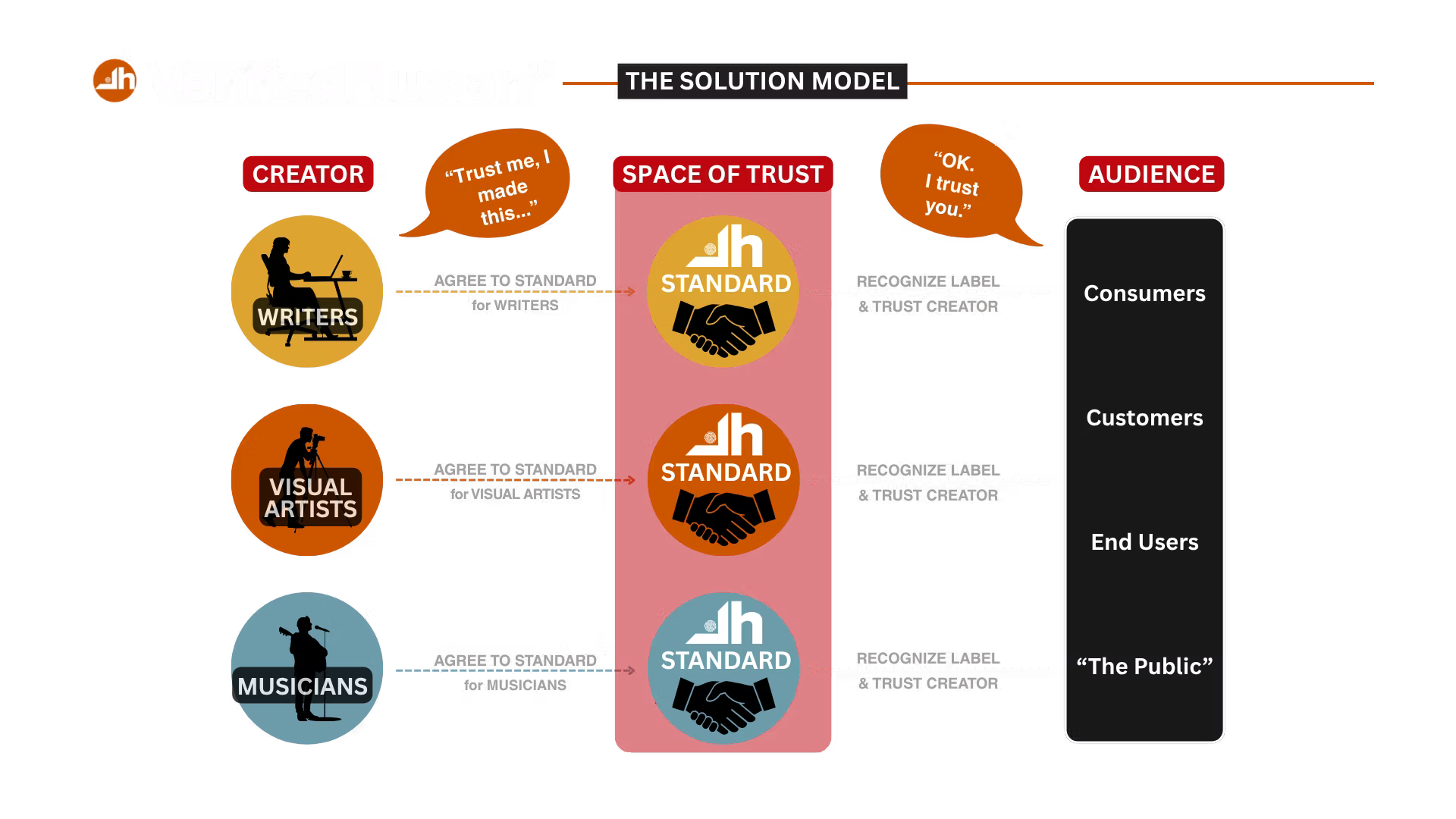
I expected the process to examine the work before issuing the mark. Instead, creators receive immediate access to the certification marks after joining and agreeing to the standard. No work is independently reviewed as part of that initial process.
A creator completes a short questionnaire (I signed up to see what it asked) and represents that qualifying work meets the requirements. The mark initially communicates that declaration.
VerifiedHuman describes its system as “trust-based, process-driven approach rather than automated detection or probabilistic analysis.” That disclosure matters because some of the language surrounding the mark suggests something stronger.
How Does VerifiedHuman Classify Human And AI Involvement?
VerifiedHuman bases its framework on a five-level classification system.
The organization argues that asking whether someone “used AI” no longer tells us enough. A writer may use AI to brainstorm, organize research, create an outline, draft passages, or produce an entire article. Treating every use as equivalent conceals what the writer contributed.
The Human-AI Collaborative Spectrum defines five levels:
👉🏾 VH5 covers work created entirely by a person without generative AI contributing to the ideas, drafting, or production.
👉🏾 VH4 allows generative AI to assist with research, outlining, brainstorming, and similar supporting tasks, while the creator produces the work.
👉🏾 VH3 allows AI to generate raw material, including drafts and passages, provided the creator substantially transforms it through their own voice, structure, perspective, and editorial decisions.
👉🏾 VH2 describes work largely generated by AI and then directed, selected, or lightly edited by a person.
👉🏾 VH1 covers work generated by AI with little human involvement beyond prompting and accepting the result.
Work classified as VH3, VH4, or VH5 may carry the VerifiedHuman mark. Work at VH2 or VH1 may not.
The boundary falls between transformation and editing. It asks who controlled the resulting work and what that person contributed.
What Work Qualifies For The VerifiedHuman Mark?
The site illustrates the difference between VH3 and VH2 with two writing scenarios.
In its VH3 scenario (which is above the threshold and qualifies the creator to use the mark), a writer begins with an AI-generated draft but rebuilds the argument, replaces generic material with original examples and analysis, and rewrites the piece in their own voice. Little of the original generated composition remains.
In its VH2 scenario (which is below the threshold and does not qualify the creator to use the mark), someone generates a complete post, makes minor changes for accuracy and tone, and publishes it. The system supplied the structure, voice, and other creative choices that define the finished piece.
Each person directed an AI tool and reviewed the result. The standard classifies the work according to how much of the generated composition survived and whether the writer imposed their own creative decisions on it.
VerifiedHuman also offers writers a gut check called the Five-Word Principle:
“If you cannot change five consecutive words from an AI draft without breaking the meaning,” the site says, the material hasn’t become your own.
The site doesn’t present this as a formal test, and it couldn’t function as one. The ability to rewrite five words doesn’t establish who originated a passage. A capable editor can rephrase machine-generated prose without becoming its author. A writer might also retain five ordinary words while replacing the argument around them.
The principle is more useful as a question about dependency. Are you expressing an idea you understand and control, or preserving the language and arrangement delivered by the system because the paragraph stops working when you disturb them?
The broader VH3 standard considers more than five words. It examines the voice, structure, perspective, examples, and analysis in the finished piece. Demonstrating an ability to paraphrase isn’t enough. The writer must take control of the composition, which is the distinction I decided to test against my own work.

Would My Writing Here Qualify For The VerifiedHuman Mark?
Quick answer. Maybe, probably, certainly not.
I use AI assistance when I write, including while developing this blog post. I work with an AI collaborator under a long editorial operating manual I wrote. The manual covers voice, evidence, sourcing, structure, and revision.
I supply the observations, map out the story arch, identify the key outcomes, and determine what needs investigation and why. I check claims against primary sources, reject drafts, change the direction, challenge assertions, and make the editorial decisions. I also typically introduce some snarky commentary that many of my readers have come to expect.
Under the VerifiedHuman standard, those decisions count. But, they don’t mean I qualify to use the mark.
If I directed the research and approved every claim but retained much of the AI-generated phrasing and structure, the piece could fall below the VH3 threshold. If I rebuilt (significantly rewrite) the material using my own language, arrangement choices, examples, and analysis, it could qualify.
An honest assessment would probably place some of my published work above that line — and some below it. The result makes me question whether (and how) the framework values the work that happens before a sentence is written.
As we writers already know, that earlier work typically involves more judgment than composing sentences. We may determine the subject, notice a contradiction, identify the evidence, reject unsupported claims, and decide what our articles should conclude. Another system may help turn our decisions into easy-to-process prose.
VerifiedHuman counts those contributions. Its criteria include the ideas, structure, perspective, and creative direction behind the writing. But directing and approving the work aren’t enough if much of the AI-generated language remains. Under those criteria, some of my writing wouldn’t qualify to display the mark.
How Does VerifiedHuman Compare With Independent Certification?
VerifiedHuman describes its model as “like Fair Trade for creativity.” The comparison makes sense, at first. Both use a voluntary standard and a recognizable mark intended to help people make choices based on how something was produced.
Fair trade compliance is established through independent audits conducted by FLOCERT. Auditors inspect operations, review records, require corrective action, and conduct unannounced audits when allegations or other risks arise.
VerifiedHuman’s initial certification works differently. Creators receive access to the mark after agreeing to the standard, without an independent review of a particular work.
Its certification-standard page describes two types of verification:
Passive verification begins when someone raises a concern about certified work. VerifiedHuman then questions the creator about the tools and process used.
Active verification involves third-party auditors evaluating random samples, particularly from educational institutions and organizations. The site doesn’t say how often active verification occurs or whether individual creators may also be sampled.
The difference makes the word verified difficult to ignore. The page for writers says that “writers need to prove their work is not AI.” Agreeing to the standard doesn’t independently provide that proof, although a later review may examine the creator’s process.
I don’t read the contradiction as an attempt to mislead. The site is unusually direct about its trust-based process. The stronger language reflects a problem VerifiedHuman cannot solve because no one else has solved it either.

Can Text Alone Confirm Human Authorship?
Researchers have found no reliable method that can examine finished text alone and determine that a person authored it. AI-detection tools claim to identify generated writing, but they can misclassify human writing, with especially high error rates documented for some groups of writers.
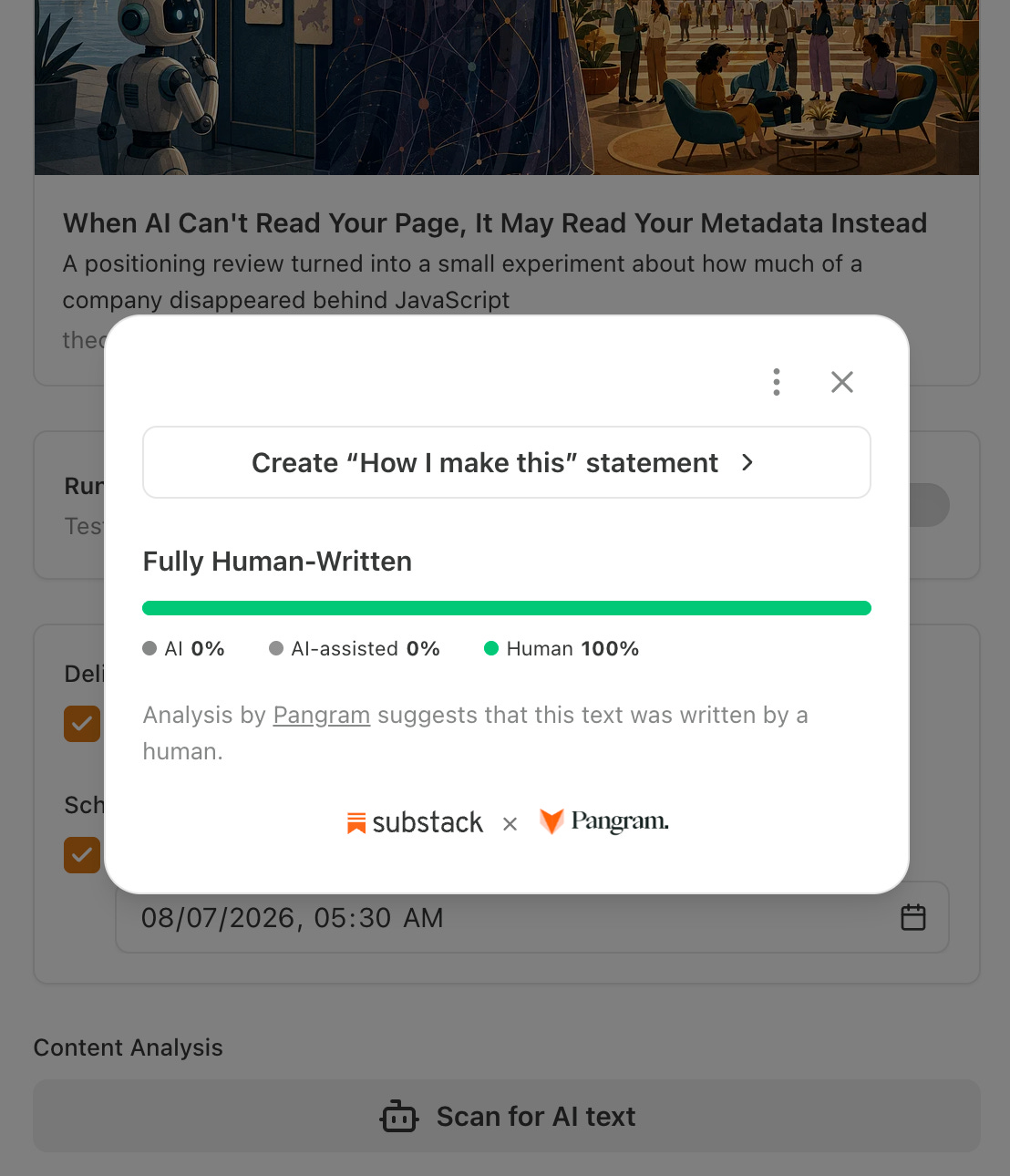
For example, SubStack (the platform I use to publish this blog) uses an AI-writing detection tool from a company Pangram that says it’s “An AI detector that actually works” and “detects AI-generated content with 99.98% accuracy.”
Chatlh! — that’s Klingon for “nonsense”. AI-assisted me in crafting the post in the screenshot below — Pangram rated it as 100% human. It’s not.
While I believe they know what human means, maybe they don’t know what 100% means. 😎
Content Provenance Matters
Content provenance records verifiable facts about the history of digital content. It doesn’t tell us whether the content is true, accurate, or valuable. Instead, it gives us more evidence to consider when making that judgment.
VerifiedHuman says it became a contributor member of the Coalition for Content Provenance and Authenticity, or C2PA, in January 2026. C2PA specifications support cryptographically signed information about a file’s origin and editing history. That information can identify recorded actions and the tools involved.
It cannot establish who supplied the thinking behind a sentence.
VerifiedHuman offers a published standard, a creator’s initial declaration, and accountability procedures that may later examine the work. The mark itself doesn’t tell readers whether that examination occurred. A declared work and one reviewed by a third party appear to carry the same mark.
What Does The VerifiedHuman Mark Mean?
The writer I spoke with wanted a mark that could confirm human authorship. The VerifiedHuman mark alone cannot do that. It tells readers that a creator has agreed to a defined framework and represents that the labeled work meets it, but it doesn’t indicate whether anyone independently examined that claim.
The declaration relies on the creator telling the truth, a limitation VerifiedHuman acknowledges. Bylines have always involved some degree of trust. GenAI has complicated that trust by raising new questions about what writers should disclose to readers about how they produce their work.
The spectrum moves the discussion beyond the blunt question, “Did you use AI?” It describes what writers actually contribute and also brings us to a boundary the mark cannot define on its own.
The VerifiedHuman mark gives writers a standard way to disclose how they produced an article. However, reviewed and unreviewed work use the same mark. Readers can see what the writer claims about the process, but they cannot tell whether an independent party checked that claim. 🤠
What are your thoughts on this approach? Share your thoughts in the comments section.