

There’s a moment in every organization when someone important discovers a problem that’s apparently existed for years and reacts like it materialized spontaneously out of thin air one random Tuesday afternoon at 2:17 pm PT. Usually this discovery arrives during a meeting involving a dashboard, a delayed release, three exhausted managers, and at least one person saying, “Wait… who owns this content?”
Silence follows. Not normal silence. Corporate silence.
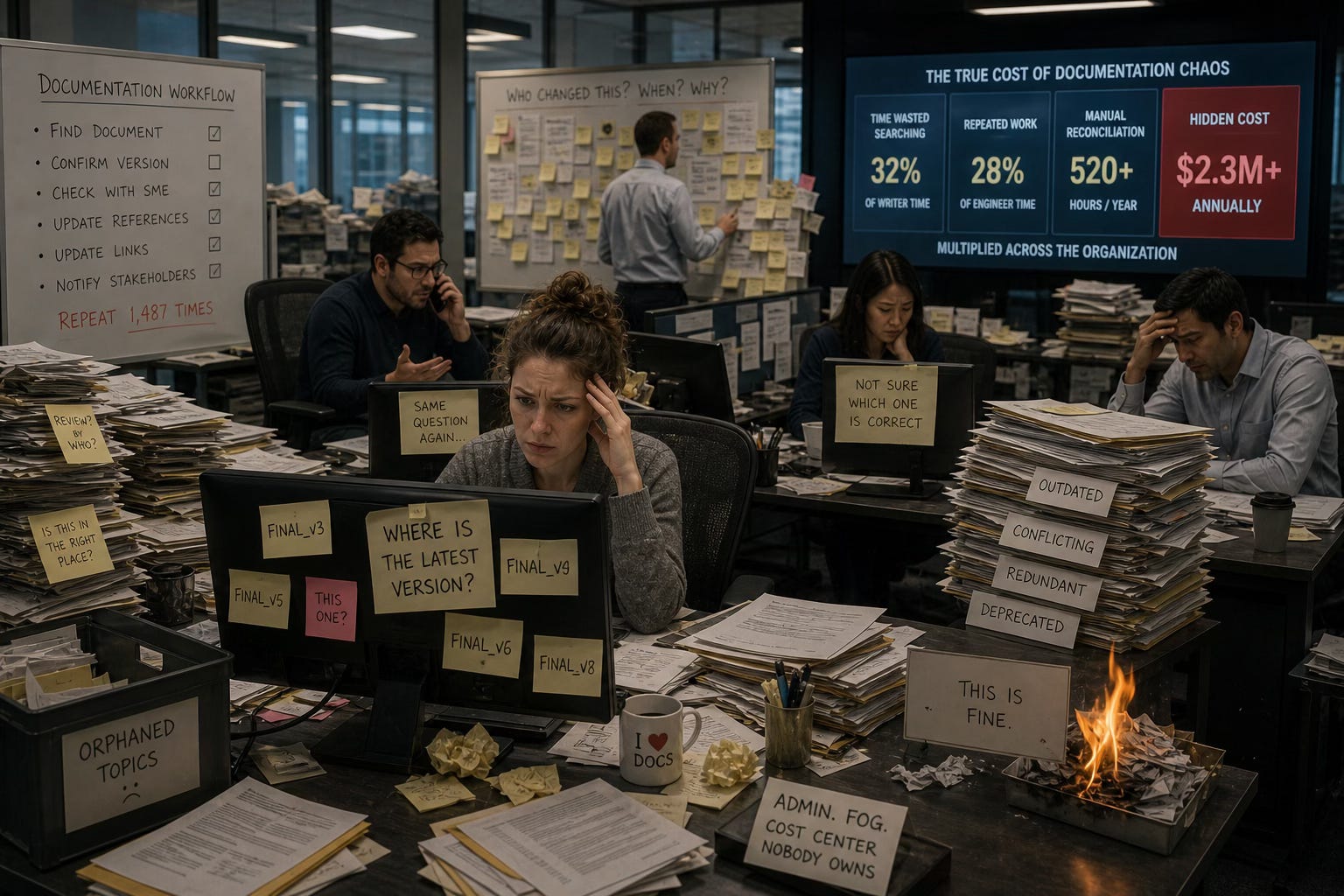
Documentation Chaos Rarely Looks Expensive At First
This is how operational inefficiency announces itself inside technical documentation teams. Not dramatically. Not with alarms. Not with smoke pouring from the walls. It arrives quietly, disguised as “the way we’ve always done things,” right up until the organization realizes it’s spending enormous amounts of money compensating for chaos nobody formally agreed to maintain.
A writer spending twenty minutes hunting for the latest approved procedure doesn’t sound catastrophic. An engineer answering the same support question for the ninth time this week seems manageable. A product manager manually reconciling conflicting documentation versions before release feels annoying but survivable.
Then the organization repeats those activities thousands of times a year.
Suddenly, entire salaries disappear into administrative fog.
The Shared Drive Is Not A Strategy
Tech docs teams often exist in places where every other department evolved operationally while documentation was left sitting beside the highway holding a three-ring binder and blinking into the sun.
Engineering has automation pipelines. Security has governance frameworks. Infrastructure teams have observability dashboards that resemble NASA launch controls.
Meanwhile, the documentation operation may still rely on filenames like: FINAL_v2_USE_THIS_ONE_REAL.docx
There’s always at least one of those. Usually seven. Maybe eight.
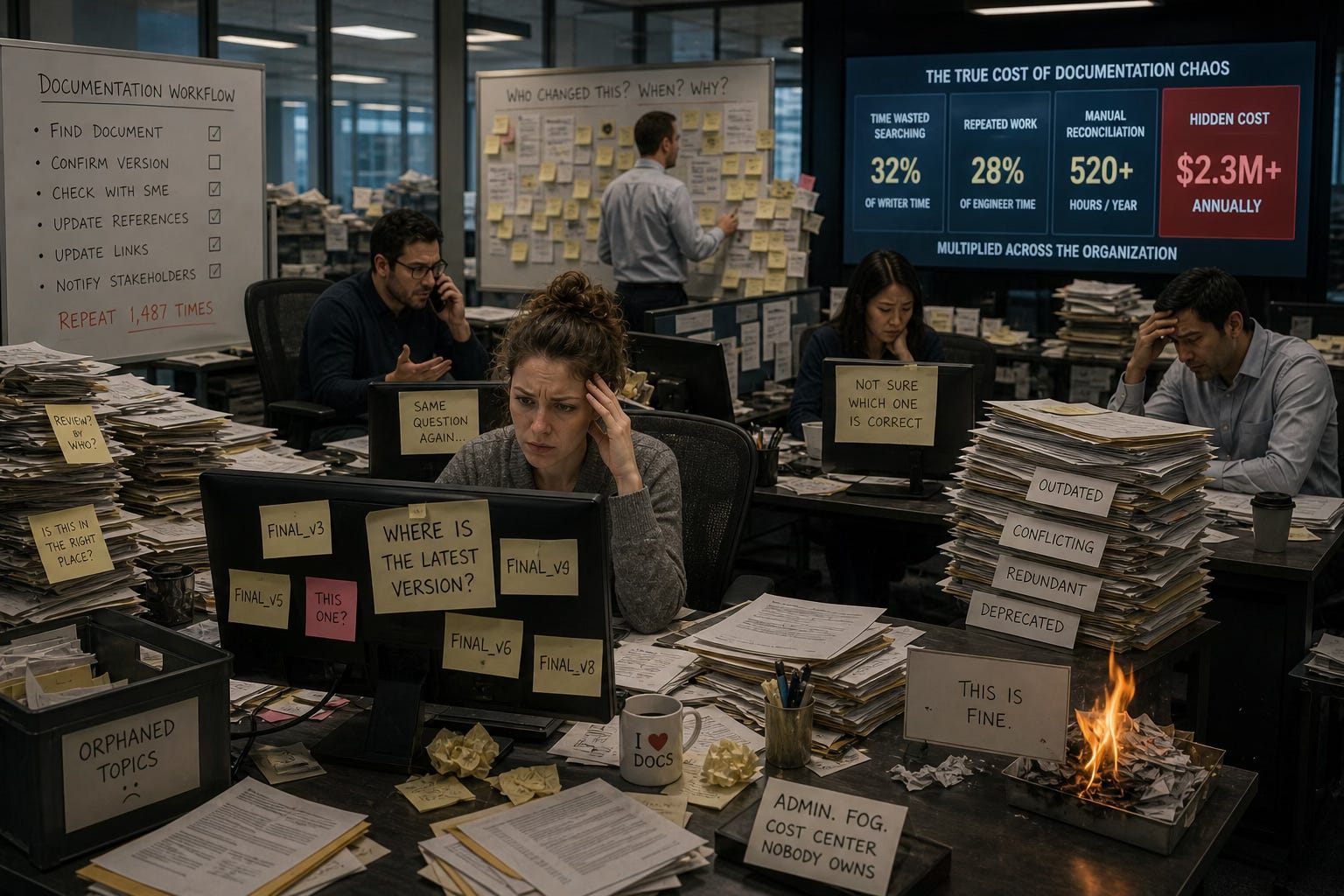
Skilled Workers Shouldn’t Be Content Janitors
PagerDuty’s research on operational inefficiency emphasizes the cost of downtime, repetitive work, technical debt, and highly skilled employees spending time on preventable friction.
Tech writers understand this instantly because many of us spend absurd amounts of time doing work that has almost nothing to do with writing.
We’re reconciling duplicate content, chasing approvals, rebuilding broken publishing workflows. And, in our copious free time — ha! — we manage to find space to copy and paste information between systems that absolutely should’ve been integrated sometime during the first iPhone administration.
As highly trained knowledge pros, we end up functioning like anxious wedding planners for content nobody wanted to govern properly in the first place.
The Buckets Were Never The Roof
Organizations convince themselves this arrangement is “cost effective” because they delayed purchasing better systems or avoided operational redesign. This is a little like refusing to repair our roof because buckets are technically cheaper.
Sure. For a while. Then mold arrives.
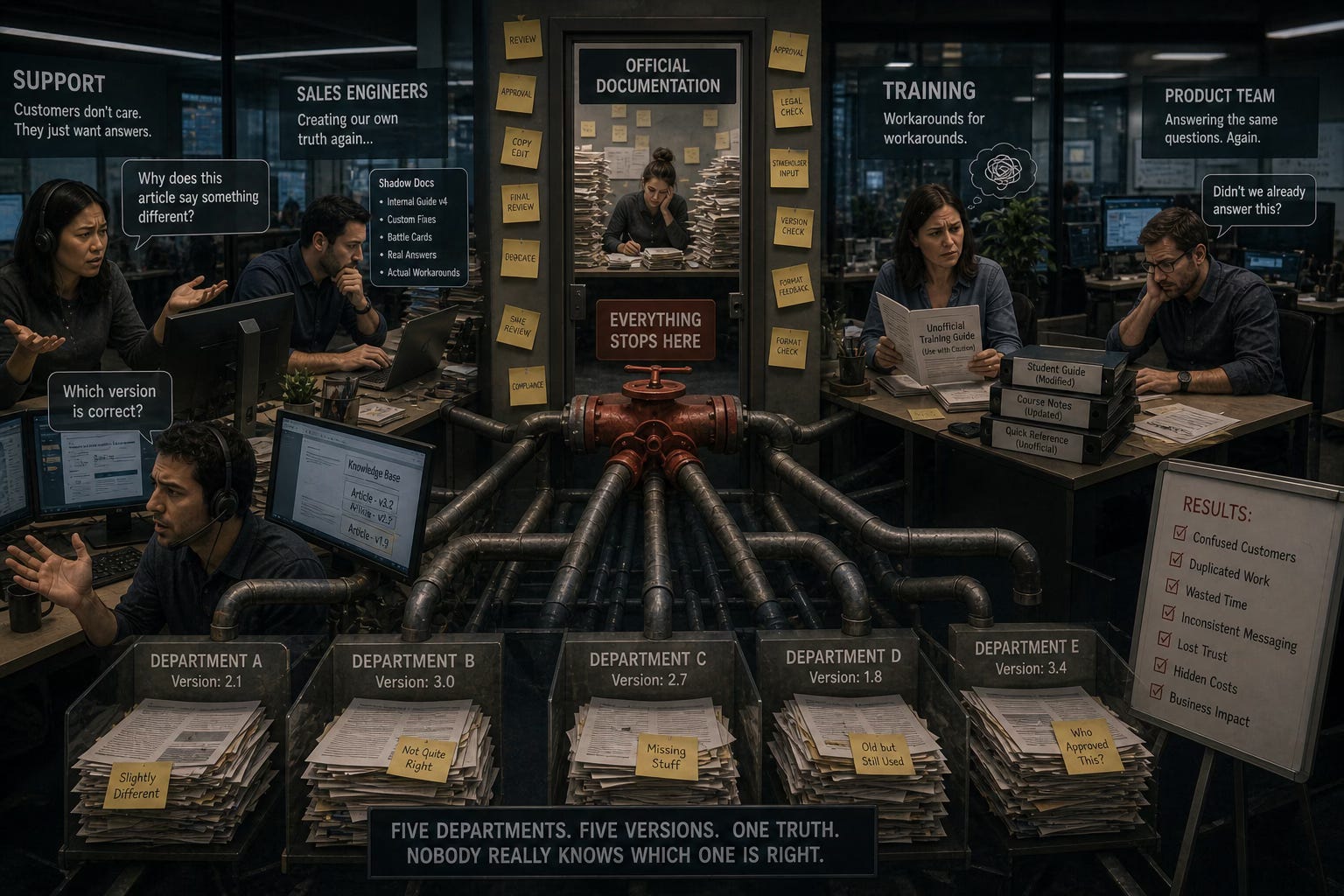
Documentation Bottlenecks Become Business Bottlenecks
The downstream effects spread everywhere. Our support teams inherit the confusion first because customers always discover content problems before executives do.
Then, with good intentions, sales engineers start creating their own shadow documentation because they can’t trust the official versions and fear that it may hamper their ability to seal a deal. Training departments subsequently join in by inventing workaround content, while product teams answer repetitive questions that shouldn’t be eating up anyone’s time.
Eventually, the organization becomes a kind of accidental content hoarding operation where five departments maintain slightly different versions of organizational “truth.”
Then AI Walks Into The Mess
For years, humans compensated for operational dysfunction through instinct and memory. Someone always knew where the “real” answer lived. Someone remembered which warning was outdated, understood that the installation procedure only worked if you ignored steps four through six instead.
AI systems don’t possess this survival instinct. They consume whatever content ecosystem exists in front of them with the confidence of a suburban dad assembling patio furniture without reading instructions.
If the source material is fragmented, inconsistent, duplicated, outdated, or poorly governed, AI scales those problems beautifully and rapidly; at enterprise speed.
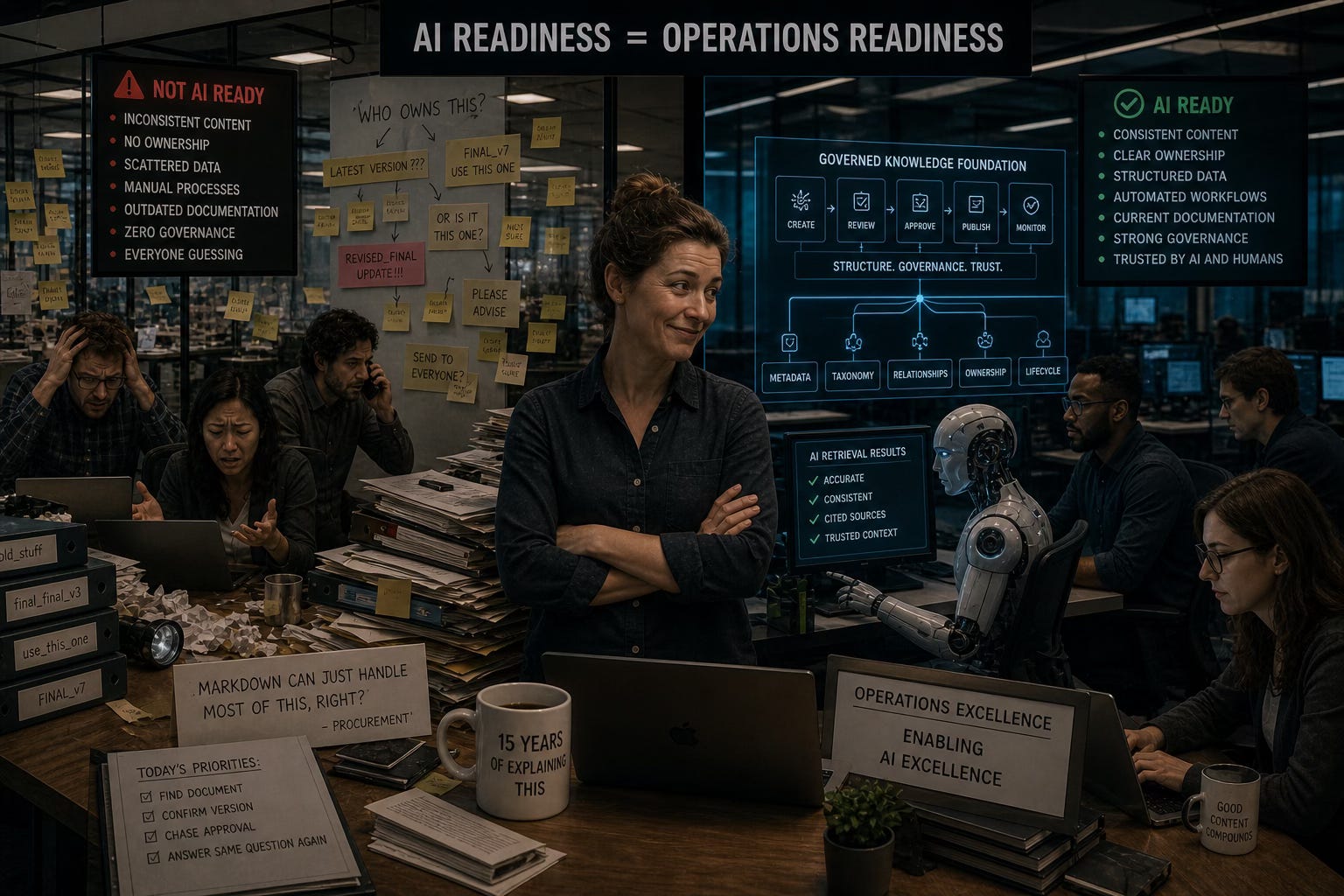
AI Readiness Is Really Content Operations Readiness
Organizations everywhere are now discovering that “AI readiness” doesn’t merely involve purchasing software licenses and holding inspirational town halls about innovation.
It requires operational maturity. Governance. Metadata discipline. Clear ownership. Structured workflows. Lifecycle management.
In other words, all the things documentation teams have been trying to explain politely for the past fifteen years while someone from procurement asked whether Markdown could “just handle most of this.”
Related reading: How to Build a Content Operation
Burnout Is An Operational Signal
Operational immaturity also creates a human problem companies routinely underestimate. Burnout.
Documentation burnout is quieter than someone throwing a badge onto a conference table before storming out into the rain. It accumulates slowly through endless context switching, duplicate work, approval bottlenecks, emergency publishing requests, and systems that behave like abandoned carnival rides.
People stop feeling strategic. They start feeling administrative. Worse, they start feeling invisible.

Functional Enough Is Where The Money Goes To Die
The most dangerous documentation operations aren’t the obviously broken ones. Those are easy to identify. The dangerous ones are “functional enough.”
Functional enough to:
avoid executive scrutiny
limp through another release cycle
keep producing outputs while quietly draining productivity (slowing onboarding, increasing support costs, weakening AI reliability, and exhausting the humans trapped inside the machine)
The Real Cost Is Paid Every Day
That’s the hidden cost of operational inefficiency. Not one catastrophic collapse. Just thousands of tiny operational taxes paid every day by people whose jobs could’ve been dramatically easier if someone had treated documentation content operations like infrastructure instead of decorative office shrubbery.
Eventually organizations realize the truth. They didn’t merely build a documentation team. They accidentally built a sprawling enterprise knowledge system held together with Slack threads, tribal memory, and emotional optimism.
And now AI is reading all of it aloud. 🤠