

Guest post by Swaha Bhattacharya
For most of the internet’s history, humans directly interacted with content. We searched, clicked, read, compared, interpreted, and decided what to trust. Websites competed for our attention. Search engines acted as maps that guided us toward information, but humans still visited the original destination.
That relationship is beginning to change.
Increasingly, AI is becoming the layer between humans and information. Instead of navigating websites, people are asking questions. Instead of reading ten links, they are receiving one synthesized answer. Instead of evaluating sources themselves, they are trusting systems to interpret the internet on their behalf.
The shift may sound subtle, but it fundamentally changes the role of content online. Content is no longer just something humans consume directly. It is becoming raw material that machines interpret, summarize, rank, and repackage before humans ever see it.
We are entering the era of invisible content.
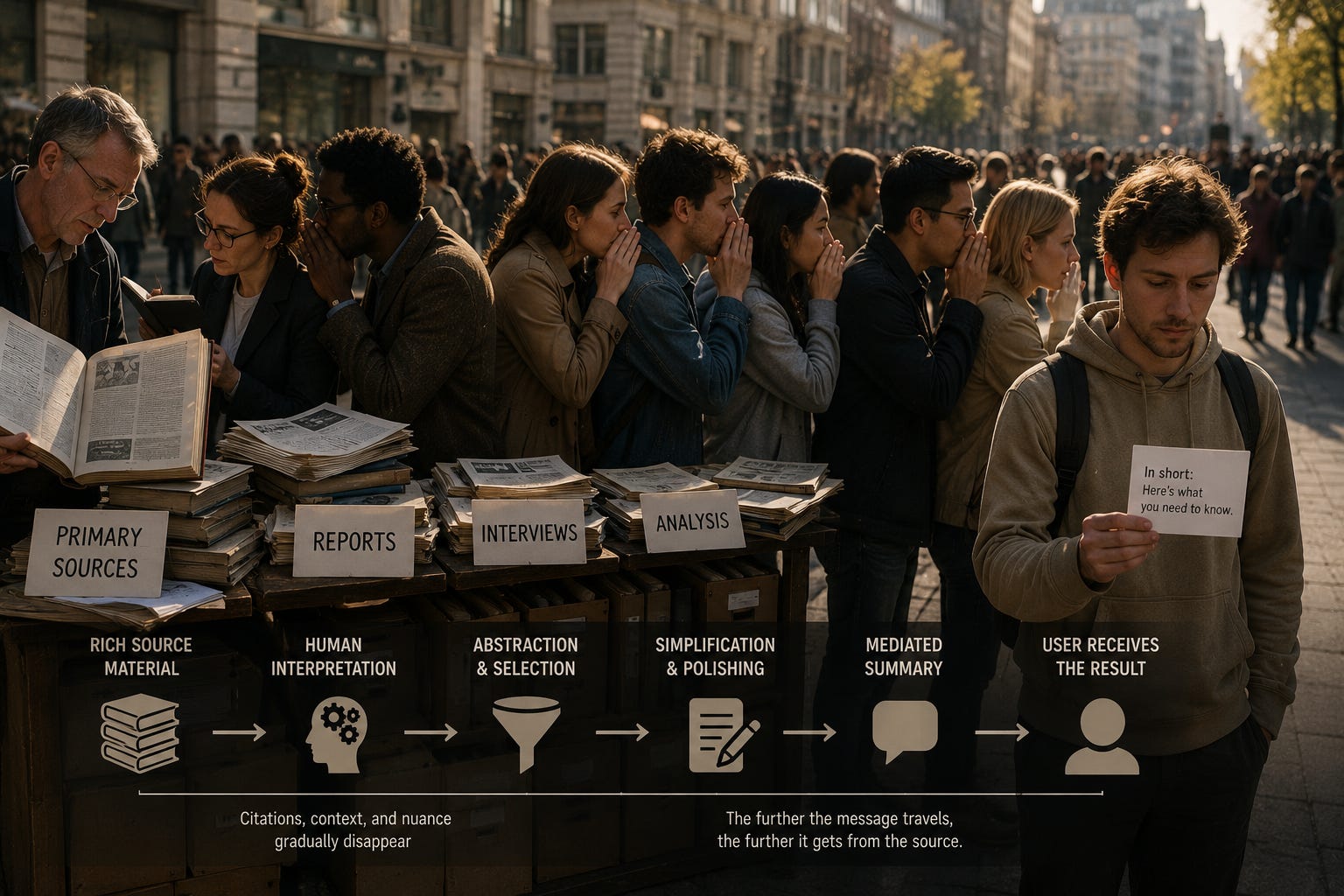
The Collapse of the Footnote
In many ways, this transformation is already here. Google’s AI Overviews, ChatGPT, Perplexity, Microsoft Copilot, and other conversational systems are changing how people interact with knowledge. Industry analysts at Gartner have projected that traditional search engine volume is on track to decline by 25 percent as users increasingly migrate toward AI driven conversational experiences.
For publishers, media companies, and enterprise organizations built around discoverability, the implications are structural. The internet is shifting from a referral driven network to an ecosystem increasingly shaped by extraction and synthesis.
As Cloudflare CEO Matthew Prince recently observed while discussing the future of AI search:
“People aren’t following the footnotes.”
To understand the scale of this transition, look at the widening gap between machine crawling and human visiting. A decade ago, search engines crawled websites primarily to guide humans back to original sources. Today, AI systems increasingly consume information without returning meaningful traffic to publishers. According to comments shared publicly by Prince, emerging AI platforms appear to generate dramatically higher crawl to referral ratios than traditional search engines, with extraction metrics for major LLM crawlers scaling into the thousands or even tens of thousands of pages scraped for every user redirected back to a source.
The result is already becoming visible across digital publishing ecosystems. Multiple analytics firms and media organizations have documented significant drops in referral traffic as users increasingly receive summarized answers directly within AI interfaces. But traffic loss is only part of the story. The deeper shift is psychological.
The internet is moving from an environment where humans evaluate information themselves to one where AI increasingly mediates reality for them.
That changes how trust works online.

From Source Literacy to Interface Trust
For years, trust on the internet was tied to visible signals. People trusted recognizable publications, established brands, expert authors, or communities they felt aligned with. Even when misinformation existed, users still had some awareness of where information originated.
AI changes that relationship because it compresses many sources into a single confident response. The original context disappears. Nuance fades. Contradictions flatten. In many cases, even the source itself becomes secondary.
The answer becomes the interface.
This compression also amplifies something psychologists have long studied: automation bias. Humans naturally tend to place greater trust in structured, automated outputs, especially when they appear confident and efficient. Researchers are increasingly examining how the fluency and conversational tone of Large Language Models can create an illusion of authority even when information is incomplete, outdated, or inaccurate.
People quickly adapt to whatever feels easiest, and fast conversational AI fits that pattern well. Once users get used to instant, low-effort answers, going back to slower manual research feels inconvenient, but convenience alone does not guarantee trust: people may prefer the speed while still questioning whether the answer is accurate, complete, or safe.
When humans begin emotionally trusting systems that summarize reality for them, the internet changes from a network of information into a network of mediated interpretation.
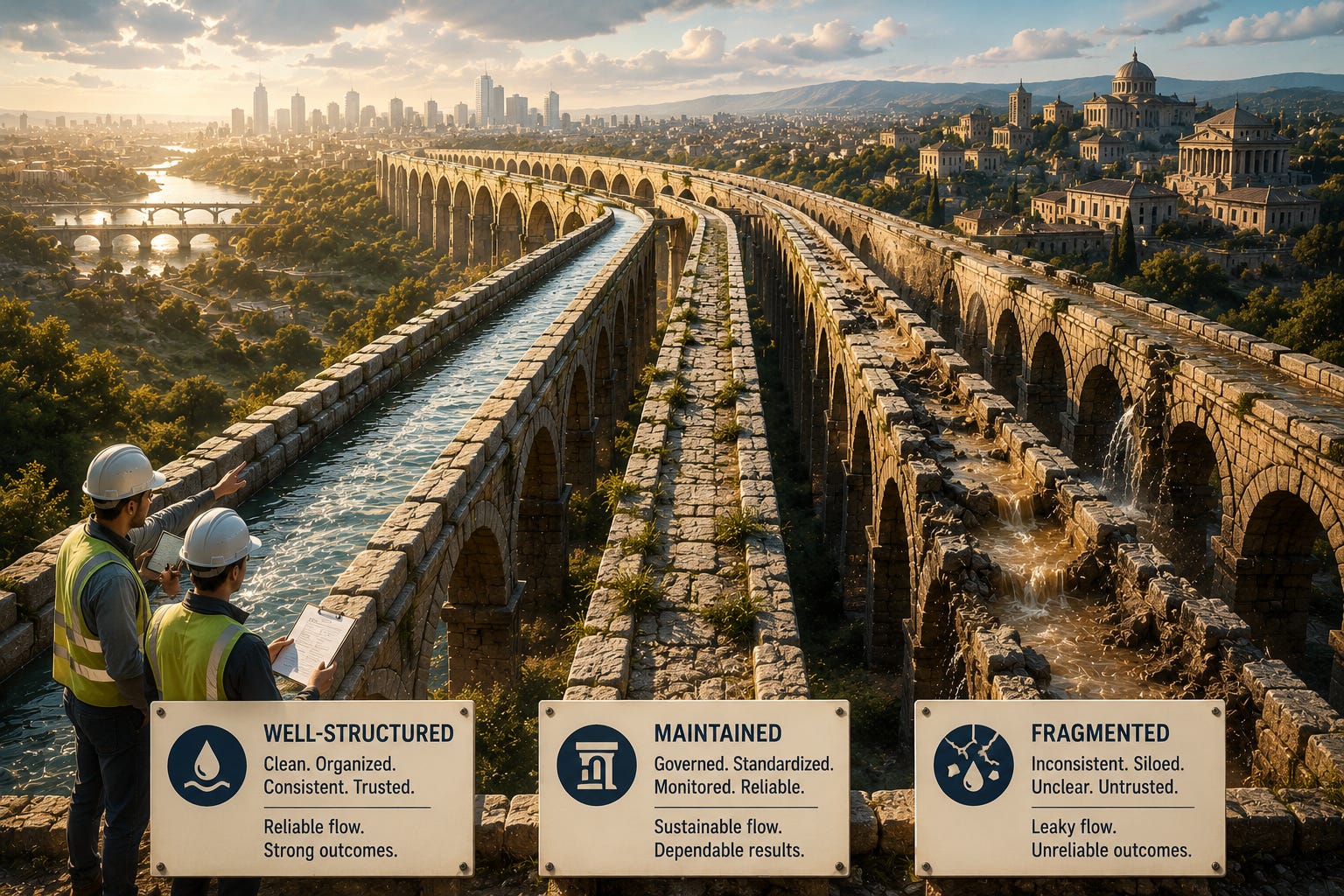
The Enterprise Imperative: Content As Machine Infrastructure
This creates an entirely new playbook for organizations far beyond media companies.
Businesses, governments, educational institutions, healthcare systems, and technology companies are all entering an environment where the quality of their underlying knowledge systems directly affects how AI represents them.
For content strategists and information architects, this may become one of the defining challenges of the next decade. We are no longer designing content exclusively for human readers. Increasingly, we are designing it for machine interpretation.
Modern AI systems rely heavily on structured and retrievable information. When organizations use Retrieval Augmented Generation frameworks to connect AI models with enterprise knowledge, the quality of the underlying content architecture becomes critical.
AI systems perform better when information is modular, semantically organized, clearly tagged, and consistently maintained.
If corporate knowledge bases, technical documentation, policies, or support systems are fragmented, inconsistent, or buried inside static files, the AI pipeline begins to weaken. Messy, incomplete, or inconsistent inputs usually lead to unreliable AI outputs because models can only work with the context and constraints they are given. When prompts are vague or poorly structured, the system is more likely to guess, omit important details, or produce inaccurate results. Even sophisticated AI models cannot consistently produce trustworthy outcomes from chaotic source material.
This is why the future of content strategy may depend less on publishing volume and more on governance, structure, and information integrity. The real competitive advantage will not come from generating endless amounts of synthetic content. It will come from building systems that preserve clarity, provenance, consistency, and trust in environments increasingly saturated with machine generated information.

A Premium On Authenticity
Ironically, as generative AI makes text, images, video, and code easier and cheaper to produce, genuinely trustworthy information may become more valuable, not less.
Human credibility, transparent sourcing, and verified expertise become premium.
We are already beginning to see the early foundations of this shift. Initiatives such as C2PA, the Coalition for Content Provenance and Authenticity, are developing technical standards that help verify where digital content originated and whether it has been manipulated. At the same time, organizations are investing more heavily in structured content systems, metadata frameworks, modular authoring models, and governed knowledge ecosystems that can support trustworthy AI experiences at scale.
Practices once considered niche disciplines within technical communication and enterprise documentation are steadily moving toward the center of business strategy.
The internet has always evolved through layers. First came static pages, then social platforms, then algorithmic feeds. AI introduces another layer entirely: interpretation itself.
The biggest change AI brings to our digital landscape is not simply that machines can create content. It’s that humans may increasingly stop seeing where that content came from in the first place, making the invisible architecture behind information one of the most important forms of infrastructure in the AI era.
The conversation about AI often focuses on what machines can create. But the more profound question may be what humans stop doing.
When AI becomes the primary interface between people and information, fewer users visit original sources, compare perspectives, examine evidence, or evaluate context for themselves. Increasingly, those responsibilities shift to the systems that retrieve, interpret, and present information on their behalf.
That makes the future of content larger than a publishing problem or a search problem. It becomes a trust problem.
The organizations that succeed in the AI era will not necessarily be those that generate the most content. They will be those that build the most trustworthy knowledge ecosystems—systems where information is accurate, structured, traceable, and resilient enough to survive multiple layers of machine interpretation.
For content pros, this represents a significant shift in responsibility. Content isn’t simply a communication asset — it’s part of the infrastructure through which people understand reality.
The era of invisible content is not really about content disappearing. It’s about the growing importance of the information architecture, governance, content provenance, and trust mechanisms that remain invisible to users but increasingly determine what they see, believe, and act upon. 🤠

Swaha Bhattacharya is a senior content strategist and technical communicator with over 11 years of experience in enterprise technology. Having worked extensively in structured content, documentation, knowledge systems, and AI-enabled experiences, she writes about the future of content strategy, information architecture, and trust in an increasingly AI-mediated world.