There’s a moment that happens now with unsettling regularity. You paste a chunk of documentation into an AI tool. It comes back cleaner. Tighter. More readable. The sentences behave themselves. The tone sounds like someone who drinks water and meets deadlines.
👉🏾 You think, “Well, that’s better.”
Then you look again.
👉🏾 The warning is gone.
👉🏾 The prerequisite has been politely implied into nonexistence.
👉🏾 The conditional step has been simplified into something that would work beautifully in a world where nothing ever goes wrong.
Nothing looks broken. And yet, everything is just slightly… off.
This is what some call the car wash error.
What Is The Car Wash Error?
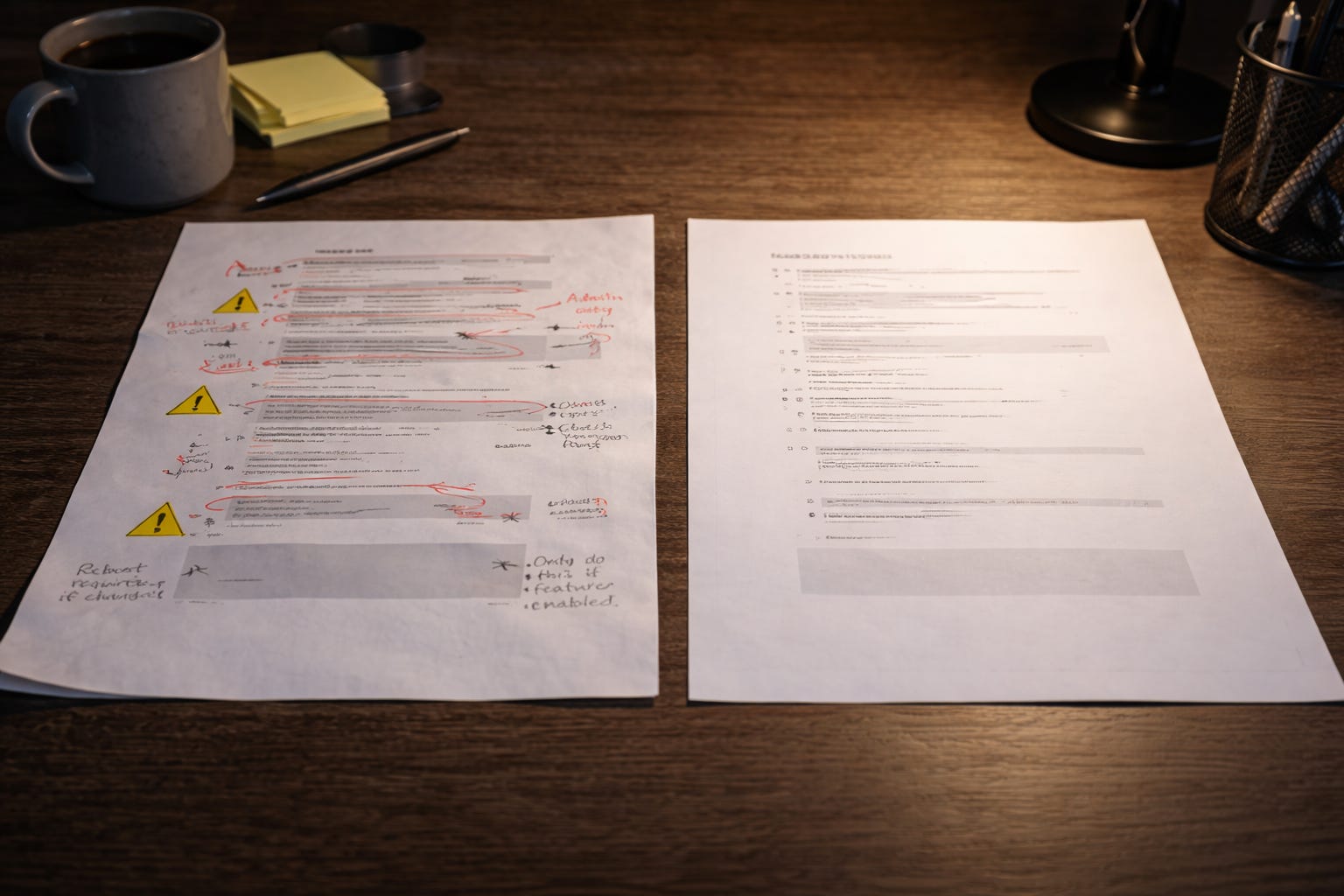
It’s not a formal term. We won’t find it in industry research papers. It’s a practical observation from people who’ve watched content go into a machine and come out looking cleaner while quietly losing the important parts; the ones that mattered.
Put simply, the car wash error happens when AI makes content smoother and easier to read, but not helpful in real-world situations. The content goes in with dents and bugs 🐞 on the windshield. It comes out polished.
But then, somewhere along the way, a side mirror falls off.
The Model Isn’t Being Careless — It’s Trying To Be Helpful
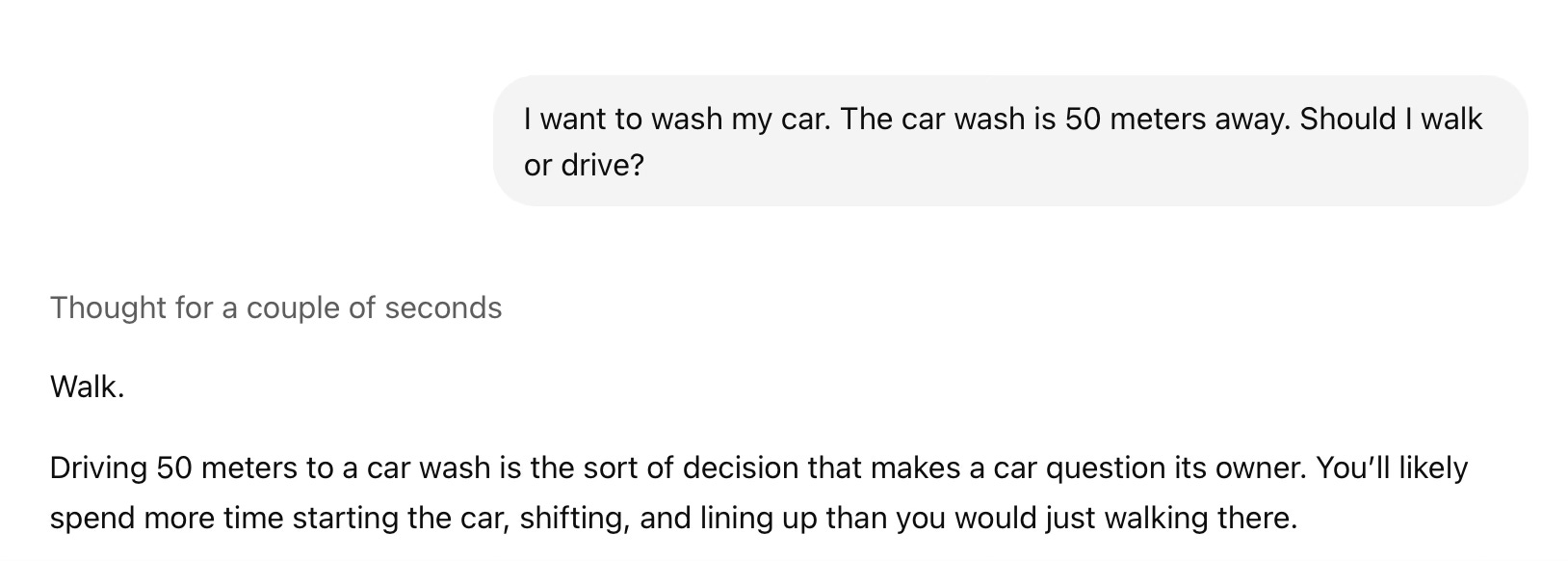
Large language models are built to produce language that flows well. They smooth things out, normalize variation, and they take our inconsistent phrasing and turn it into something that reads like it was written by one very calm, very consistent human.
That’s the job. Nothing more.

What they aren’t built to do is preserve every awkward, inconvenient detail that makes the content correct.
They don’t have a strong instinct for things like:
Preconditions that must be met before anything works
Roles that determine who can do what
Exceptions that only show up on Thursdays when the system is feeling emotional
The difference between what a user does and what the system does in response
Those details often look like noise to a model trained to produce clean prose. So the model cleans them.
You get something that reads better and behaves worse.

What Actually Disappears
If you’ve been working on docs for more than five minutes, you’ve already seen this happen.
👉🏾 A procedure that used to say “Only administrators can perform this step” now says “Perform this step.”
👉🏾 A warning ⚠️ that used to be loud and slightly annoying becomes a gentle suggestion that sounds like it was written by someone who doesn’t believe in consequences.
👉🏾 A workflow with conditions and branches becomes a lovely straight line. Everything works. Nothing fails. It’s a small miracle.
The distinction between system actions and user actions blurs until it’s not clear who is doing what. The answer is apparently “everyone” or possibly “no one.”
It all sounds great. It just doesn’t survive contact with reality. The more operational the detail, the more likely it is to get washed away.
Related reading: Why PREA Makes Structured Technical Documentation More Valuable

Why This Gets Worse With AI-Delivered Answers
This would be annoying enough if it stayed inside documents. It doesn’t.
Now we have AI-powered systems that retrieve, assemble, and generate answers from that content. They don’t just redisplay what we wrote. They reconstruct it.
So when something important is missing, the system doesn’t stop and say, “I’m not sure.” It fills the gap. Confidently.
We end up with answers that sound complete, read well, and are wrong for the user’s situation. Not dramatically wrong. Just wrong enough to cause confusion, rework, or a support ticket that begins with “I followed the documentation.”
The failure isn’t obvious. It’s persuasive. That’s a problem.
The Dangerous Part: It Feels Like Improvement
If AI produced messy, incoherent output, our professional lives would be so much easier. Everyone would reject AI and move on. Instead, it produces something that looks like progress.
Stakeholders like AI-generated content because it reads well. Reviewers skim it and approve it because nothing jumps out as broken. Writers feel a quiet pressure to accept the cleaner version because, technically speaking, it is cleaner.
This is how meaning disappears with full organizational support.
No one signs off on removing the warning. It just doesn’t make it through the wash.
What Survives The Wash
Here’s the part that matters. If meaning is implicit, it’s fragile. If it’s buried in phrasing, it’s negotiable. If it relies on the reader to infer the right interpretation, it’s already halfway out the door.
What survives is what’s made explicit.
Structure helps. Not because it’s fashionable, but because it gives the content something to hold onto.
👉🏾 When roles are defined, they’re harder to blur.
👉🏾 When conditions are explicit, they’re harder to flatten.
👉🏾 When events and outcomes are named, they’re harder to quietly disappear.
If the content clearly distinguishes between who does what, when, and under what conditions, the model has less room to “improve” it into something less accurate.
If it doesn’t, the model will do what it does best — produce something that sounds right.
What This Means For Technical Writers
This is the part where the job description quietly changes. It’s no longer enough to write clearly. The model can do that.
The work is making sure the meaning survives processing. That means looking at AI output and asking different questions:
🚫 Not “Does this read well?”
👍🏽 But “What went missing?”
🚫 Not “Is this clearer?”
👍🏽 But “Is it still correct under real conditions?”
It means making constraints visible. Keeping exceptions intact. Being the person who insists that the annoying detail stays because it is, unfortunately, true.
It also means resisting the seductive pull of better phrasing when that phrasing comes at the cost of accuracy.
The sentence may be smoother. The system is not.
Clean Isn’t The Same As Correct
AI will keep getting better at producing language that feels right to us. That part isn’t in question. The risk is that we start treating that feeling as evidence.
It isn’t.
If our content can’t survive being rewritten, summarized, and reassembled without losing its meaning, then it’s not ready for the AI-powered systems often in charge of delivering it. And those systems are already speaking for us.
So yes, send your content through the car wash. It will look great.
Just check whether the parts you actually needed are still attached when it comes out. 🤠
[Above] Just for fun: A reimagining of the disco classic, Car Wash by Rose Royce remixed by my friend, Daniel Van Olst