

I’ve spent a lot of time telling anyone who’ll listen that AI readiness is a documentation problem wearing an AI Halloween 🎃 costume. While I was researching how organizations measure AI readiness, I came across Microsoft’s AI Readiness Assessment.
It attempts to evaluate organizational preparedness across seven pillars. The strange thing is, technical documentation isn’t one of them. That sent me looking for where, exactly, technical documentation should fit into Microsoft’s model, and whether an organization can call itself AI-ready while the documentation feeding its answer engine isn’t.
What Microsoft Means By AI Readiness
Microsoft’s AI Readiness Assessment evaluates whether an organization has the strategy, governance, data, people, infrastructure, and model-management capabilities to adopt AI securely and at scale.
It’s built around seven pillars:
Business Strategy
AI Governance & Security
Data Foundations
AI Strategy & Experience
Organization & Culture
Infrastructure for AI
Model Management
The assessment runs on multiple-choice / multiple-response questions. Completing it produces an overall score, category-level recommendations, and links to related guidance. Signed-in participants can export their results to a CSV file.
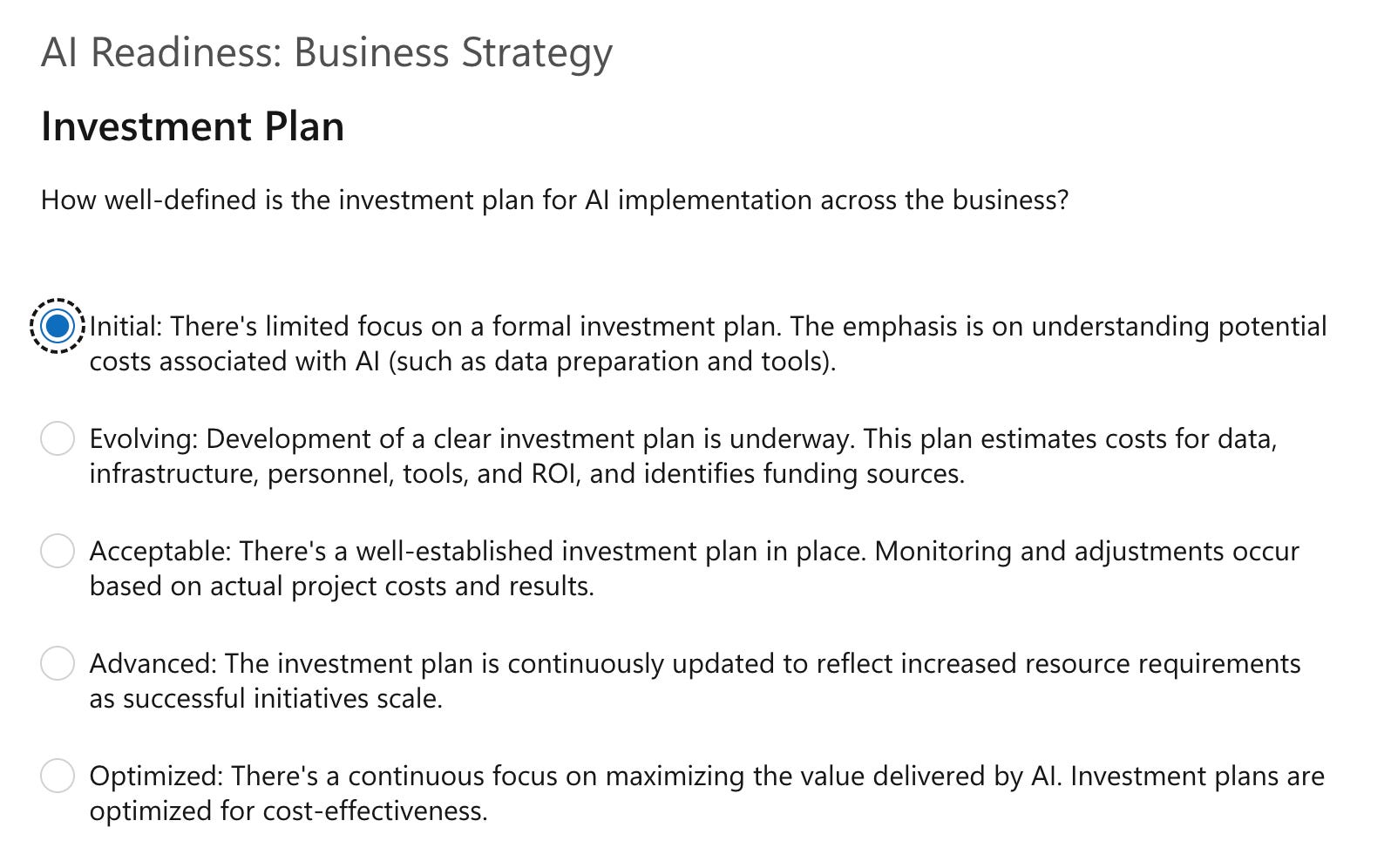
This assessment approach seems like a reasonable way to size up organizational readiness. Companies looking to put AI to work need leadership support, real safeguards, usable data, decent infrastructure, and people who know WTF they’re doing.
But there’s a question hiding inside those seven pillars that Microsoft never asks directly:
What knowledge is the AI actually going to use when someone asks a question (and expects an accurate answer) about how our products work?
