

There’s a certain fantasy floating around about self-employment. We picture ourselves sipping coffee, rejecting meetings, and finally doing “real work” without someone Slacking us every seven minutes.
And then reality shows up, sits down across from us, and quietly explains that we’ve just become our own finance department, sales team, IT support desk, and emotional support animal.
Lauren Pope’s post — What being self-employed in content really looks like — pulls back the curtain on what self-employment in content actually looks like — not the LinkedIn version, the real one. For tech writers flirting with the idea of going solo, there are some lessons here you. Read these before you dramatically quit your job.

Lesson 1: Your Income Is Not Your Income
Freelance math is not normal math. We might invoice what looks like a comfortable annual income, but we’ll take home roughly half after taxes, expenses, and the need to survive slow periods.
Also, no one is quietly contributing to our retirement while we sleep, either. That’s now our job. Along with insurance. And software subscription costs that multiply like rabbits when we’re not paying attention.
Translation for tech writers: That shiny day rate you’re imagining? Cut it in half before planning your new life as a financially stable rebel.

Lesson 2: You Don’t Have Clients, You Have a Portfolio of Risk
You’ll rarely have one steady stream of work. More often, you’ll be juggling two or three projects at a time, trying to balance focus with income stability.
Too few clients? You panic.
Too many clients? You do bad work and still panic.
And the kind of deep, strategic work many tech writers aspire to — content models, governance, structured content — requires long stretches of uninterrupted thinking. That doesn’t pair well with a calendar that looks like a game of Tetris.

Lesson 3: Work Comes From People, Not Platforms
Forget the fantasy of “I’ll just hang out a shingle and clients will appear.”
Ha! Not so much.
Most work comes from:
People who already know us
People who’ve worked with us
People who’ve read our stuff or who we’ve otherwise engaged
Word of mouth and reputation do most of the heavy lifting. Cold outreach? Advertising? Optional — and often ineffective depending on our niche.
Translation for tech writers: Our content isn’t just docs anymore. It’s marketing. Every blog post, webinar, or conference talk is quietly auditioning for our next client.

Lesson 4: The Market Doesn’t Care About Your Timing
We can be well-intentioned and do everything “right” and still have a bad year.
Budgets shrink. Strategy cycles end. Work dries up. We get sick. A project goes sideways and takes our sanity with it.
And here’s the fun part: when things go wrong, it feels personal. Because there’s no company to blame. It’s just us, staring at our insufficient pipeline of upcoming work.
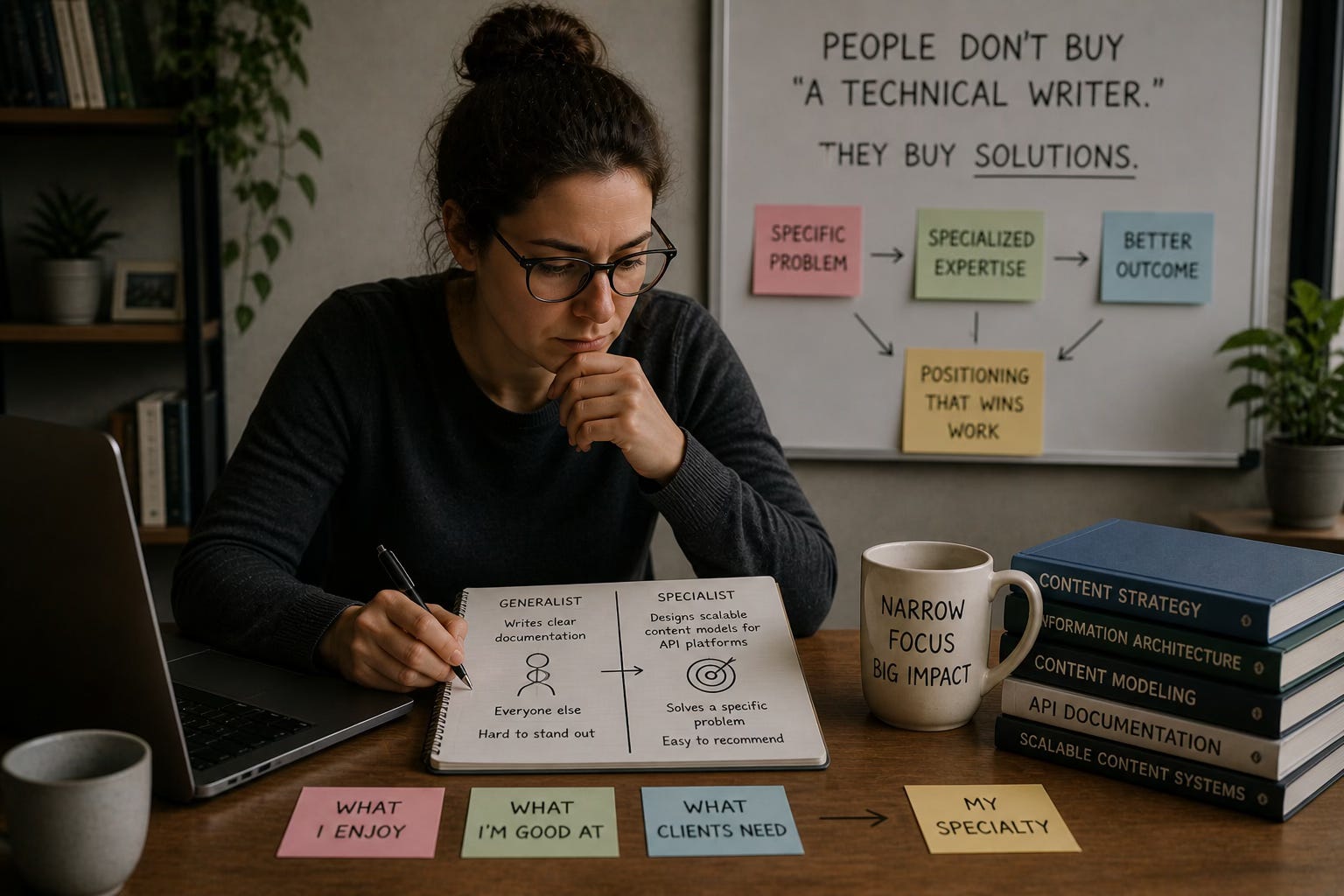
Lesson 5: You Must Specialize
Pope’s work leans heavily into content strategy, even though she still offers related services. That’s not an accident — it’s survival.
Clients don’t buy “a technical writer.” They buy someone who solves a very specific problem.
Translation for tech writers:
“Writes clear documentation” is not a niche. “Designs scalable content models for API platforms” is getting closer.

Lesson 6: Pricing Is Part Courage, Part Therapy
Most freelancers undercharge. Especially early on. My advice? Charge as much as you can without feeling physically ill — and then maybe a little more.
But don’t be delusional. Benchmark against peers. Understand the market. Then push yourself anyway.
It’s a struggle for many of us starting out to avoid allowing personal price sensitivity to impact our feelings about our worth. Sometimes, freelancers I’ve mentored undervalue their expertise because what they think they should charge sounds expensive, so they opt to charge less thinking this is how they will get the gig (by not charging too much — whatever that is).
If we don’t price your time and talents wisely, we’ll quietly build a business that looks busy but pays like a hobby.

Lesson 7: You’re Not Escaping Work — You’re Redefining It
Self-employment isn’t less work. It’s different work. You’re still writing, designing, structuring, and solving problems.
But now you’re also:
Managing cash flow
Finding clients
Negotiating contracts
Deciding what work to take (and what to walk away from)
The upside? We get to shape our careers around our values, interests, and make decisions that don’t overwhelm our tolerance for nonsense.
The downside? We have to shape it. No one else is coming to do that for us.
What This Means For Tech Writers
Thinking about going freelance? Here’s the quiet truth:
We’re not just becoming an independent writer. We’re becoming a small business that also happens to produce content.
And the skills that will matter most aren’t just:
writing clearly
structuring information
managing content systems
Instead, they’re:
positioning our expertise
building relationships
managing uncertainty
differentiating ourselves from the competitions
pricing our value
managing work-life balance
In other words, the work doesn’t get easier. It gets broader.
The Takeaway For Tech Writers
Self-employment can absolutely give us the career we wish existed. But it will also expose every weak spot in how we think about money, value, visibility, and resilience.
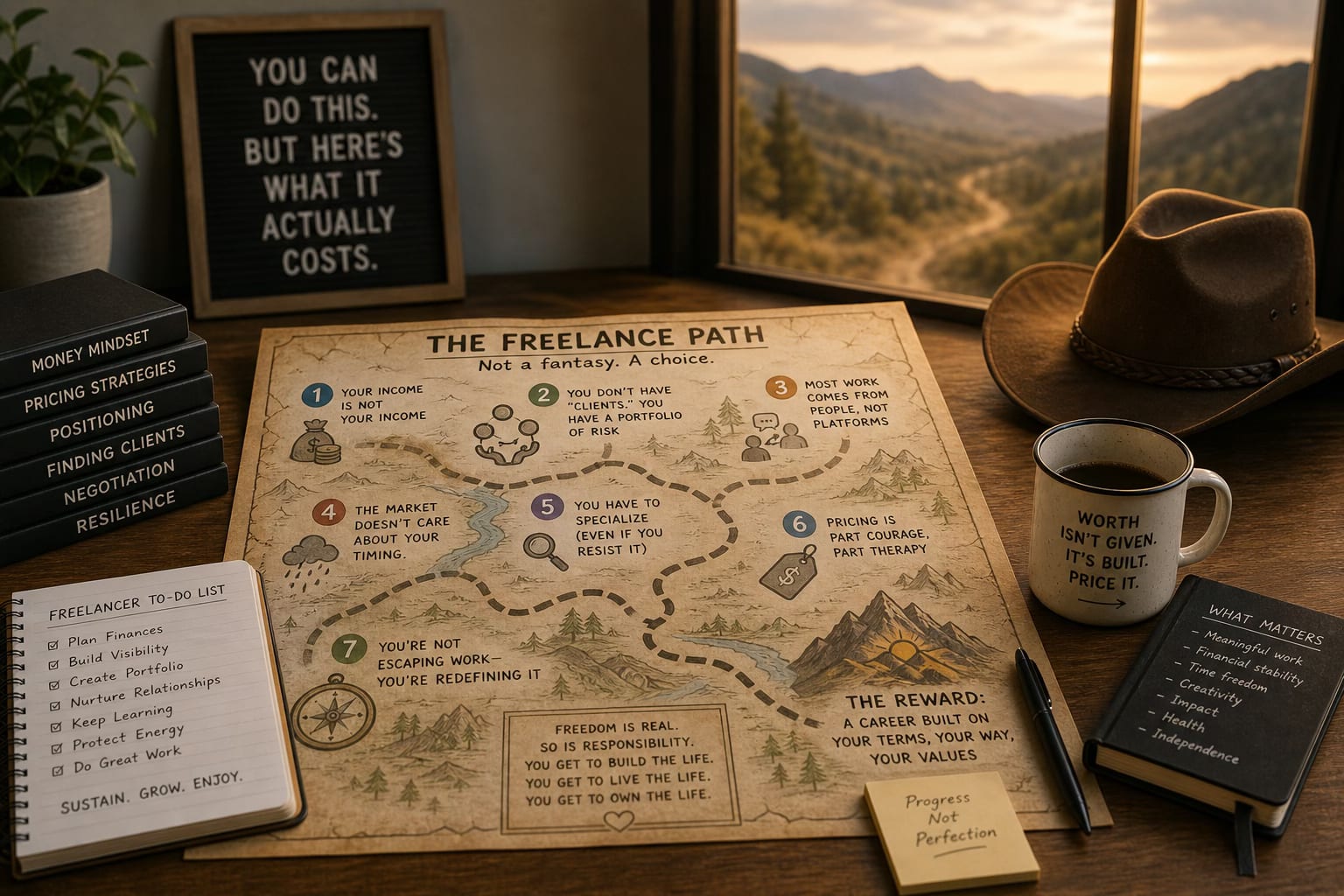
Which is why posts like this matter. They replace the unrealistic fantasy we conjure up ourselves with something far more useful: A map that says, “Yes, we can do this. But here’s what it actually costs.” 🤠
Outstanding. Absolutely true, simply and effectively written, and - surprise - relevant to almost any field, not just tech writing. Take it from one who did it (along with numerous side gigs) for 21 years . Thanks for sharing.
Thank you for this article! I relate deeply with this piece. Being a freelancer is extremely hard in so many ways, but I feel it also comes with a lot of stigma. Although I’m not so sure if it’s more linked to personal beliefs or more of a system issue. I just posted an article around this perspective. Please feel free to give it a read 💫 https://marielagodi.substack.com/p/i-am-a-wavelength-of-disciplines?r=3yss84&utm_medium=ios