

I’m working to develop a tool for spotting where documentation leaves an AI system to infer relationships it was never given. I call that an inference gap, and it can occur even when every page of our content is accurate on its own.
Consider this hypothetical example, a project-management app’s help center states these facts on three separate web pages in its documentation portal:
Only administrators can restore deleted projects.
Deleted projects remain recoverable for 30 days.
Trial accounts don’t support project restoration.
A user asks,
Can I restore the project I deleted yesterday?
The help center contains pages that state every policy involved in making such a determination, but no one page of docs connects them. To determine whether this user qualifies, an AI system has to work out — infer or guess [perhaps incorrectly] — how the restoration policy relates to roles and account types. It also needs to know the user’s role and account type before it can generate a trustworthy reply.
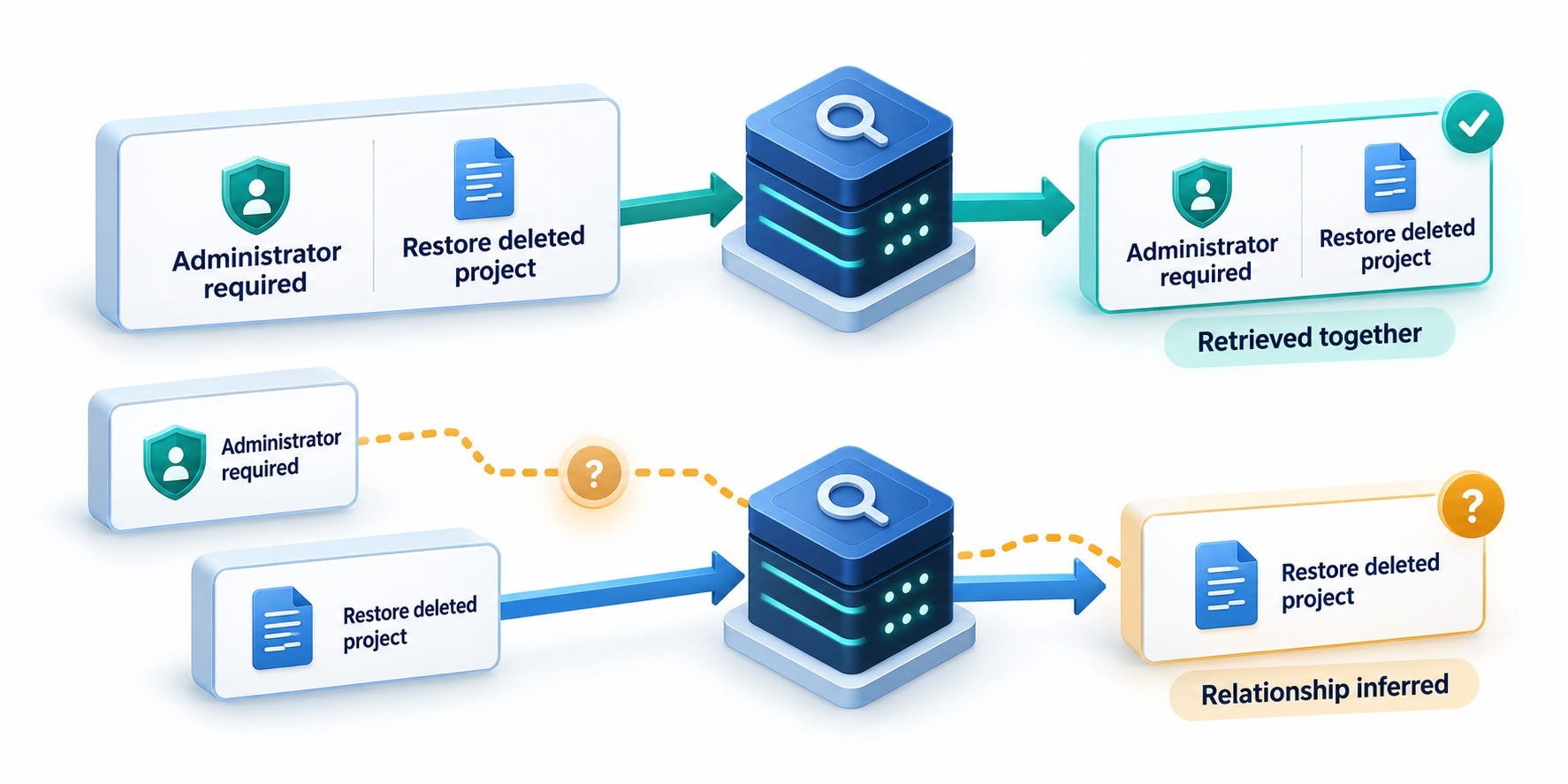
Each of those help center pages could be just like yours: full of good documentation that’s accurate, clear, complete, consistent, findable, and usable. Like yours, they probably follow familiar best practices and pass editing scrutiny.
None of that closes an inference gap, however.
Gaps like this raise two questions. I went looking for research to support (or challenge) my thinking about them:
👉🏾 1 Does stating how facts relate help an AI system answer more accurately?
👉🏾 2 Does knowing the user’s circumstances help it decide whether a rule applies?
