

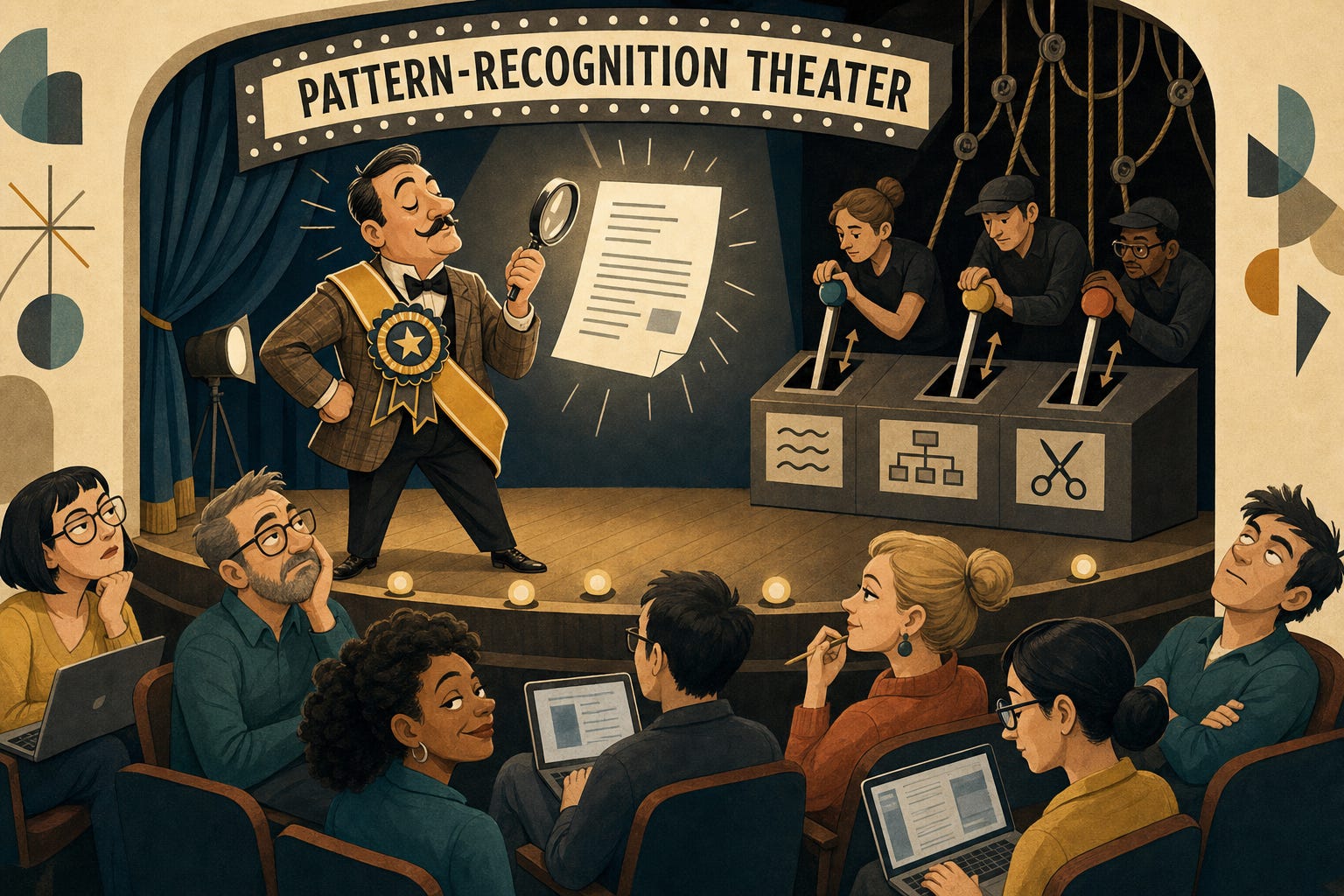
We’re now living through a strange little era of pattern-recognition theater.
You’ve maybe, probably, certainly seen 👀 it. Someone reads a post — not even a controversial one, just… competent — and within seconds they’ve appointed themselves Acting Director of Artificial Intelligence Detection. There’s an imaginary badge involved. Possibly a sash.
“Aha,” they announce, as if the room were waiting. “AI.”
Not because they ran tests. Not because they checked anything verifiable.
Because it felt like AI.
The Checklist Nobody Admits They’re Using
Here’s the quiet little rubric I believe some people carry around.
👉🏾 If the writing is smooth — suspicious.
👉🏾 If the structure holds together — very suspicious.
👉🏾 If the sentences don’t wander off halfway through like a man who forgot why he walked into the kitchen — practically a confession.
Add a neutral tone of voice, a few clean transitions, and suddenly we’ve got a case. Forget the fact that these are also the E-X-A-C-T things editors have been begging writers to do for decades. There are textbooks and apps designed to help us master these principles of good writing.
And, now… they’re evidence. 🔎
We’ve managed to turn basic competence into a red flag.
What They’re Actually Reacting To (It’s Not What They Think)
Some of what gets labeled “AI writing” isn’t machine output. It’s writing that hasn’t been claimed by a human voice yet. It may sound general; maybe a little abstract (like it could apply to far too many situations).
You read it and think, “Yep, fine… but who’s talking?”
That feeling? That’s not detection. That’s absence.
👉🏾 No specific constraints
👉🏾 No decisions you can point to
👉🏾 No moment where the writer clearly chose one thing over another and left fingerprints behind
It’s not artificial. It’s just… unfinished.
And we’ve had that problem long before anyone started prompting anything.
The Awkward Part For The Detectives
The characteristics that make writing better also happen to erase most of the so-called signals.
👉🏾 You add a real example — suddenly it “feels human”
👉🏾 You cut the filler phrases — now it’s “more authentic”
👉🏾 You vary the rhythm a bit, let one sentence run long and snap the next one short — apparently that’s personality now
👉🏾 You take a stance — even a mild one — and people relax
At no point did you disguise anything. You just did the job editors have always done: you made the writing specific enough to belong to someone.
Which leaves our comment-section sleuths in a slightly awkward position. They’re not identifying authorship so much as reacting to whether the draft got finished.
The Running Commentary Problem
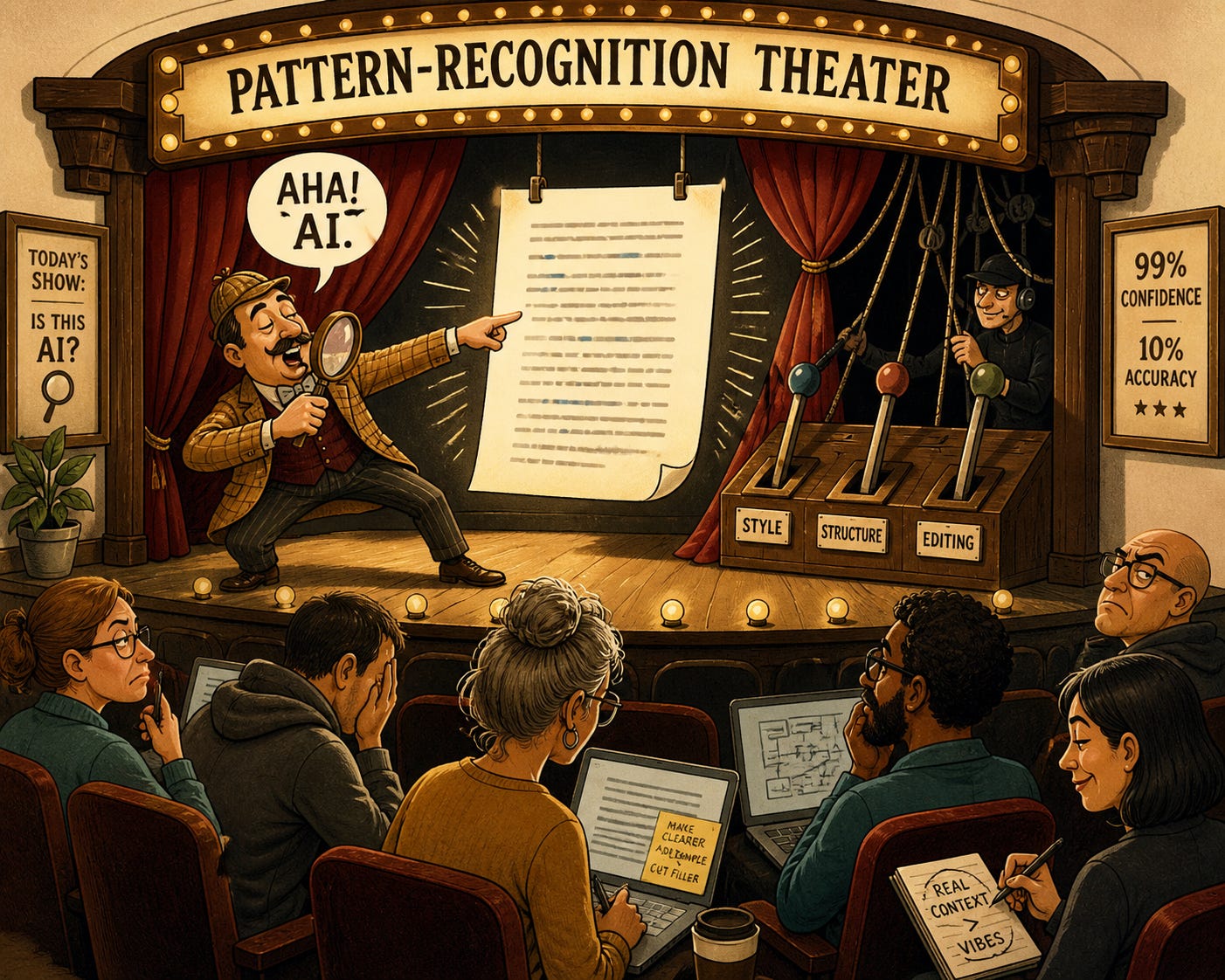
“This sounds AI-generated.”
Okay. And?
👉🏾 Did it say something wrong?
👉🏾 Did it miss something important?
👉🏾 Did it help anyone do anything?
Because if the answer to those questions is silence, then what we’re left with is a label floating above the work like a weather report no one asked for.
It feels like participation. It isn’t.
The Questions That Actually Move Things Forward
Better questions we should be asking:
👉🏾 Is this correct?
👉🏾 Is it useful in a real situation?
👉🏾 Does it reflect actual constraints, or just theoretical ones?
👉🏾 Would someone trust this enough to act on it?
These questions don’t care how our first drafts are made. Nope, they don’t — not at all. They care whether the final result holds up.
Here’s the part that tends to irritate most everyone equally:
👉🏾 A human can write something deeply unhelpful
👉🏾 A human, with assistance, can write something excellent
The tool doesn’t settle the question. The outcome does.

The Quiet Shift Nobody Wants To Name
What we’re really watching is a shift in expectations. Clean, structured, readable writing is no longer rare enough to be impressive; now it’s suspicious.
And instead of adjusting our standards upward (asking for more specificity, more accountability, more clarity) some people have decided to stand at the door and comment on the tools.
Not the work. The tools. 🧰
Stop Commenting On The Stove
If your first instinct when you read something is to announce whether AI was involved, you’re not engaging with the content. You’re describing the authoring process.
And in a world where process is increasingly blended, assisted, and frankly none of your business, that’s about as useful as reviewing a meal by speculating about the stove.
Meanwhile, the rest of us are trying to decide if the food is any good. 🤠
Excellent commentary. This has been my grouse too from the beginning - the core problem of being human (in the larger context with all its quirks) is still here. We just seem to be complaining about a different set of external tools. It used to be a variety of things across history - now it is also AI.
This is a great short article that gets to the core issue of AI search and retrieval. In practice, AI today is being used as a reference librarian that can quickly prepare a summary of data related to a request.
When I read a summary, I don't know what the request is - even when it's me who enters the prompt, I don't know the mechanics of how it's handled within the AI engine. All I can see is the result. The value of the result is determined by how I apply it to the work I'm doing, not whether it was prepared by ChatGPT or poorly translated from Arabic, or generated as a "hallucination."
If an enhanced AI mechanism accompanies its output with a "reliability index", are we any better off than we would be without it?