

I was hiking above Palm Springs on Mount San Jacinto a while back and had an a-ha moment. Being surrounded by nature gives me space to think. The desert floor spreads out below, the sky expands and the view is spectacular. The poor cell service means there are no constant notifications or beeps from my mobile device. I can focus on just being present. And, on a lucky day, I might even spot a bighorn sheep.
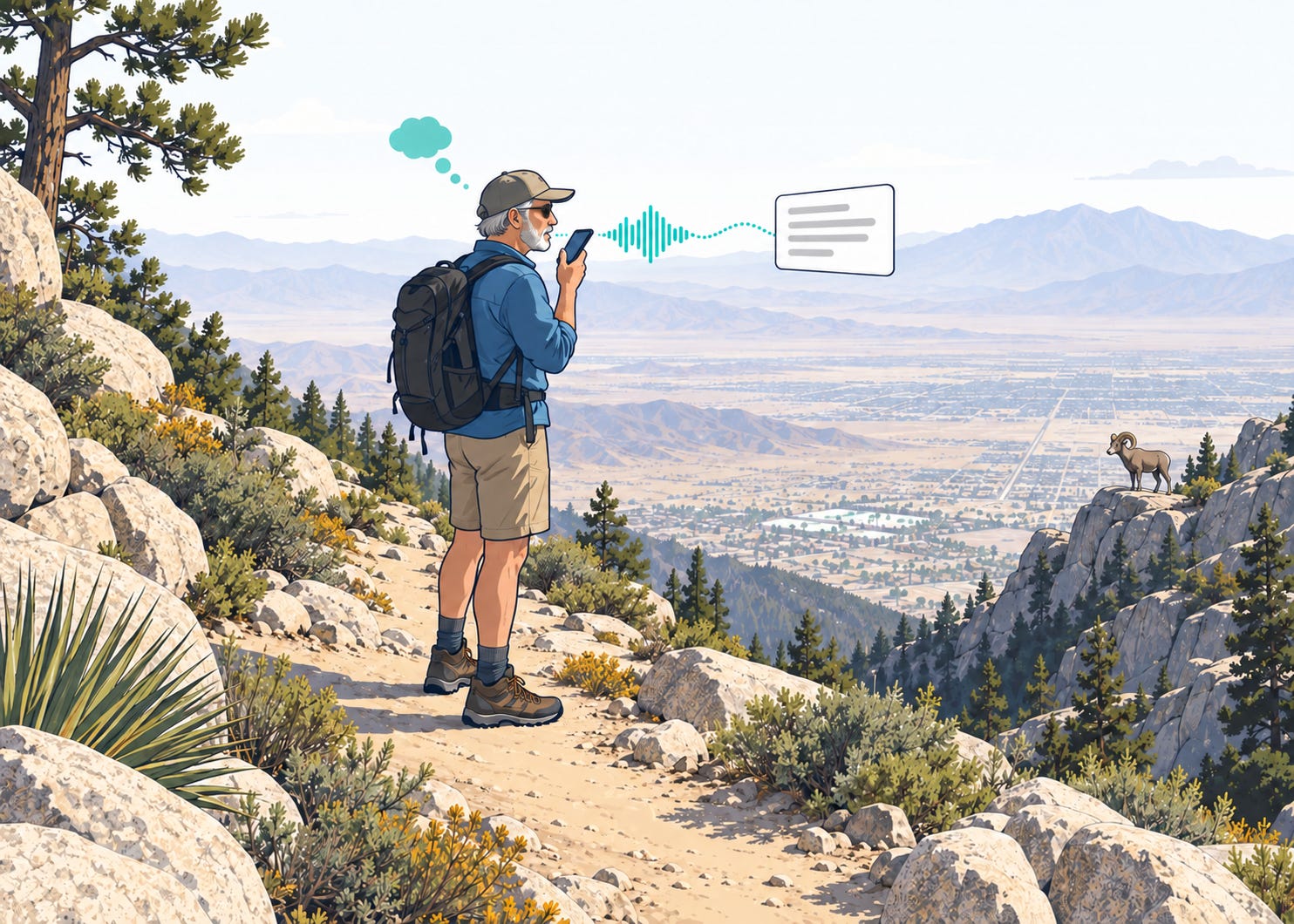
Notifications aren’t able to reach me easily on the mountain trail, and yet, my phone still proves helpful on these adventures. I use it as a compass, to take photos, listen to music, and to capture ideas that pop into my head like the aforementioned a-ha moment.
As the idea percolated around in my brain, I reached for my phone to save it. Through my polarized sunglasses, the screen looked almost blank. I knew what was happening. I had researched this phenomenon before and understood the polarized lenses were interfering with my ability to see the display.
I dictated the note instead.
The same thing has happened on sun-filled days at the pool and while bicycle riding. When the screen becomes hard or impossible to read, voice is easier than taking off my sunglasses, finding my prescription readers, and attempting to correctly type a message.
I’ve noticed similar choices about voice input among friends. Some say they use voice because changes in their vision make screens difficult to read. Others say they dictate messages because they’re often outside in bright light and have the same challenge as I did that day on the mountain. Others just prefer talking to typing.
Those observations are anecdotal, of course, but they gave me a question to investigate.
