

Many startup software companies assign ownership of API documentation to developers. On the surface, that makes sense. Devs build the APIs, understand their architecture, and know implementation details better than anyone else should.
The challenge is that knowing how a system works is not the same thing as knowing how to explain it to someone who has never seen it before.
Most developer-authored API documentation does a good job describing the API itself. Endpoints are listed, parameters defined, response codes documented, and OpenAPI-generated reference material provides a reliable inventory of available functionality.
And, yet…
👉🏾 developers still open support tickets
👉🏾 Integrations still fail
👉🏾 New users search community forums and GitHub discussions looking for answers
If the documentation already contains the technical details, why does that happen?
The answer is that API consumers are usually trying to accomplish a task, not study an API.

Documenting An API vs Helping Someone Use It
When devs write docs, they often focus on describing what exists. Tech writers focus on helping users understand how to use it. Those are related goals, but they’re not the same thing.
Developers might document the parameters accepted by an endpoint and the structure of the response. Tech writers add context.
👉🏾 Why would someone use this endpoint?
👉🏾 What business problem does it solve?
👉🏾 What assumptions does it make?
👉🏾 What must happen before it can be used successfully?
👉🏾 How does it fit into a larger workflow?
Those questions become important when users are under pressure to put something to work. Most people reading API docs are trying to complete a project, meet a deadline, or troubleshoot a problem. They aren’t reading for curiosity. They’re looking for the fastest path from problem to solution.
Does Content Consistency Reduce Confusion?
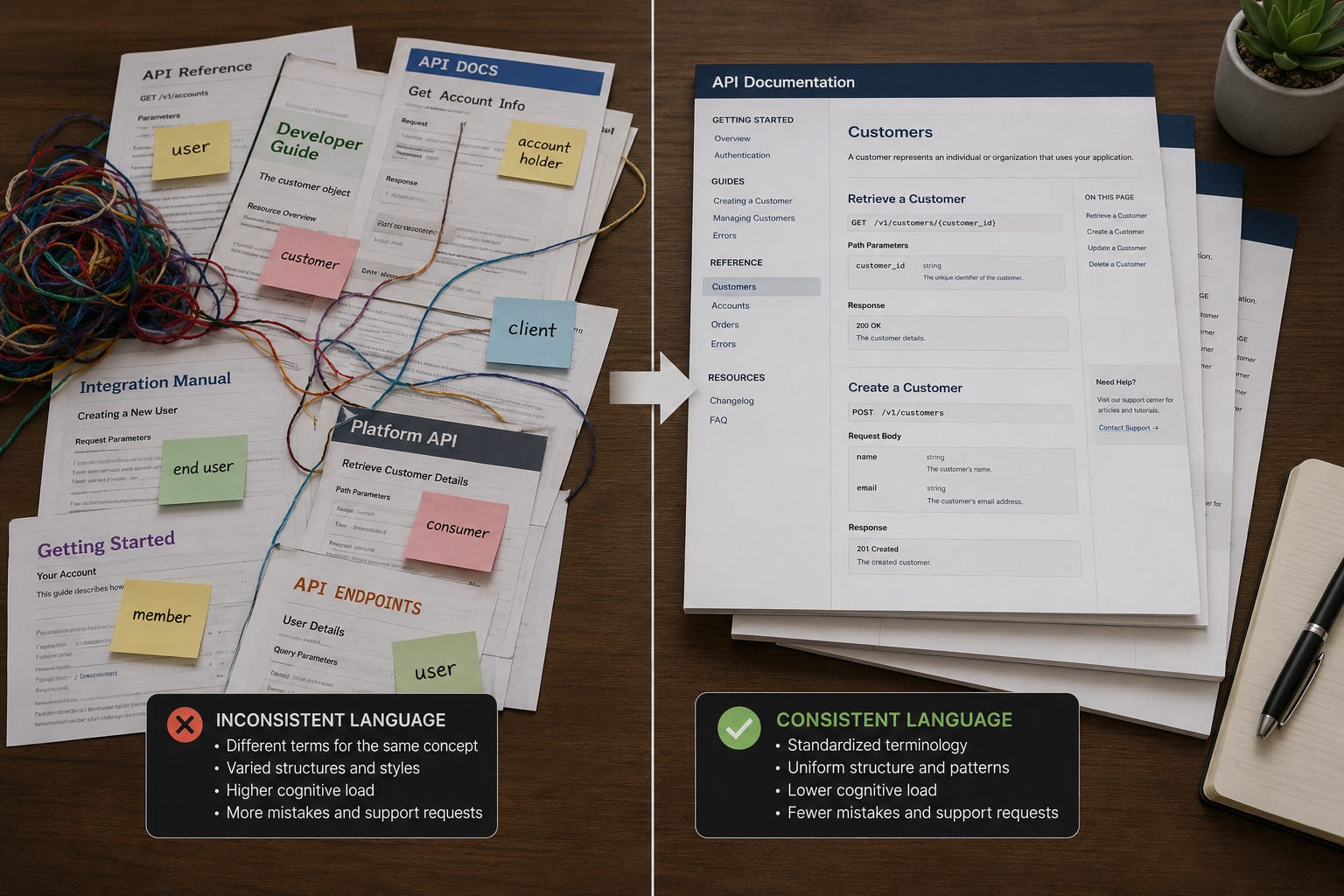
Yes. Consistent terminology, formatting, and organization make content easier to understand because readers do not have to stop and figure out whether different words, labels, or patterns mean different things. When content is inconsistent, people spend more time interpreting the information and are more likely to misunderstand it. Consistency helps readers find information faster, understand it with less effort, and complete tasks with greater confidence.
Without editorial oversight, API documentation can become a patchwork quilt of styles, terminology, and assumptions. Tech writers help bring consistency to the entire documentation set.
One team may refer to a “user.” Another uses “customer” to refer to the same role. A third introduces an entirely different term. The meaning may be obvious to the people who built the system and selected the term they use, but it is far less obvious to someone encountering it for the first time.
Consistency isn’t cosmetic. When terminology shifts, readers begin wondering whether different words describe different things. Ambiguity slows comprehension, increases mistakes, and creates unnecessary support requests.
Tech writers help reduce that ambiguity by standardizing terminology, creating documentation patterns, enforcing structure, and aligning language across the documentation set. We spend time making sure information is presented consistently because consistency reduces the effort required to understand it.
Related reading: Recommendations for Reducing Ambiguity in Written Procedures
APIs Live Inside Workflows
Another difference is that tech writers tend to think in workflows rather than individual components.
Developers often document APIs one endpoint at a time. Readers, however, need to accomplish tasks that span multiple endpoints and systems. They need to authenticate, submit requests, handle errors, manage pagination, work around rate limits, and recover when something goes wrong.
Good technical documentation connects those activities into a coherent process instead of treating each endpoint as an isolated object.

The Happy Path Is Only The Beginning
Examples are another area where technical writers often improve the user experience. Developer-authored examples frequently illustrate ideal conditions: valid inputs, successful responses, and predictable outcomes. Real implementations are rarely that tidy.
Users need to understand what happens when permissions are missing, requests fail, data is malformed, or assumptions prove incorrect. They need guidance for troubleshooting and recovery, not just confirmation that the happy path works.
Asking Different Questions
Perhaps the most valuable contribution tech writers make is serving as advocates for users.
Developers naturally view systems from the inside out. They understand the architecture because they created it (well, they used to understand, before they started co-coding it with Claude).
Tech writers approach the same system from the outside in. We ask what a new user will find confusing, what knowledge is assumed but never stated, which prerequisites exist only as tribal knowledge, and where someone is most likely to encounter difficulty.
Those questions improve docs but they often improve products, too. Documentation reviews frequently reveal onboarding problems, workflow gaps, inconsistent terminology, confusing error messages, and design decisions that create friction for customers.
Is Technical Documentation Part Of The Developer Experience?
Yes, API Docs are a critical part of DevX. API Docs aren’t simply a technical inventory of endpoints and parameters. They’re part of the developer experience. Developers provide the technical foundation, while tech writers help transform that foundation into something people and machines can understand, adopt, and use successfully.
The API may already be documented. Our opportunity is to make it usable. 🤠