

AI systems don’t “understand intent” the way humans do. They don’t read a question and grasp meaning the way you or I might. They don’t recognize tone, pick up on your oh-so-subtle hesitation, or notice that you are clearly panicking because your router is blinking like it’s auditioning for a electronic music festival.
Instead, AI infers intent. —> It guesses.
When you type, “How do I reset my router?” your AI doesn’t actually know what you mean. It doesn’t know if you want to reboot your device, restore its factory defaults, reset your Wi-Fi password, or erase all of your configuration settings and start over.
A human support agent would ask follow-up questions to determine those things. Large language models, on the other hand, often try to help by choosing the most statistically likely interpretation and charging forward with unbridled confidence.
That confidence is the problem.
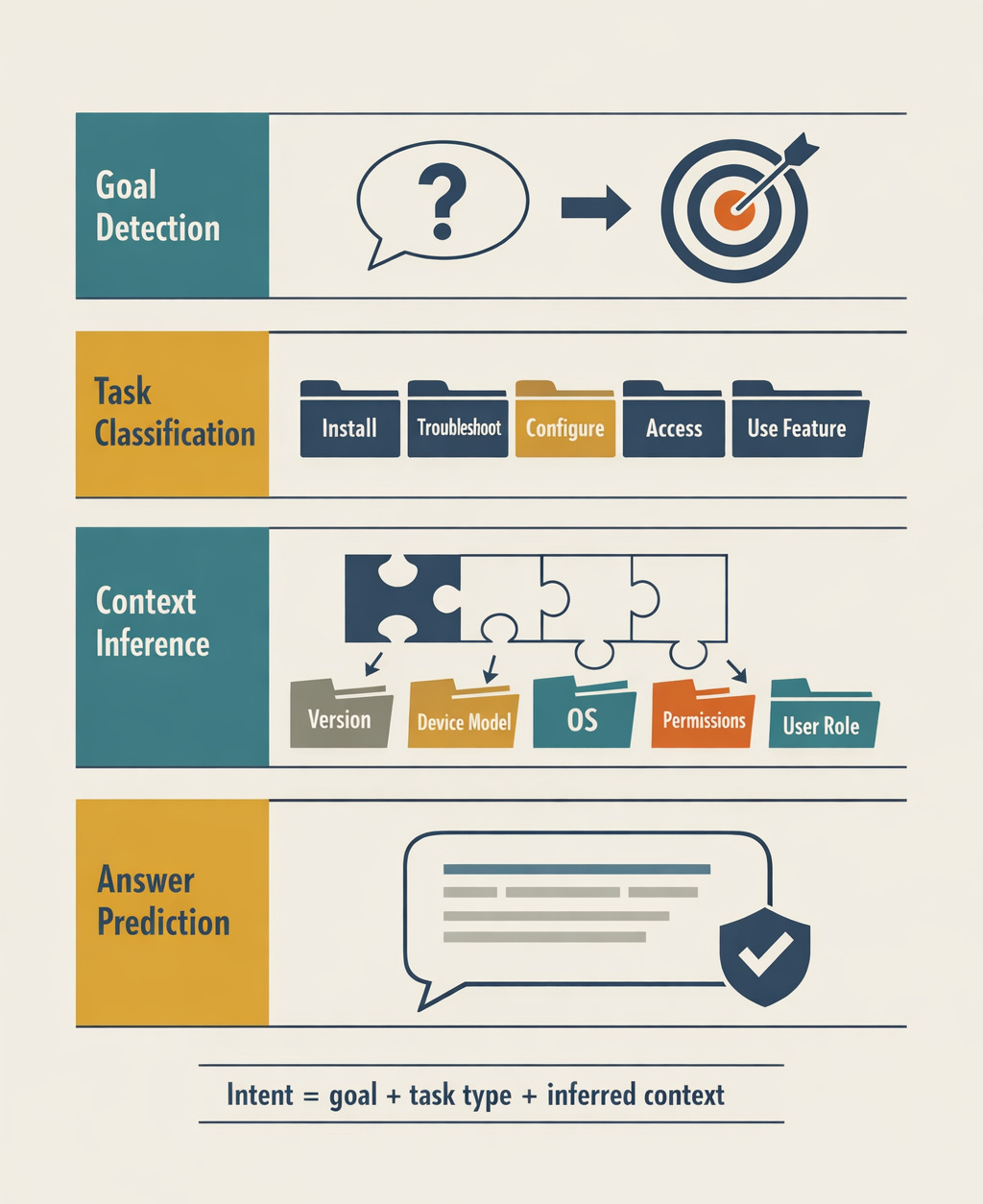
Most AI systems interpret intent through a combination of classification and prediction. First, the model tries to identify our user’s underlying goal. Then it tries to categorize their request into a general task type: installation, troubleshooting, configuration, account access, feature usage, compliance question, and so on. After that, it attempts to infer our missing context — product version, device model, operating system, permissions, and user role.
Finally, it assembles an answer. And this is where things can get really messy.
If the system has access to a retrieval layer (Retrieval-Augmented Generation or RAG), it pulls content from our docs and uses it to ground its response. If it doesn’t find the right content, or if it finds something incomplete, vague, or contradictory, it fills the gaps in our content using general training data and pattern recognition. In other words, it makes an educated guess.
Which is a polite way of saying: it invents plausible nonsense when it has to.