

Documentation debt creates support costs, frustrates customers, increases operational risk, and makes AI systems less reliable. None of these problems are new.
We’ve lived with the consequences of outdated content for years. What’s changed today is that those consequences are now much easier to see. Support analytics, customer feedback, self-service metrics, and AI systems now expose information problems that in the past may have remained hidden.
Tech writers have discussed these issues for decades. The costs are simply harder to ignore now.
What Is Documentation Debt?
Documentation debt accumulates when content changes more slowly than the products, services, policies, or processes it describes.
The symptoms are familiar: outdated procedures, obsolete screenshots, broken links, duplicate content, conflicting instructions, and knowledge base articles that no longer match the product.
Documentation debt rarely arrives all at once. A feature ships before the technical documentation is updated. A subject matter expert leaves the company. Ownership becomes unclear. Teams focus on creating new content while older information slowly falls out of date.
The work doesn’t disappear; it accumulates.
Many Tech Writers Already Understand Technical Debt
Many of us have spent years working alongside software teams that discuss technical debt.
Developers use the term to describe shortcuts, deferred maintenance, aging code, or design decisions that eventually make software harder to maintain. Teams understand that the cost does not disappear simply because the work was delayed.
Documentation works much the same way.
When updates are postponed, maintenance is deferred, or ownership becomes unclear, organizations accumulate documentation debt.
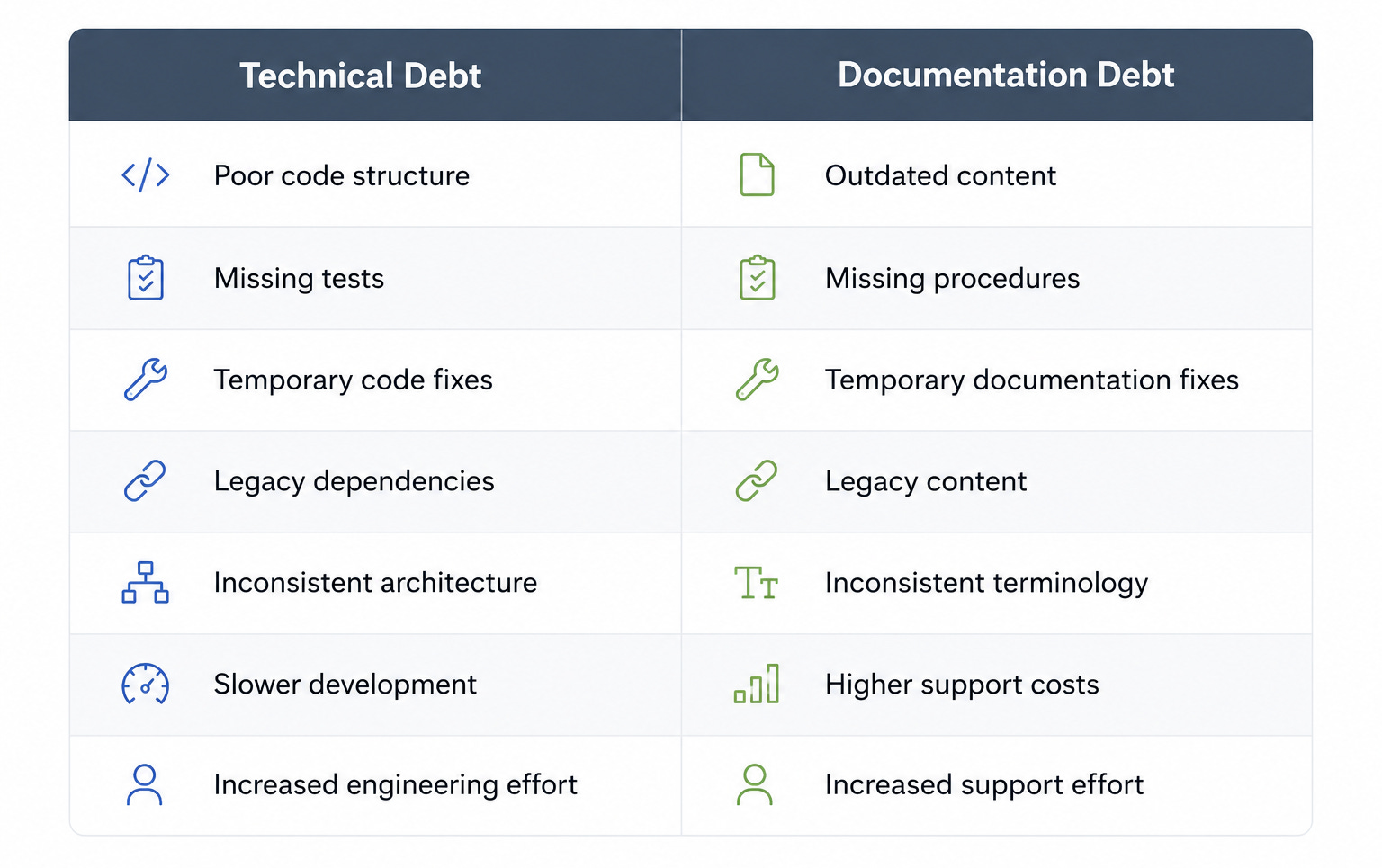
Both forms of debt represent deferred maintenance.
Technical debt affects the software itself. Documentation debt affects the information people rely on to use, support, maintain, purchase, and troubleshoot that software.
Engineers encounter technical debt in the codebase. Tech writers run into documentation debt through support tickets, failed searches, outdated procedures, and frustrated users.
Technical debt is widely recognized because it affects schedules, budgets, and engineering productivity. Documentation debt affects support costs, customer experience, operational risk, and the reliability of information systems.
Support Costs Increase
Customers who can’t find accurate answers themselves eventually give up and often contact customer support.
Support teams spend time correcting outdated instructions, explaining product changes, or helping customers navigate procedures that no longer match the product. The same questions appear repeatedly because the underlying information problem remains unresolved.
Organizations invest in self-service because they want customers to solve problems on their own. When users stop trusting the docs (or the answers generated by AI systems with access to them), those investments lose much of their value.
Higher ticket volumes, longer resolution times, and repeated support requests are often symptoms of documentation debt.
User Frustration Grows
Users rarely complain that our docs are outdated. Instead, they say the product is confusing. They struggle during onboarding, abandon self-service, and contact customer support because they can no longer find the answers they need. Sometimes they conclude that the company is difficult to work with and look to one of our competitors.
To the user, bad documentation is part of the product.
When instructions fail, screenshots no longer match the interface, or search results lead to obsolete content, confidence begins to disappear. Customers may blame the software, the support team, or (more than likely) the company itself.
Documentation influences the customer experience long before someone contacts support.
Notable quote:
“A mismatch between the copy used to describe a service and the choices that a user can actually make is an easy way to lose trust.”
— Lexie Kane, Nielsen Norman Group
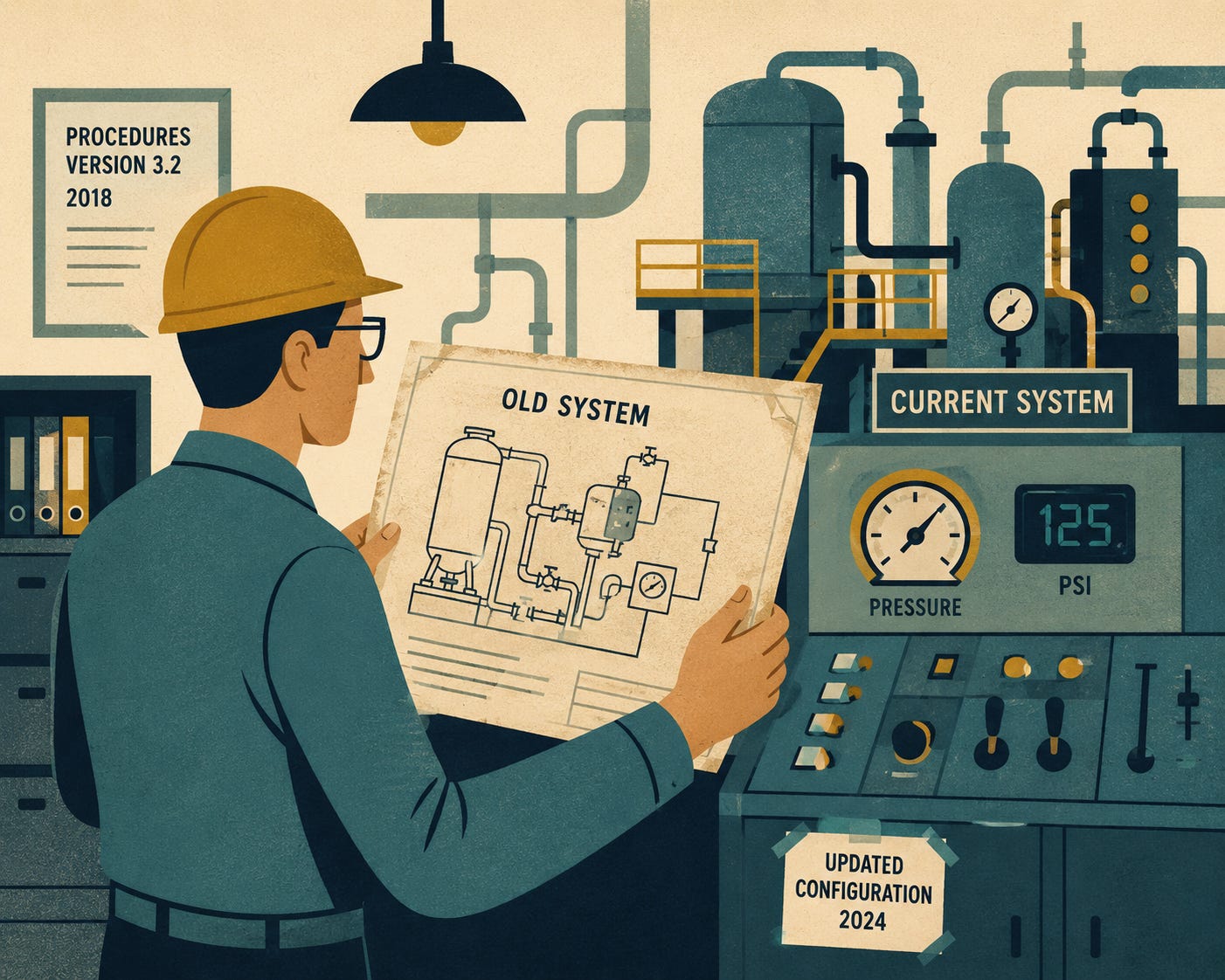
When Information No Longer Matches Reality
Problems arise when people rely on information that no longer matches the systems, products, or policies they use every day.
Incorrect procedures, obsolete warnings, inaccurate configuration instructions, or outdated policy information can affect compliance, security, safety, and business operations.
Internal documentation creates similar risks. Employees may rely on procedures that no longer reflect current systems or company policies.
Every organization depends on accurate information to help employees and customers make decisions.
AI Makes Documentation Problems Easier To See
In some organizations, AI has become the equivalent of a very impatient customer. It encounters outdated content, conflicting instructions, and missing information immediately.
AI assistants often rely on product documentation, knowledge bases, customer support articles, and internal data repositories to answer questions. When those sources contain outdated or conflicting information, the answers they generate often reflect those same problems.
Generative AI has made documentation problems much harder to ignore. It frequently exposes information problems that support teams and customers have encountered for years.
Some organizations first recognize their documentation problems when an internal assistant or customer-facing chatbot gives users the wrong answer. Investigation often reveals that the underlying content itself is unreliable.
Why Tech Writers Should Care
Technical writers understand that information requires maintenance. Most of us have encountered procedures nobody follows, features that changed without notice (or were never implemented as planned), and content that remained untouched for years because no one owned it.
What has changed is who experiences the consequences.
Support leaders are seeing rising ticket volumes. Customer success teams are hearing complaints. Product managers are struggling with adoption problems, and executives are worrying about the risks associated with inaccurate AI answers.
These concerns create opportunities for tech writers to participate in conversations that extend beyond publishing schedules and content deliverables.
Documentation quality is a business issue.

What Technical Writers Can Do
Tech writers may not own every content decision, but they often recognize documentation debt before anyone else does. Many writers have encountered knowledge base articles that nobody has reviewed in years, procedures tied to features that no longer exist, or instructions that support teams quietly work around every day. The challenge is often not identifying the problem. It is helping the organization understand which problems matter most and why they should care.
Find The Biggest Problems First
Many organizations don’t know how much outdated content they maintain.
Content audits can reveal pages that have not been reviewed in years, procedures associated with retired features, broken links, duplicate information, and articles connected to recurring support cases. Support data, search analytics, and usage information often point directly to the places where stale content creates the greatest frustration.
We don’t have to fix everything at once. We need to identify where inaccurate information creates the greatest consequences.
Start Where The Pain Is
Not every piece of documentation deserves the same level of attention.
Customer onboarding information, installation instructions, troubleshooting content, frequently viewed knowledge articles, and safety or compliance information often have the greatest impact on customers and support teams. Content associated with recurring support cases may also deserve immediate attention.
A relatively small amount of content often creates a disproportionate amount of user frustration.
Make Maintenance Part Of The Process
Documentation debt accumulates when maintenance becomes nobody’s responsibility.
Review schedules, named content owners, release-driven content reviews, and regular audits help prevent information from quietly becoming obsolete. Software development teams routinely plan for maintenance work. Documentation teams can benefit from the same discipline.
Use AI To Find Problems
AI can help identify documentation debt as well. Doc teams can use AI tools to locate duplicate content, identify inconsistent terminology, compare procedures against current interfaces, and detect references to retired features.
Human review remains essential, but AI can help surface information problems that might otherwise remain hidden.
Tech writers may not control product roadmaps, staffing decisions, or organizational priorities, but they do understand how information breaks down over time and where those failures affect customers, employees, and support teams.
That perspective is increasingly valuable.

Documentation Supports Business Operations
Organizations often think of documentation as something that gets written, published, and moved aside.
The people using that information experience it differently.
👉🏾 Employees depend on it to do their jobs.
👉🏾 Customers use it to solve problems.
👉🏾 Support teams rely on it to answer questions.
👉🏾 AI systems increasingly use it to generate responses.
When the information no longer matches reality, the consequences show up throughout the organization.
Technical debt became an accepted business concern because organizations learned that ignoring it became expensive. Documentation debt is no different.
Many organizations still treat documentation debt as a publishing problem rather than a business problem. It’s time for that to change. 🤠