

A colleague recently asked for my feedback on a presentation idea: a draft paper advocating the adoption of S1000D in the nuclear energy industry.
I agreed with much of it. S1000D helps organizations manage and exchange reusable technical information, and it records which equipment configurations each instruction applies to. Those capabilities are valuable where an incorrect maintenance instruction could put people at risk.
One claim went further. The author credited S1000D with providing a machine-readable foundation for AI platforms, “eliminating information blind spots and model hallucination risks.”
Eliminating is the word I object to. That’s not a defensible claim. I’ve advocated for structured content, including DITA XML and component content management systems, for much of my career, and I share the author’s preference for structured information over the standalone word processor files the paper describes.
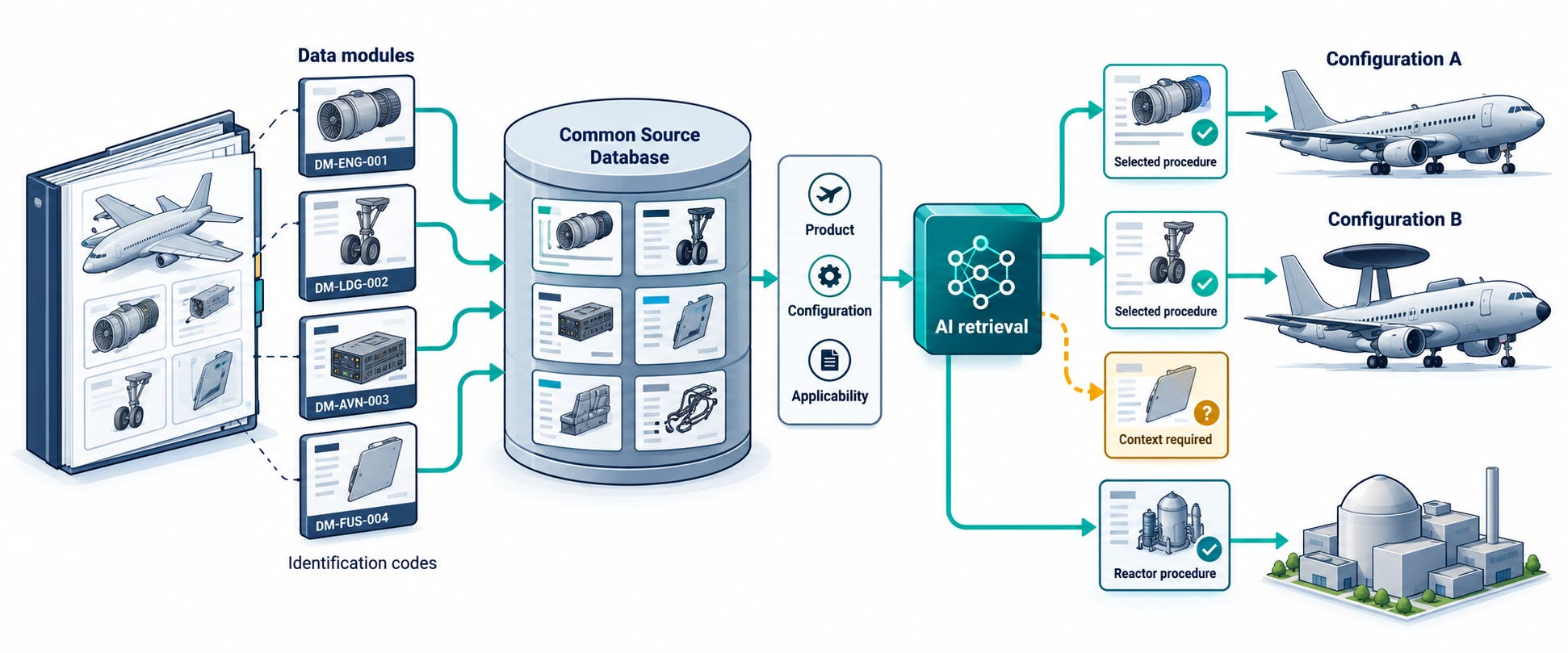
One Aircraft, Many Configurations
S1000D began in European aerospace and defense in the 1980s. It organizes technical information into data modules, identified by codes and managed in a Common Source Database (CSDB). The modules can be maintained independently and used in publications for different products or configurations.
An aircraft manufacturer, for example, may need one procedure for a particular equipment configuration and another for a different one. S1000D provides a way to identify where each procedure applies. An AI system could use that information to help select the appropriate instructions, provided its retrieval process has access to it and applies it correctly.
