

by Colleen Jones, Content Science
Imagine an AI agent that can investigate why customers keep asking the same question, find the relevant product documentation, compare it with known issues, identify gaps in the explanation, and recommend what your team should fix first.
Now imagine that agent can do more than make recommendations. It can prepare an updated knowledge article, check it against your terminology and style standards, route it for review, and help measure whether the change reduces customer confusion. That is a much different proposition from asking AI to draft a paragraph.
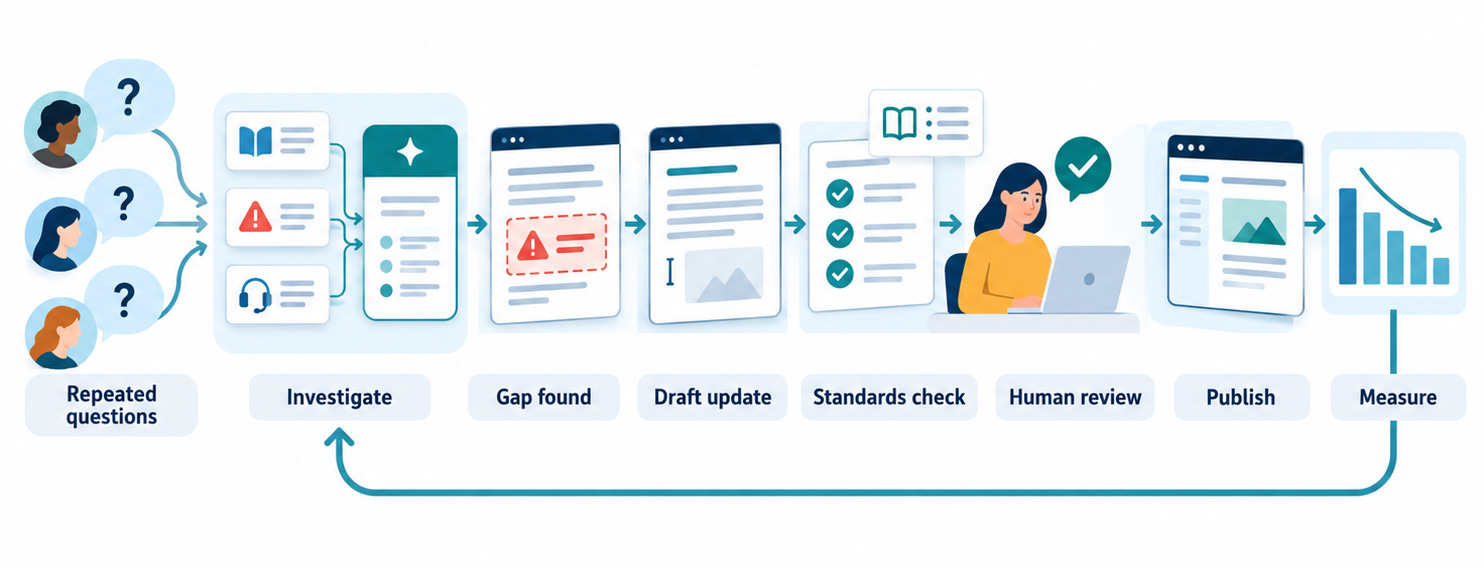
It also raises a different set of questions:
What knowledge does the agent need?
How will it know what good looks like?
Which tasks can it perform independently?
Where should a person review its work?
And how will your organization know whether the effort improves the customer experience?
These are the questions forward-thinking technical communication, product content, customer support, and customer success leaders will ask as agentic AI evolves.
In my recent article, Are AI Agents Useless Failures or the Key to AI’s Future?, I explored why the promise of agents depends on applying them to useful organizational work, making them easier to manage, and connecting them to the right knowledge.
For content teams, those principles have particularly important implications. Agents could change not only how content gets created, but also how teams maintain product knowledge, resolve customer issues, coordinate work, and improve experiences over time.
The real opportunity here is not to create more content with fewer people. It’s to make organizational expertise more accessible and actionable. Let’s consider five ways to act on this opportunity.
1. Start With the Work Customers and Teams Need Done
The first question about agentic AI shouldn’t be,
“What can this agent do?”
It should be,
“What work needs to get done, and why is it difficult today?”
Or, use this eye-opening variation that Laura Barnes, senior director at Red Hat, shared with me on my podcast Content Powers AI,
“What do you not want to do anymore? What do you think is a waste of your time?”
Consider the work surrounding a seemingly straightforward support question. A customer encounters an error. A support specialist searches documentation, checks a troubleshooting guide, consults an internal knowledge base, reviews known issues, and perhaps asks a product expert for help. If the documentation is incomplete or outdated, the specialist may need to piece together an answer from several sources.
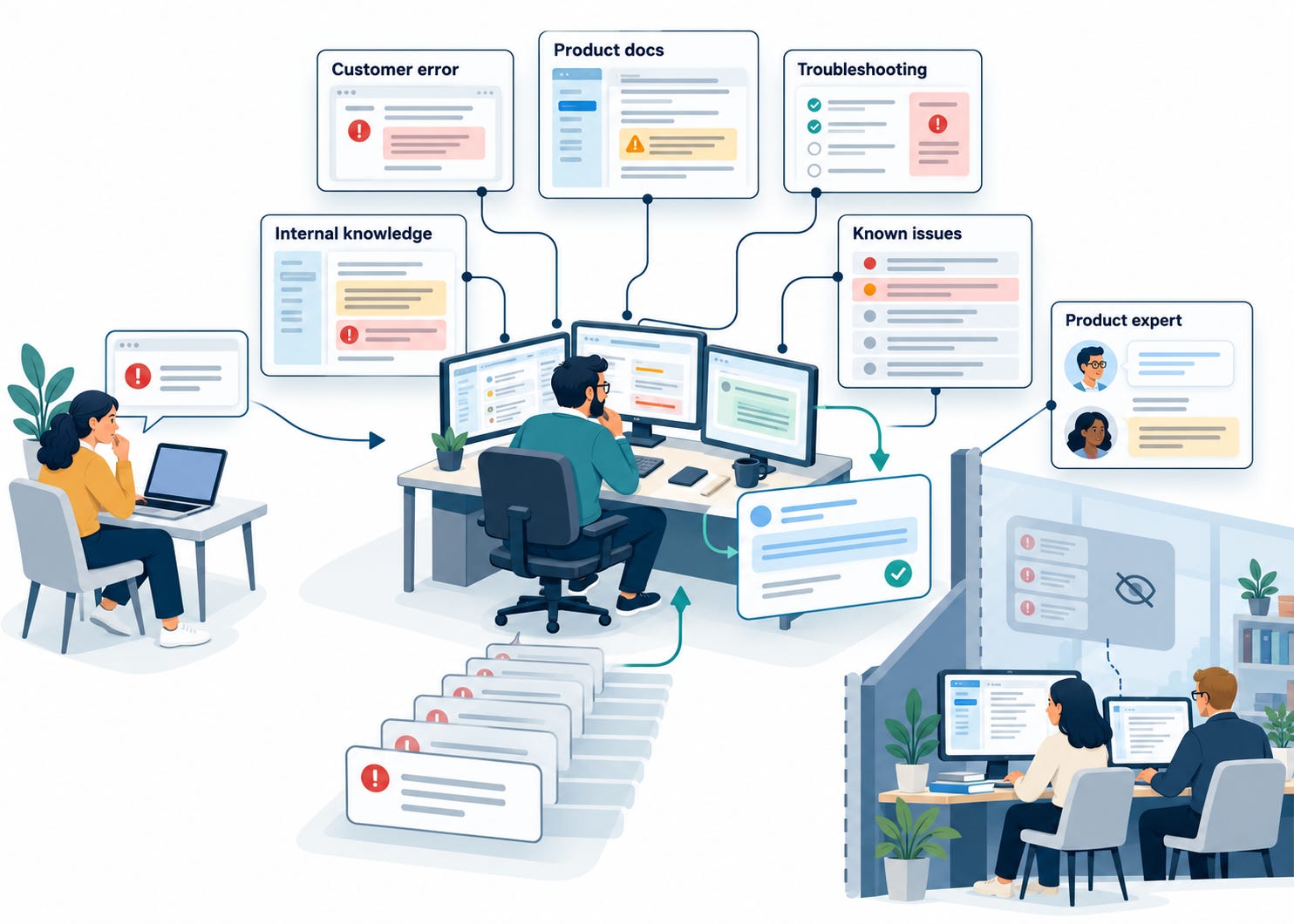
Meanwhile, the documentation team may not know that the same question has consumed hours of support time across hundreds of cases.
The underlying work crosses functions, systems, and content types. It may require research, analysis, coordination, and judgment—not just writing.
Agentic AI can be useful when it takes on portions of this interconnected work. For example, an agent might:
Analyze support cases to identify recurring questions and emerging issues.
Locate relevant product documentation, release notes, and internal knowledge.
Compare customer questions with existing answers to identify content gaps.
Assemble evidence and recommendations for a technical writer or product expert.
Prepare a content update and route it through the appropriate review process.
Help connect changes in documentation with subsequent support outcomes.
These are potential applications, not capabilities every agent automatically possesses. They depend on the agent’s tools, access, instructions, and the quality of the organization’s underlying information.
The important shift is to begin with a real workflow and identify where an agent can make a meaningful contribution.
For content and support leaders, this means looking beyond isolated writing tasks. Examine the work that happens before and after content is published: finding information, validating it, maintaining it, responding to feedback, and coordinating changes across teams. That is where larger opportunities lie.
2. Design the Workflow, Not Just the Agent
An agent can be impressive in a demonstration and still struggle to deliver value in daily work. That’s because organizations don’t operate through isolated prompts. They operate through workflows, responsibilities, systems, and decisions.
A technical writer might need to know whether a product feature has shipped before updating its documentation. A support specialist might need to distinguish between a verified solution and a workaround that applies only to certain configurations. A customer success manager might need to coordinate guidance across product versions, customer environments, and account-specific requirements.
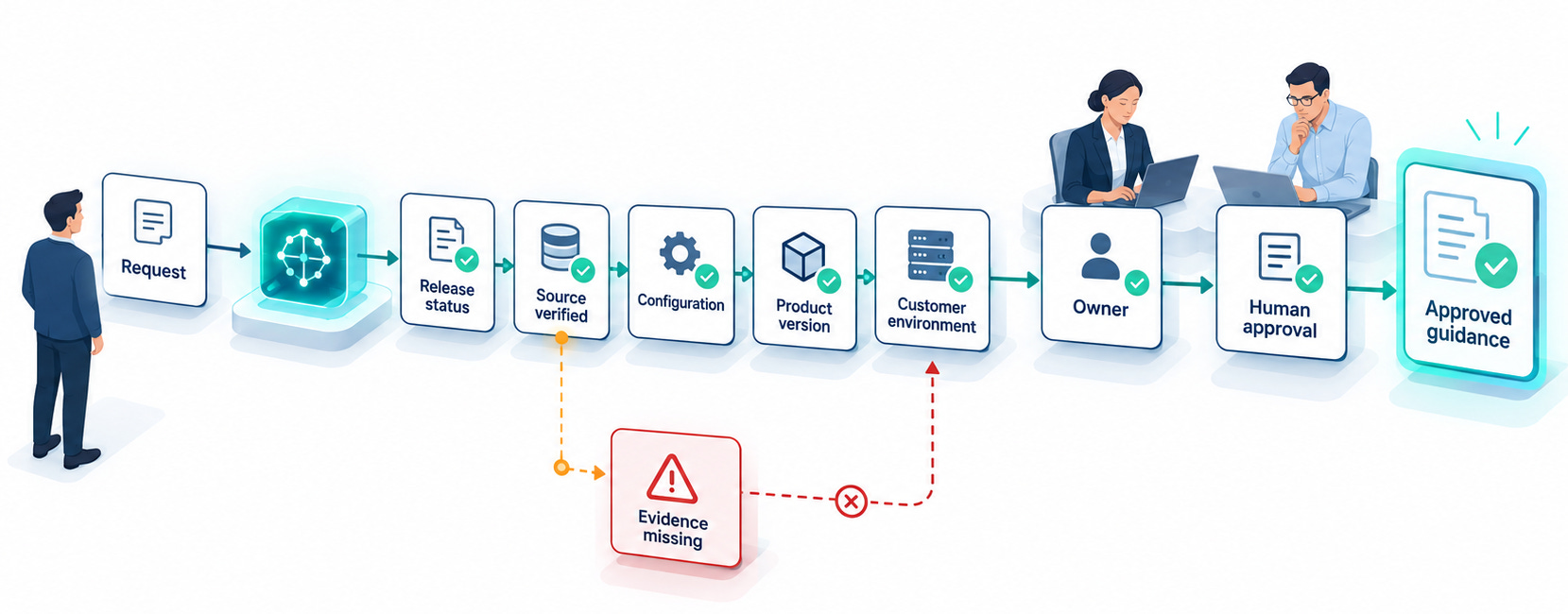
An agent that ignores these realities can produce plausible work that is nevertheless wrong, premature, or unusable. Chuck Gahun, a principal analyst at Forrester, and I recently discussed this on Content Powers AI. He noted,
“The ones that are being successful … are the ones that are thinking through their content ops processes fundamentally differently in the age of agents. That’s where the value comes for an organization.”
Making agentic AI useful requires rethinking how work moves through the organization. It starts by mapping the workflow you want to improve. Identify the information needed at each step, the decisions people make, the systems involved, and the conditions under which work can move forward.
When you really get into this thinking, you realize agents can do very useful things—such as run multiple analyses in parallel, synthesize results, and draft insights—that humans simply cannot do. And that can unlock new possibilities.
For instance, even though our research into content operations for the past decade shows measuring content effectiveness or impact is a top success factor, 50% of organizations don’t do it. They report not having the time, training, tools, or resources. Agentic AI can close this gap.
As you consider the possibilities, further determine which activities an agent can perform, which decisions require human judgment, and which actions need explicit approval.
For instance, an agent might be allowed to identify outdated documentation and prepare a proposed revision. It might also check the draft against product terminology, accessibility requirements, and approved sources. But publishing a change that affects a critical workflow could require review by a product specialist or designated content owner.
This isn’t about adding approval steps everywhere. It’s about placing controls where errors could meaningfully affect customers, employees, or the business.
It also means designing for exceptions. What happens when sources disagree? What if the product version is unclear? What if the agent cannot verify an answer?
A useful agent needs a way to recognize when it lacks sufficient information and escalate rather than confidently improvise.
The goal is not to automate an existing workflow exactly as it is. It’s to determine whether the workflow itself should change—and then decide where agentic AI can make that new workflow more effective.
3. Give Agents the Knowledge and Context They Need
Here’s a challenge that content professionals understand particularly well: Having information available is not the same as having information that is useful and actionable.
An organization may have extensive product documentation, troubleshooting guides, knowledge articles, release notes, and internal expertise. Yet customers and employees can still struggle to find the right answer.
Information may be scattered across repositories. Terminology may vary between product teams. Instructions may contradict one another. An article may be accurate for one product version but wrong for another. Important knowledge may exist only in the experience of a few specialists.
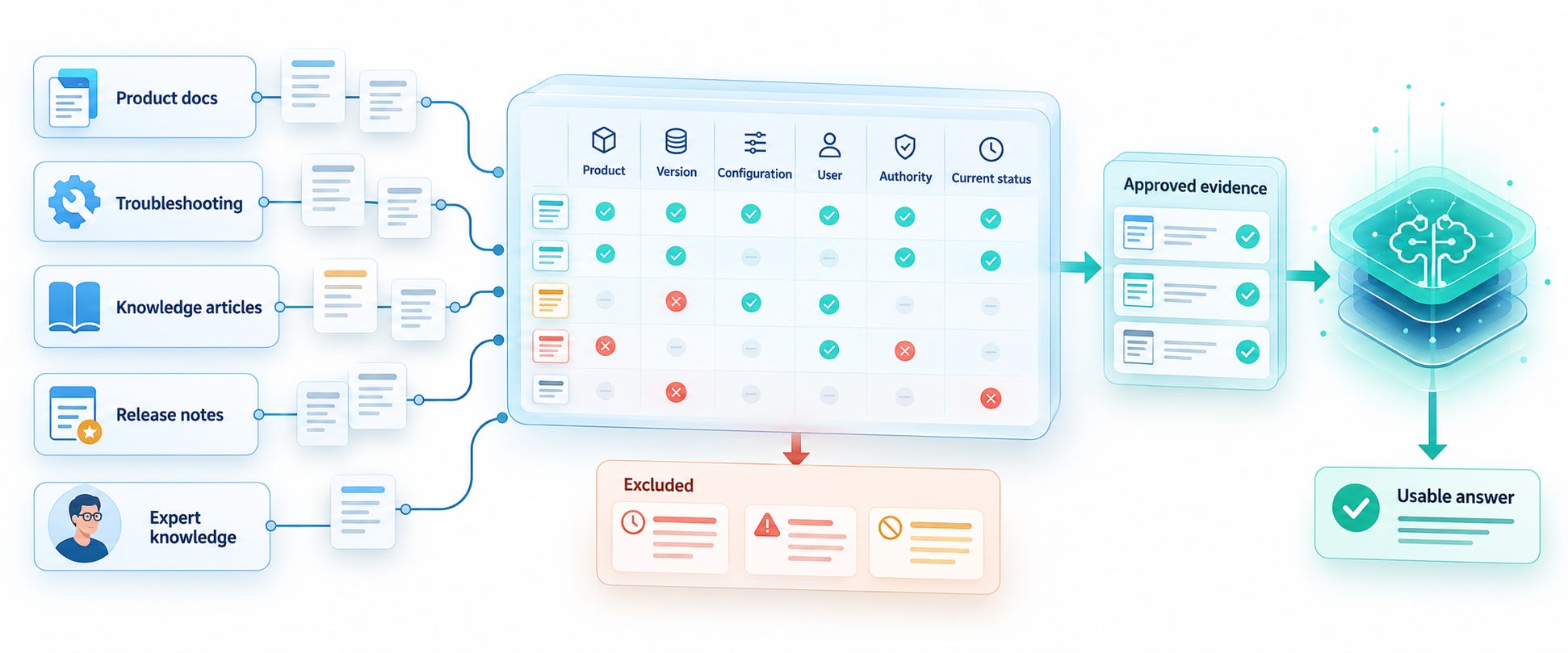
These issues become especially consequential when AI agents begin using organizational information to recommend answers or take action.
A human expert can sometimes recognize that a document is outdated, infer what an ambiguous instruction means, or ask a colleague for clarification. An agent may not have the context needed to make those distinctions reliably.
That makes the content environment a critical part of agentic AI. For technical communication and product content teams, preparing that environment may involve:
Establishing trustworthy sources. Identify authoritative content and clarify which sources take precedence when information conflicts.
Improving structure and relationships. Make products, features, tasks, concepts, versions, and related information easier to distinguish and connect.
Maintaining accuracy over time. Connect content updates to product releases, policy changes, known issues, and other events that affect its validity.
Clarifying ownership. Establish who is responsible for approving, maintaining, and retiring different types of knowledge.
Providing meaningful context. Make clear who an instruction is for, when it applies, what prerequisites it assumes, and what limitations matter.
Making expertise accessible. Capture the reasoning, standards, and specialized knowledge that help experienced people make good decisions.
Not every organization can restructure all of its content before experimenting with agents. If you’re in that situation, you can start with the knowledge required for a specific workflow. Assess its quality, accessibility, structure, and governance. Address the gaps that are likely to affect the agent’s performance, then expand based on what you learn.
The broader lesson is that content quality for agentic AI involves more than well-written sentences. It includes the reliability, relationships, context, and governance of the knowledge those sentences convey.
4. Make Human Expertise More Valuable, Not Less
If people no longer have to do the content work they don’t like or that is a waste of their time, an interesting question arises. What can people can do with the capacity that becomes available?
Technical communicators bring more than writing skills. They understand how people use products, where instructions break down, how terminology affects comprehension, and how to translate complex systems into useful guidance.
Customer success professionals understand customer goals, adoption barriers, organizational context, and the factors that help customers realize value.
These capabilities represent different forms of expertise that can improve the decisions an AI system supports.
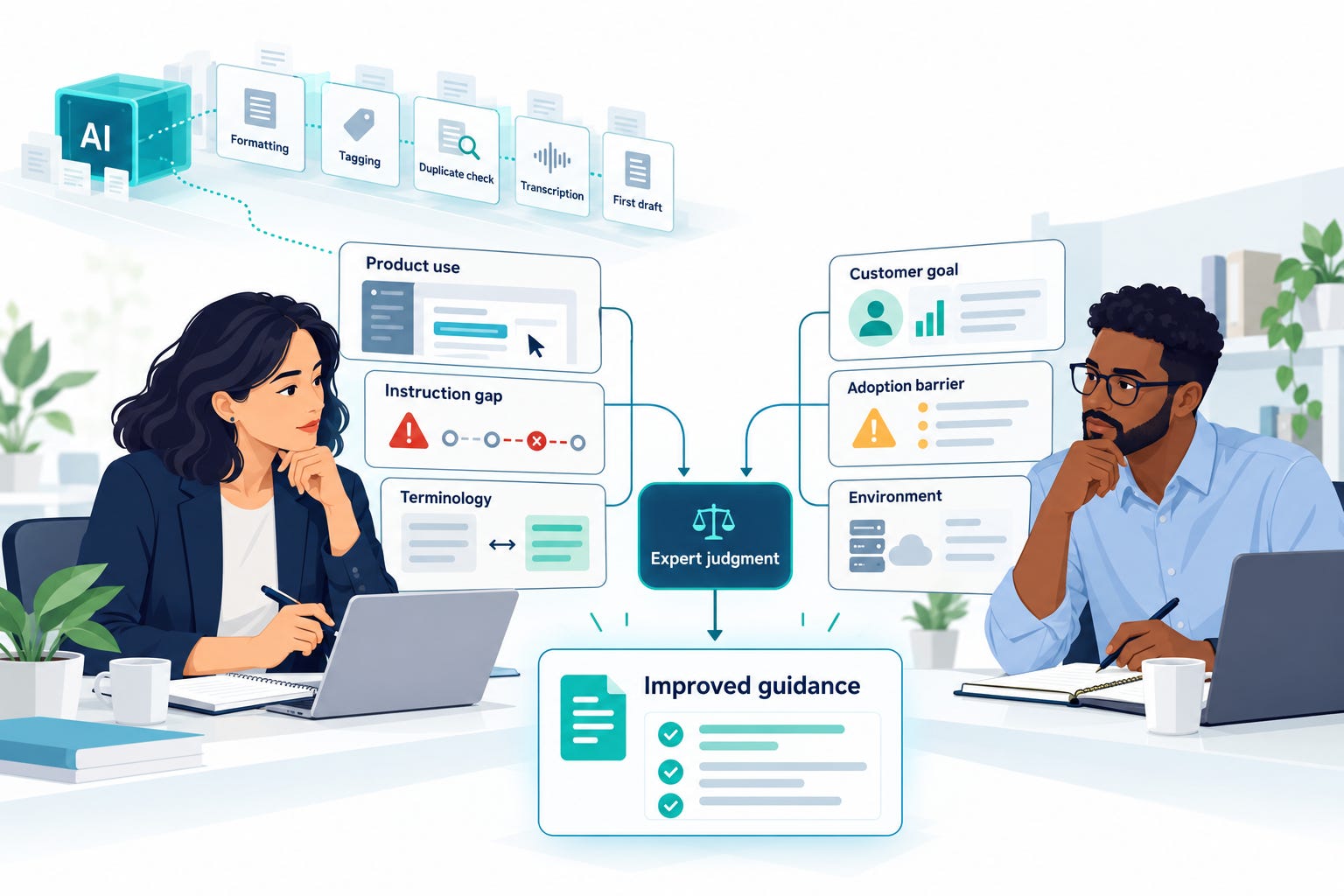
Imagine an agent that analyzes thousands of support cases and identifies a pattern. The pattern itself is only the beginning. A technical communicator might determine that a confusing prerequisite is missing from the documentation. A product specialist might discover that a recent interface change has made an instruction inaccurate. A customer success leader might recognize that customers misunderstand the larger process, not just one feature.
AI can help surface the evidence. People bring the contextual understanding needed to interpret it, decide what matters, and determine what should change.
That division of work will vary by organization and use case. Some tasks may eventually be handled with little intervention; others will continue to require substantial human involvement. The objective should be to use human expertise where it has the greatest impact.
5. Measure Whether the Work Gets Better
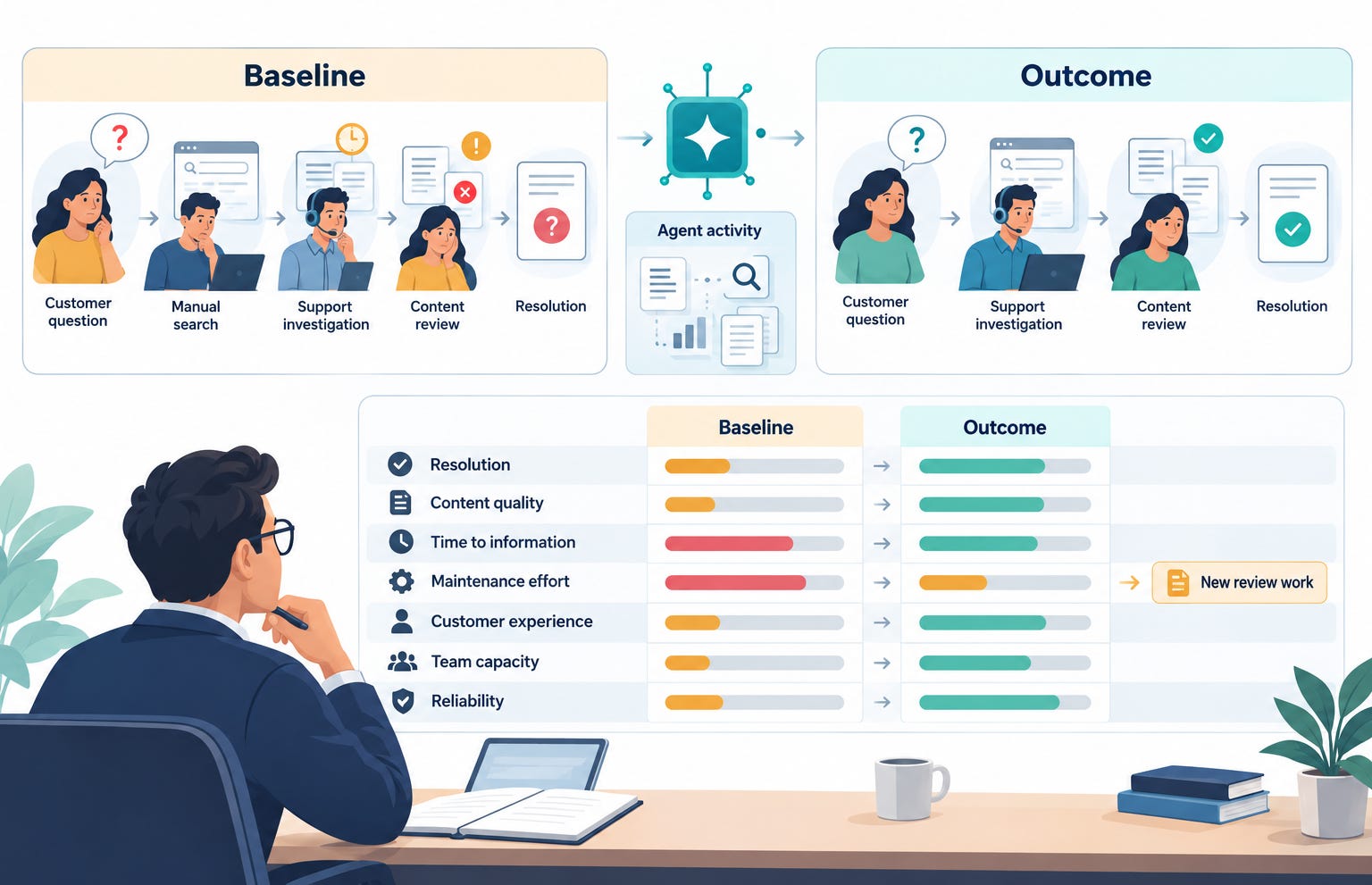
It’s easy to measure an agent’s activity. It may process articles, execute analyses, generate recommendations, or complete a sequence of steps. But activity isn’t the same as value.
For content, support, and customer success teams, the more meaningful question is whether agentic AI improves the work and the experiences that depend on it.
The right measures will vary by workflow, but could include:
Resolution effectiveness: Are customers and support specialists finding accurate answers and resolving issues more successfully?
Content quality: Are instructions still clear, complete, and accurate for the relevant product or customer situation?
Time to useful information: Can employees and customers find the knowledge they need more quickly?
Maintenance efficiency: Can teams identify and address outdated, duplicated, or missing content with less effort?
Customer experience: Are recurring sources of confusion declining? Are customers better able to complete tasks or adopt product capabilities?
Operational capacity: Are content and support professionals spending less time on repetitive work and more time on analysis, problem-solving, and improvements?
Risk and reliability: How often does the agent produce unsupported recommendations, encounter exceptions, or require human intervention?
These measures should be tied to a clear baseline wherever possible. If the goal is to reduce repetitive support work, for example, measure the current effort and outcomes before introducing an agent. Then evaluate what changes, including any new review or maintenance work the system creates.
It’s also important to measure the right level of the system. A faster content-production process may be useful, but if it generates more material that customers cannot find or understand, the overall experience may not improve.
This is why content effectiveness matters. The value of an agent isn’t determined solely by how much work it performs. It’s determined by what that work enables.
Where Should Content Teams Start?
Getting started with agentic AI doesn’t necessarily mean building a custom agent from scratch. It means preparing your team, choosing the right tools, and testing where agents can make a meaningful difference.
1. Build your team’s understanding. Train content, product, and support professionals to understand how agentic AI works, where it can add value, what its limitations are, and how to evaluate its outputs. Involve the people closest to the work in identifying promising opportunities.
2. Decide whether to build or buy. Explore whether agentic capabilities already available in your existing content, knowledge, support, and workflow tools. Consider new tools or custom agents when existing capabilities don’t meet your needs, or when your use case requires specialized knowledge, integrations, or control.
3. Plan a focused pilot. Choose one manageable use case with a clear business or customer benefit. Define what the agent will do, what information and permissions it needs, where human review is required, and how you’ll measure success. Test it against real scenarios, learn from the results, and refine your approach before expanding.
The goal is to build the skills and experience to determine where agentic AI can improve the work and how to make those improvements stick.
The Future Of Content Is Bigger Than Production
AI agents could become valuable collaborators for technical communication, product content, support, and customer success teams. They may help organizations connect information, analyze patterns, coordinate work, and turn knowledge into action at a scale that would otherwise be very difficult to achieve.
But those outcomes won’t come from agent capabilities alone. They depend on understanding the work, designing effective workflows, providing reliable knowledge, establishing appropriate governance, and preserving the human expertise needed to make good decisions.
For content professionals, that creates an opportunity to expand their influence. Your role can extend beyond creating and maintaining individual deliverables to shaping the knowledge, standards, and systems that guide AI-powered work. That is a significant shift, and it makes your discipline exponentially more valuable. 🤠

Colleen Jones is the president of Content Science and a recognized expert on content, AI, and digital transformation, advising top organizations around the world such as Dell, Thompson Reuters, and The Home Depot. The author of the top-rated book The Content Advantage (third edition out now), Colleen hosts conversations with senior leaders on the Content Powers AI podcast.
A passionate entrepreneur, Colleen has led Content Science to conduct the world’s largest ongoing study of content operations and AI, develop the patented ContentWRX evaluation system, and architect of the AI superagent ContentIQ.
She served as head of content at Mailchimp during its transformation into a marketing platform and eventual $12 billion acquisition by Intuit. Colleen also led customer experience transformation at AT&T and the Center for Disease Control. Sharing insights based on her experience and her firm’s research, she is a frequent contributor to business and technology publications and podcasts as well as a top LinkedIn Learning instructor. Follow Colleen on LinkedIn.