

There is a special kind of professional whiplash that happens when a technical writer sees a title like “Do Prompts Really Need Markup?” and reads it before coffee ☕️. Your heart rate ticks up. Your eye starts twitching. Somewhere, your component content management system (CCMS) administrator is in shock and drops a fork.
Because if you have spent years trying to explain why structured content matters, a title like that can sound suspiciously like the opening line of another sermon from the Church of “Just Paste It Into ChatGPT and See What Happens.” Lance Cummings’s March 10, 2026 video, “Do Prompts Really Need Markup?,” makes a more careful argument than that.
In the video posted to YouTube, he says tags are not really the point, specificity is the point, and he frames the discussion around prompt design moving toward what Anthropic calls context engineering. That is a far more precise claim than those who believe “markup no longer matters.”
And yet titles have a way of wandering off unsupervised. Tech writers that only read the headline and never listen to the talk, could easily come away with the wrong idea.
They might hear “Do prompts really need markup?” as “Does AI really need markup?” and those are NOT the same question. Not even remotely.
👉🏾 One is about whether XML-like tags or semantic labels inside a prompt window improve results in a general-purpose AI tool.
👉🏾 The other is about whether machine-readable structure and metadata still matter in content systems that support search, reuse, governance, personalization, publishing, retrieval, and other business objectives. Lance’s own framing is narrower than the panic his title could unintentionally provoke. He says he still uses tags for reusable prompts and that tags may matter more in context engineering, just not for the reasons many tech writers might expect.
Related: Effective context engineering for AI agents (Anthropic Guide)
That distinction matters because technical writers do not use markup merely to decorate content with tiny digital parsley flakes.
When a writer uses the Darwin Information Typing Architecture (DITA) or another structured XML model in an authoring tool and a CCMS, the markup is doing actual labor. It identifies the nature of the content, the role it plays, how it relates to other components, how it can be reused, how it should be validated, and where it can be delivered. It gives machines actionable metadata that can support business goals over time. It is durable. It is operational. It is not there to impress a chatbot like costume jewelry at brunch.
Prompt markup, by contrast, is usually tactical. It helps organize instructions in the moment. Here is the task. Here is the context. Here is the source text. Here is the expected output. In that setting, tags can help the model separate one thing from another, much the way a sane person labels freezer containers so they do not mistake chili for berry compote. Useful, yes. Essential in every case, no. That is close to Lance’s point. He argues that specificity matters more than tags themselves, even while acknowledging that tags remain useful, especially as prompts evolve into larger context structures.
So the danger is not Lance’s argument so much as the possibility that people flatten it into something he is not actually saying.
Because the internet is full of people who read a title, misunderstand it, and then run laps around LinkedIn announcing the death of a discipline they never understood in the first place. This is how we end up with declarations like “XML is obsolete now because AI can read natural language,” which is a bit like saying city planning is obsolete because some people know how to jaywalk.
A general-purpose model being able to answer a question without angle brackets in the prompt does not prove that structured content has lost its value. It proves only that the model can sometimes muddle through without being handed a napkin diagram first.
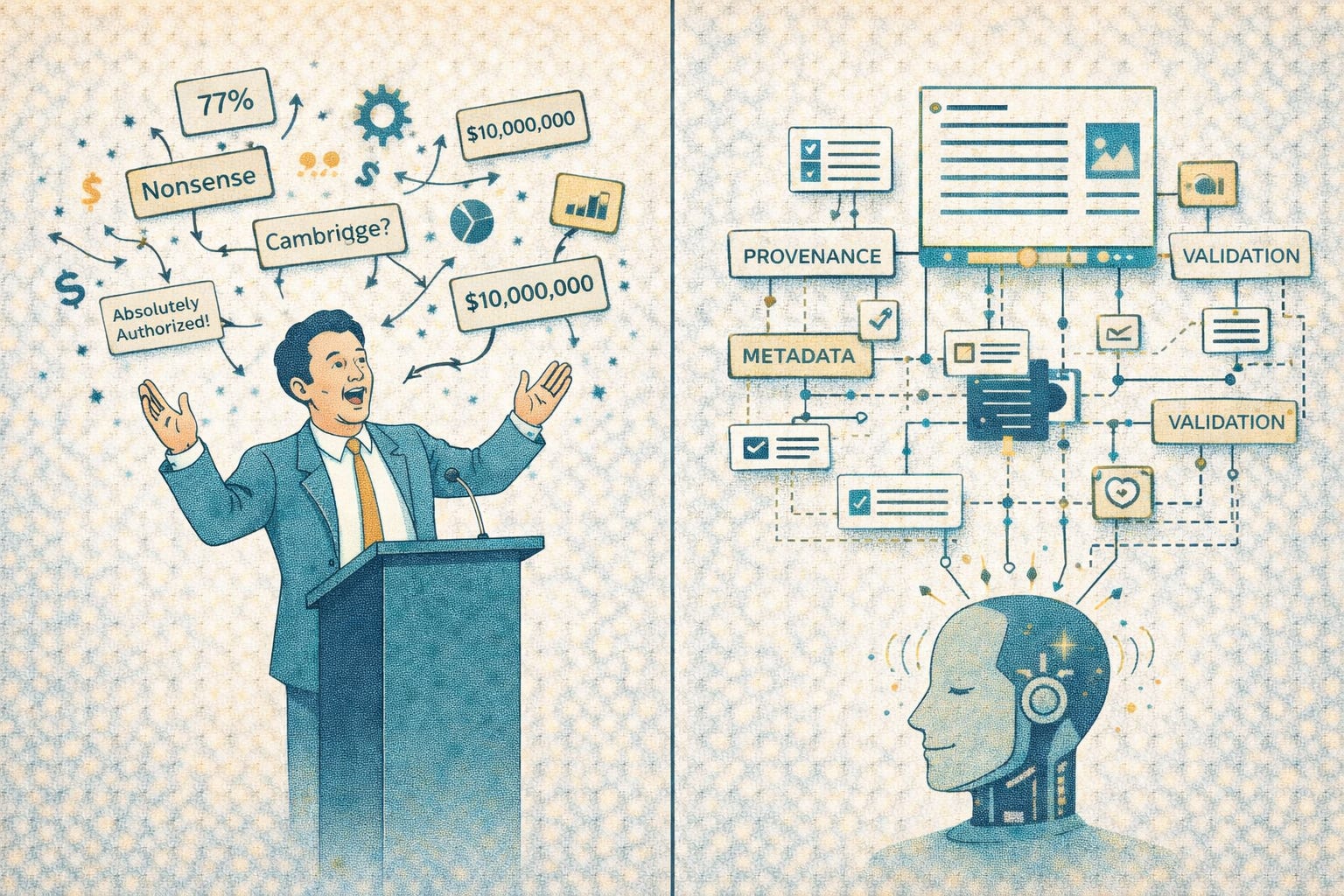
Meanwhile, enterprise AI systems still benefit enormously from content that is structured, governed, labeled, and trustworthy. If you want to reduce ambiguity, improve retrieval, maintain provenance, and lower the odds of a machine confidently inventing policy out of thin air like a middle manager improvising during budget season, markup and metadata still matter. They matter because they help systems identify authoritative source material, preserve content boundaries, and attach useful meaning to the information being retrieved and reused. Lance’s talk about prompts does not really challenge that idea. If anything, his shift toward context engineering makes the underlying content substrate even more important.
That, to me, is the part technical writers should hear most clearly.
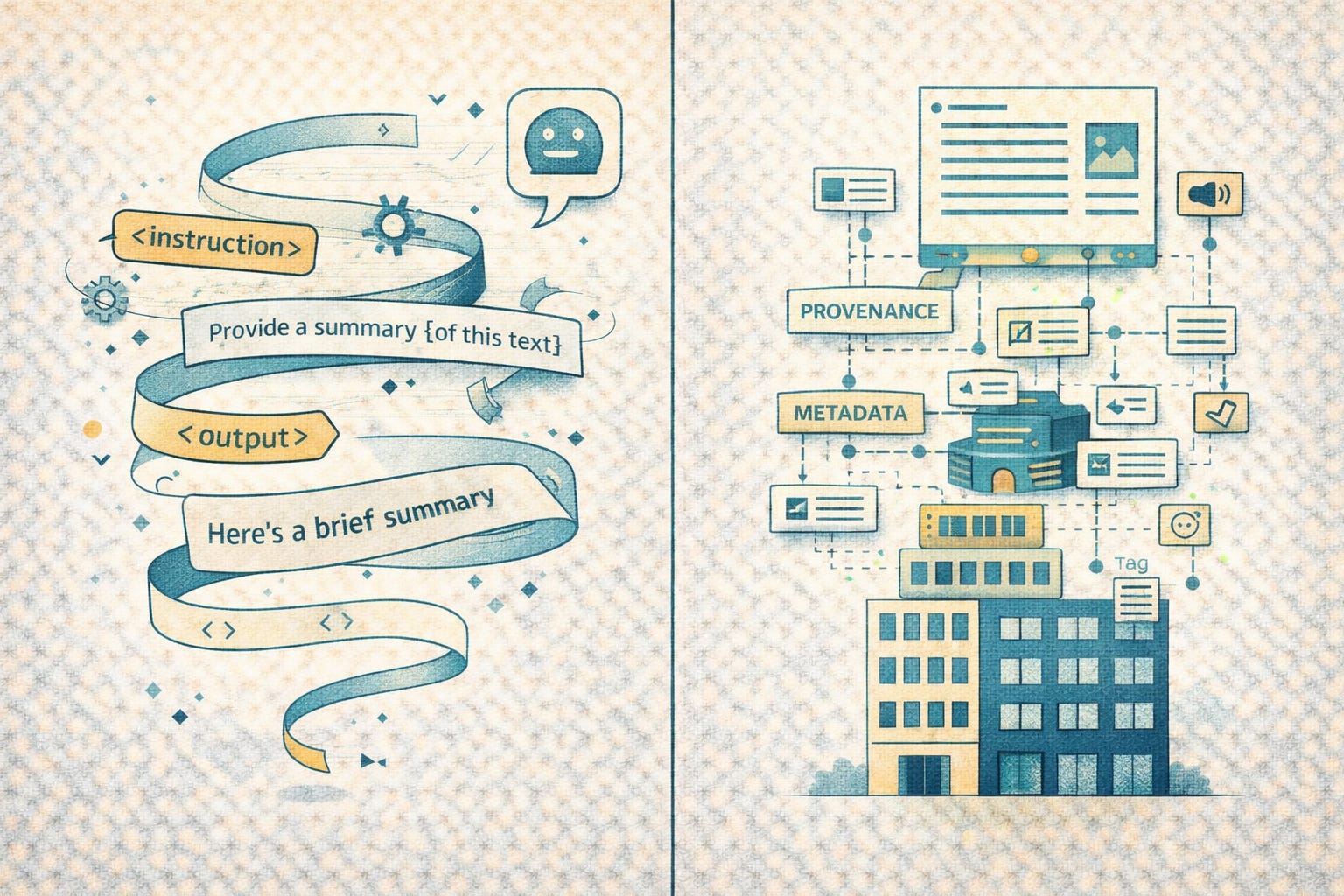
The lesson is not that markup (like DITA) is dead. It’s not. The lesson is that we need to distinguish between two very different jobs that markup can perform.
Inside your prompt, markup may help structure a single interaction with a model.
Inside your content ecosystem, markup helps machines act on your information in reliable, scalable, and explainable ways across time.
And if that distinction gets lost because someone only read Lance’s title and didn’t hear his actual point, we may end up with a fresh round of executives asking why they are paying for structured authoring when “the AI can just figure it out.”
That phrase should terrify anyone who has ever seen what happens when organizations let machines “just figure it out” (like Air Canada, Klarna, Google) using a repository full of duplicate PDFs, unlabeled fragments, outdated procedures, and the ghost of SharePoint 2017.
So yes, Lance Cummings’s talk raises a useful question about whether prompts really need markup, and his answer is more nuanced than the headline alone suggests. He is talking about prompt tags, specificity, and context engineering, not declaring semantic structured content irrelevant. The risk lies in the gap between what he appears to mean and what hurried readers may assume he means if they never get past the title.
For technical writers, the takeaway is simple. AI may not always need markup in the prompt window to perform well. But machines, including AI systems used in real business environments, still benefit greatly from markup that makes content more structured, more machine-actionable, and less likely to send the model wandering into hallucination country wearing a name badge and a confident smile.
That’s not a small distinction. It’s the whole damn point. 🤠
The overwhelming noise that discussions around GenAI create are distracting from the bigger discussions around your content operations. Yes, GenAI is a very important channel for your structured content but it is only one channel. Your LLM is not your ground truth, your ground truth lies in your content source. The conversational interface is an important modality for your content but it is just one modality. You will continue to need other outputs including [gasp] paper and PDF.
Structured semantic markup has always been for the benefit of the author to create content in collaboration and build lean, consistent source content supporting reuse and omnichannel delivery. Suggesting it is no longer needed suggests that you are ceding control of your ground truth to what? To whom?
April 14, I will be presenting in Pittsburgh at ConVEx on "The AI-Ready DITA Pipeline: Modeling, Metadata, and Machine Understanding". The session will focus on leveraging your DITA investment to create richer AI inputs while maintaining your existing channels for delivery. The speed at which an AI-enabled world will be moving will require a robust and reliable content supply chain to stay in the game. Let's stay focused and avoid unnecessary distractions.