

For years, tech writers working in structured authoring environments listened to the rest of the technology industry talk about Extensible Markup Language (XML) like it was an embarrassing relic discovered in a dusty Rubbermaid container beside old AOL installation CDs and a tax return from 1997.
👉🏾 Too complicated
👉🏾 Too rigid
👉🏾 Too enterprise
👉🏾 Too many angle brackets
👉🏾 Too old
👉🏾 Too “legacy”
And perhaps most emotionally loaded of all:
“Won’t structure kill our creativity?”

That last one always fascinated me because nobody asks airline pilots whether take-off preparation checklists suppress self-expression. Nobody asks surgeons whether standardized procedures interfere with their artistic vision while someone’s spleen is open on the table. 😷
But documentation? Oh yes. Suddenly everybody became a misunderstood poet trapped inside a <task> element.
Meanwhile, tech docs teams using structured content quietly continued doing things their less-structured counterparts struggled to manage consistently: multichannel publishing, large-scale localization, semantic metadata management, content reuse, personalization, governance, and automation.
Because XML never left – at least not in oplaces where leadership understood the business value structure provided.
The funny part is that XML’s roots in Standard Generalized Markup Language (SGML) made some people treat it like historical reenactment software. Mention SGML at a conference and some younger attendees react like you just brought up Mesopotamian irrigation techniques.
“Oh wow,” their expression says.
“Did monks preserve that on scrolls?” 😆
And yet, despite all the mockery, structured content systems kept quietly powering enormous documentation ecosystems behind the scenes while the rest of the industry periodically reinvented badly organized content in various ways.
Today, AI has arrived and software engineers, startup founders, and self-appointed “prompt engineers” are wrapping prompts in XML tags because they are learning some of the same lessons we learned years ago:
Computers work better when you stop making them guess.
Somewhere, a senior DITA architect just smiled so hard they startled the cat and pulled a neck muscle.
Related: XML Tutorial from W3Schools
AI Needs More Structure Than People Expect
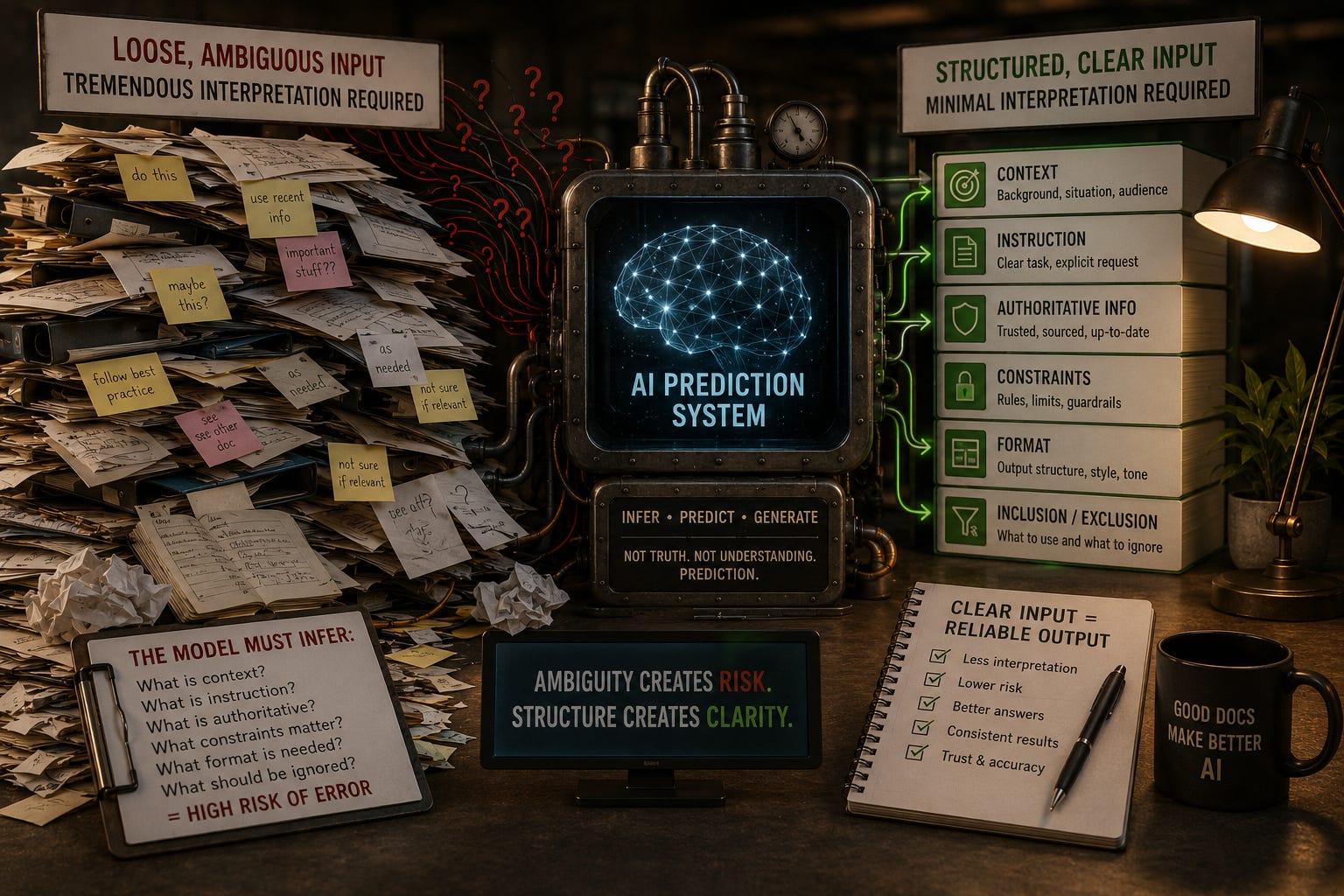
Large language models are very sophisticated prediction systems. Which means ambiguity creates problems very quickly.
When an AI model receives a giant content hairball comprised of loosely organized technical documentation, it must infer:
👉🏾 What is context
👉🏾 What is instruction
👉🏾 What information is authoritative
👉🏾 What constraints matter
👉🏾 What format the user wants
👉🏾 Which information should be ignored
That’s a tremendous amount of interpretation (where things begin going sideways).
Tech writers understand this already because humans behave exactly the same way when our docs lack structure. 🤠
